
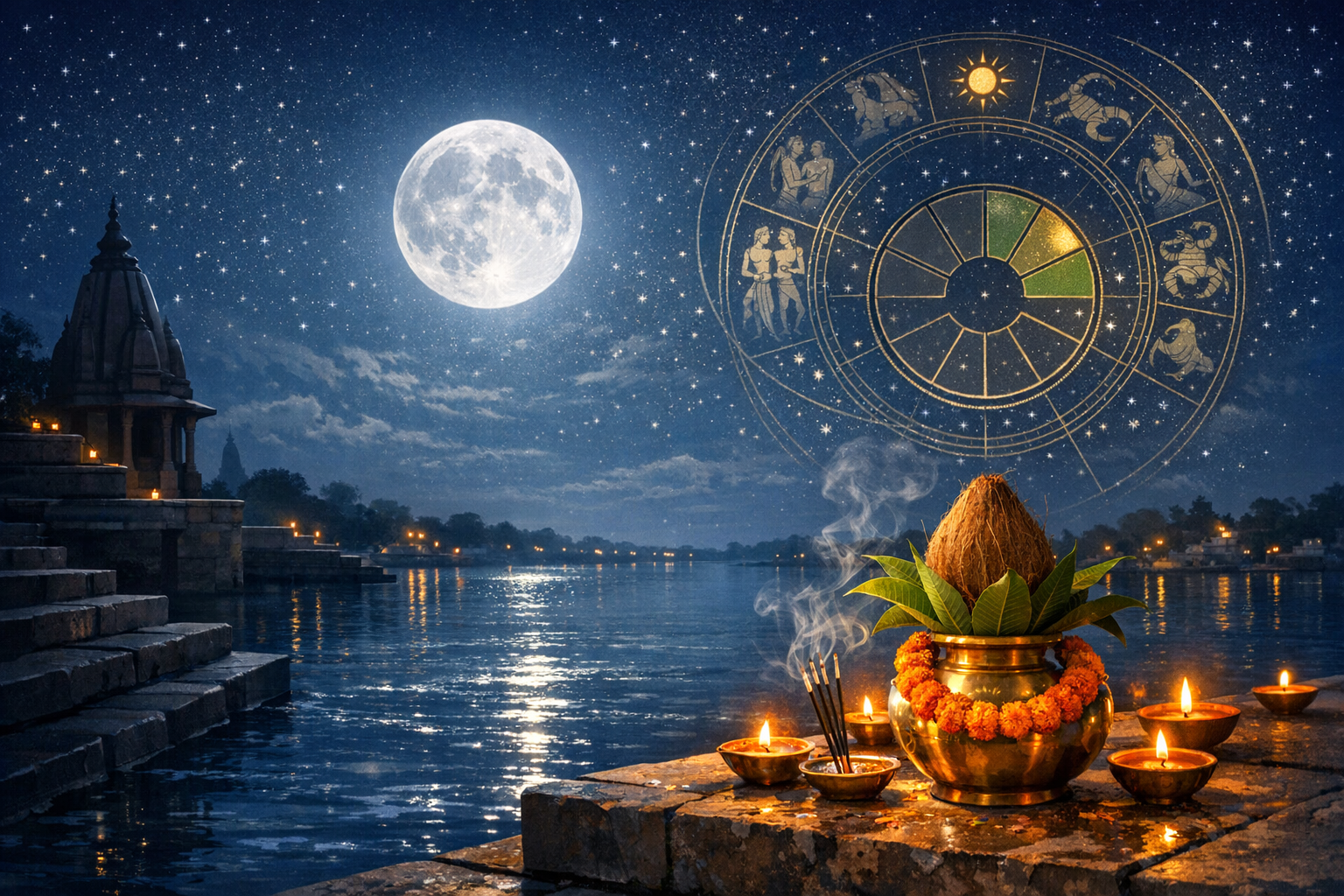
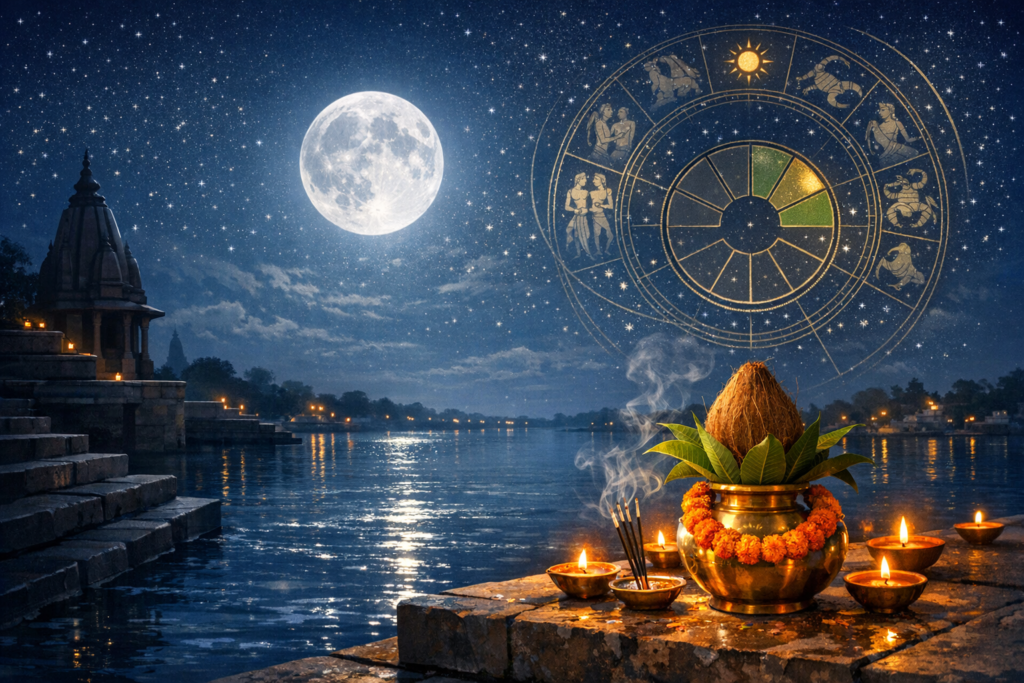
Monday, June 29, 2026, aligns with a sacred full-moon observance in the Hindu calendar. According to the Panchang, Shukla Paksha Chaturdashi prevails until 2:35 AM on June 29, after which Purnima Tithi continues through the day and ends at 4:35 AM on June 30. For most regions across northern, southern, and eastern India (IST), the civil day of June 29 is therefore observed as Purnima.
Technically, a tithi is defined by the 12-degree elongation between the Sun and the Moon, and its duration varies (roughly 19 to 26 hours) due to the non-uniform apparent motion of the Moon. The transition from Shukla Paksha Chaturdashi to Purnima at 2:35 AM IST on June 29 explains why the full-moon day is observed on the 29th for most local calendars; the operative rule in many traditions is that the tithi present at local sunrise determines the day’s observance.
For ritual planning, this means that sankalpa, vrata, and household worship on June 29 can rightly be framed as Purnima observances. While the astronomical end of Purnima occurs in the pre-dawn hours of June 30 (4:35 AM IST), the devotional life of households and temples appropriately centers on June 29, the sunrise-bearing Purnima day.
Purnima carries enduring significance across dharmic communities. In many Hindu homes, the day is dedicated to Satyanarayan Puja, Vishnu-Lakshmi worship, sacred river bathing (snāna), and dana (charitable giving). In Buddhist practice, the full-moon Uposatha is a time for intensified meditation and ethical reflection; in several Theravāda regions, the Ashadha full moon is associated with Asalha Puja (Dhamma Day). In Jain traditions, full-moon days are often marked by upavāsa (fasting), snātra puja, or scriptural study. Sikh families sometimes engage in seva and communal remembrance on culturally significant lunar dates within broader Punjabi and regional rhythms. These convergences highlight shared contemplative values and reinforce unity across Hinduism, Buddhism, Jainism, and Sikhism.
June 29, 2026, also falls in the Ashadha period for most Indian regional calendars, a month renowned in many regions for devotion, pilgrimage, and learning. Depending on whether a tradition follows the Amānta (month ends on Amavasya) or Purnimānta (month ends on Purnima) reckoning, the naming of the month may vary, yet the spiritual emphasis on the full moon remains consistent.
The request for “Good Time” or Shubh Muhurat on this date is best addressed with location-aware methods. A widely observed mid-day auspicious window is the Abhijit Muhurat, centered on local solar noon (approximately 24 minutes before and after true noon). Because true noon shifts with longitude and the equation of time, practitioners should compute it from their precise sunrise and longitude rather than rely on fixed clock-time approximations.
Choghadiya, another practical framework, segments the daylight into eight equal parts, labeling each segment as Amrit, Shubh, Labh (generally favorable) or Chal, Udveg, Kaal, Rog (generally unfavorable). Since June sunrise and sunset vary city to city, favorable Choghadiya segments for June 29, 2026, must be drawn from local sunrise/sunset to ensure accuracy. This approach preserves the technical precision that the Panchang tradition requires.
Astro-remedial windows like Rahu Kaal, Yamaganda, and Gulika Kalam also depend on dividing the actual length of daylight by eight and assigning weekday-specific segments. On Mondays, the Rahu Kaal segment falls in a fixed ordinal slot relative to sunrise; however, its wall-clock timing changes with season and latitude. Computing these windows correctly on June 29, 2026, therefore requires local sunrise time as input to avoid inaccuracies.
Nakshatra and Rashi insights on a full moon near the end of June follow a coherent astronomical logic. With the Sun typically in Mithuna Rashi (Gemini) around late June, the full Moon will be roughly opposite—generally in Dhanu or early Makara Rashi—often traversing the Mula–Purvashadha–Uttarashadha sector of the sky. The exact nakshatra at a given place and hour on June 29, 2026, will depend on the observer’s longitude, latitude, and the precise time of observation, so local Panchang or ephemerides should be consulted for definitive values.
From a calendrical perspective, the statement “Times are applicable across most northern, southern, and eastern regions” signals broad IST consistency for the tithi transitions given above; micro-variations of a few minutes can occur due to computational conventions among almanacs. For householders, a reliable practice is to anchor major rites to sunrise-based tithi determination while using locally computed Muhurat windows for fine-tuning.
Practical observance on this Purnima commonly includes early-morning snāna, a simple sattvic diet or fasting according to family lineage, recitation of Vishnu-sahasranama or Gita passages, and evening deepa offerings under the moon. In many towns, the palpable calm of the full-moon night brings families together for Satyanarayan Katha, children watch the moonrise, and elders encourage quiet reading, meditation, and acts of seva—intimate rhythms that align with the lunar cycle’s contemplative quality.
For temple committees and event coordinators, the technical takeaway is straightforward: June 29, 2026, should be scheduled as the community’s Purnima day in most parts of India, as Purnima prevails at sunrise. Where cross-regional or international congregations are involved, a brief notice encouraging attendees to verify local sunrise-based Muhurat can sustain both accuracy and inclusivity.
In research and pedagogy, this date neatly illustrates enduring Panchang principles: (1) the astronomical tithi transitions (Chaturdashi to Purnima at 2:35 AM, Purnima ending 4:35 AM the next day), (2) the sunrise criterion for festival-day assignment, and (3) the location sensitivity of Muhurat, Nakshatra, Rashi, and daily remedial segments like Rahu Kaal. Together, these show how classical time-reckoning marries mathematical rigor with lived spiritual practice.
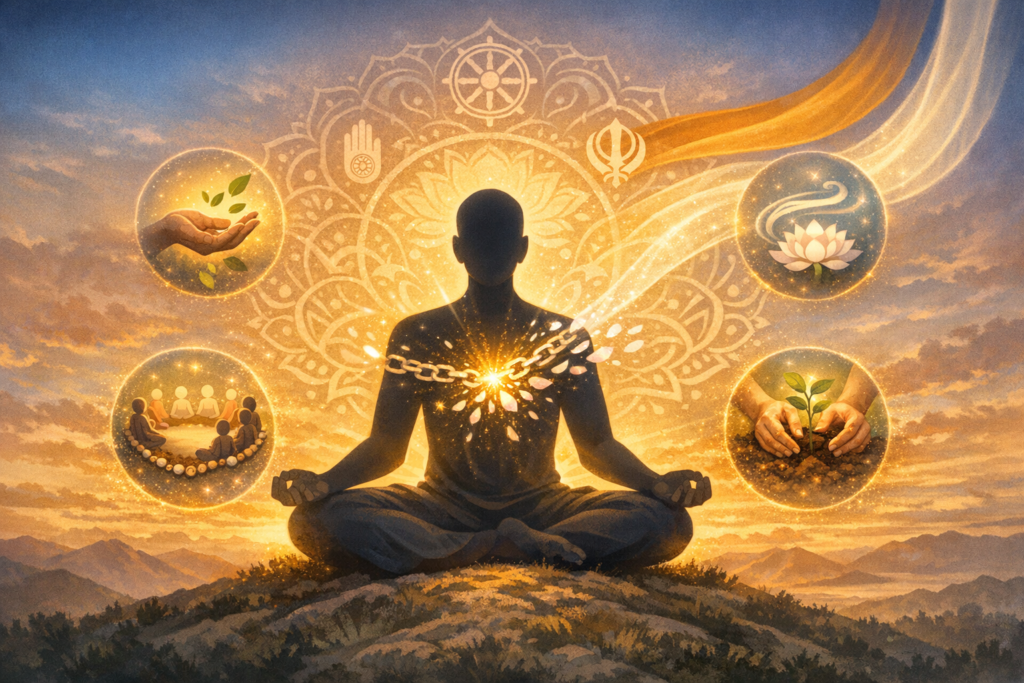
Finally, the shared ethos of full-moon mindfulness—present across Hindu, Buddhist, Jain, and Sikh communities in complementary ways—underscores a unifying vision: light, learning, and compassionate action. Observed with accuracy and mutual respect, June 29, 2026, Purnima becomes not only a point on the Hindu calendar, but also a luminous moment of dharmic harmony.
Inspired by this post on Hindu Blog.




Leave a Reply
You must be logged in to post a comment.