

The figure of Pingaladevi stands at a charged intersection of theology, sacred geography, and lived ritual in the Kathmandu Valley. Within the Shaiva vision of Pashupatinath’s pañcamukha (five-faced) reality, she is remembered as the Devi who tempers and redirects the fierce southern current of Aghora—transmuting the heat of dissolution into the radiance of purification. The result is not merely a mythic vignette but a sustained theological insight: energies that unmake can, when rightly aligned, become energies that liberate.
In Shaiva cosmology, the five faces of Shiva—Tatpuruṣa (east), Aghora (south), Vāmadeva (north), Sadyojāta (west), and Īśāna (zenith)—encode a complete map of manifestation and return. Each face corresponds to a direction, a tattva (elemental emphasis), and a mode of divine action. Traditional mappings preserved in the Pañcabrahma tradition commonly align Tatpuruṣa with air (vāyu) and the veiling power, Aghora with fire (agni) and dissolution, Vāmadeva with water (jala) and preservation, Sadyojāta with earth (pṛthivī) and creation, and Īśāna with ether (ākāśa) and revelation. This framework is not an abstraction in Nepal; it is built into how the land, rivers, shrines, and processions are oriented and understood.
At Pashupatinath, the Bagmati flows past cremation ghats where the south-pointing Aghora current is palpably felt. The very presence of flames at the śmaśāna (smashan) provides a visceral commentary on impermanence and release. The linga of Pashupatinath manifests Shiva’s four horizontal faces with the fifth, Īśāna, implied above; together they charge the precinct with a directional theology. The southern vector is not merely cartographic—it is energetic, marked by the heat of transformation and the sobering nearness of mortality.
Pingaladevi enters here as Shakti—not to negate Aghora but to translate it. Etymologically, pingala denotes a tawny or copper-gold hue, a quality of radiance associated in yogic anatomy with the right-sided solar channel, the Pingalā-nāḍī. Where Aghora burns, Pingala brightens; where one dismembers the old, the other re-members life as tapas (disciplined fire), prāṇa (vitality), and tejas (luminous intelligence). The tradition thus frames Pingaladevi as the axis that makes Aghora livable: fierce grace, not mere ferocity.
The Kathmandu Valley renders this theology in space. Its ritual cartography—long curated by Newar lineages—forms protective mandalas of Bhairavas, Mātrikās, and Ajimā goddesses around key Shaiva and Shakta seats. Pashupatinath to the east pairs with Guhyeśvarī (Guhyeshwari Temple) across the Bagmati as consort and complement; to the south, Dakṣiṇakālī gathers another face of the fierce feminine; to the west, Swayambhū’s ancient stupa speaks to the valley’s syncretic Shaiva–Buddhist frame. Within this integrated field, Pingaladevi is venerated as an organizing principle of the southern current—the conversion of dakṣiṇāgni (southern fire) from consuming blaze into sacramental heat.
Accounts preserved in local oral memory and temple lore narrate that the unmitigated southern force of Aghora once threatened to scorch the valley’s subtle order. Pingaladevi was invoked—not to extinguish Aghora but to yoke it. In this telling, her seat faces the river and the cremation grounds not as a retreat from death but as a sentry to guide it. The story’s theological teaching is clear: the same fire that cremates also consecrates when steadied by Shakti.
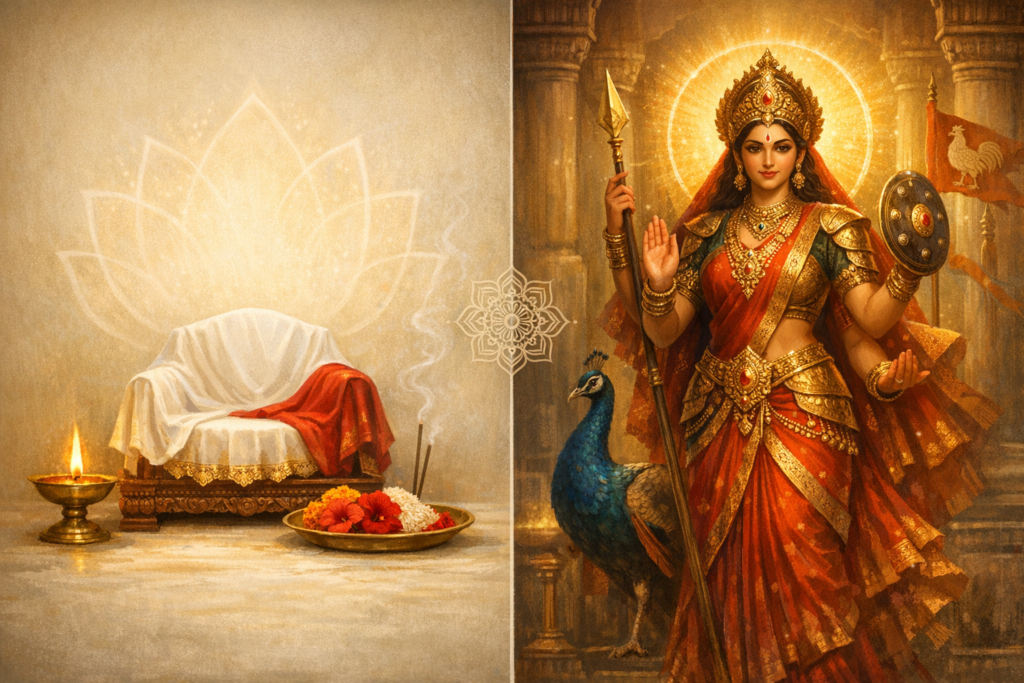
Iconographically, regional depictions of Pingaladevi emphasize her tawny-red brilliance, a benign yet formidable gaze, and implements that suggest both protection and transformation. While local forms vary, the grammar is consistent with the wider Shakta repertoire: radiance, resolve, and the readiness to stand at thresholds—particularly those between life and death, impurity and purity, fear and insight. In Nepal’s ritual arts, such traits resonate with the Matrikā circuit and the valley’s devotion to guardianship deities who stabilize the liminal.
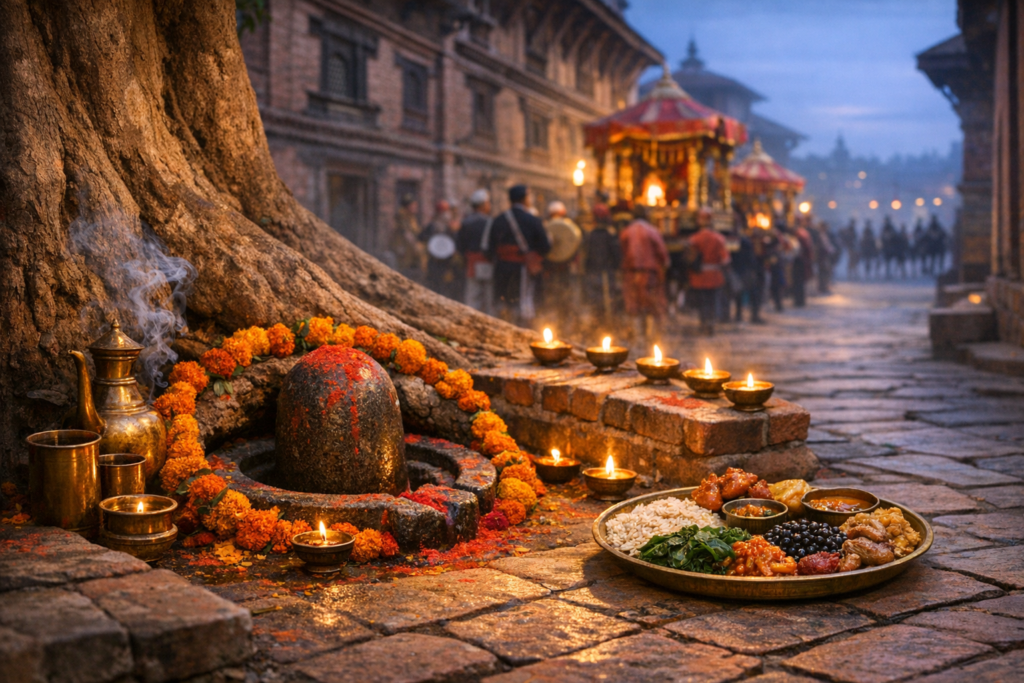
The ritual life of Pashupatinath gives this theology rhythm. At the cremation ghats, the recitation of Aghora invocations and the Pañcabrahma mantras situates grief within metaphysical assurance. Devotees light lamps to the south, offer red-hued flowers, and inwardly dedicate the heat of loss to Pingaladevi’s transforming intelligence. The gesture is simple but profound: what cannot be escaped can be transfigured.
Yogic anatomy adds a technical layer. The Pingalā-nāḍī, associated with the solar current and the right nostril, governs activity, warmth, and clarity when balanced. Too little solar tone leads to lethargy; too much yields agitation. In meditative praxis, breath disciplines such as gentle sūrya-bhedana (right-nostril–initiated inhalations, practiced with caution and guidance) are understood to kindle the inner fire without scorching the mind. Pingaladevi personifies this principle at the level of deity: she is the solar Shakti that makes heat humane.
The Kathmandu Valley’s sacred geography reinforces this balance. Guhyeśvarī embodies the secret (guhya) heart of Shakti beside Pashupatinath’s manifest lordship; Dakṣiṇakālī externalizes terrifying compassion so it remains in the world as protection; Vajrayoginī seats—revered in Newar Vajrayāna Buddhism—further encode the feminine transformative power across hill and cusp. Rather than oppose these traditions, practitioners routinely cross their ritual streams: Hindus bow at Buddhist seats and Buddhists at Shaiva–Shakta shrines. Pingaladevi’s role harmonizes within this ecumene as a southern light in a shared mandala.
Texts situate these patterns within older lineages. Purāṇic materials such as sections of the Skanda Purāṇa, the Swayambhūpurāṇa cherished in the valley, and Shaiva tantric sources identify cremation grounds as privileged sites of insight. Aghora is not a cult of morbidity but a grammar for releasing clinging. In that register, Pingaladevi does not soften the truth of death; she clarifies it, ensuring that the encounter yields wisdom rather than despair.
The phenomenology of pilgrimage confirms this synthesis. Visitors commonly report a paradox at the ghats: palpable heat and an undertow of serenity. The crackle of fire, the flow of the Bagmati, and the recitational cadence produce an atmosphere in which attention sharpens. Grief, fear, and reverence intermingle. In that charged pause, the idea of Pingaladevi becomes experiential—a felt sense that something fiercely maternal holds the boundary so that mourning can mature into meaning.
This southern grammar is not unique to Nepal, though it is uniquely expressed there. Across the Indic landscape, south and fire are ritually aligned with Yama, time, and the rites that confront finitude: Kashi’s Maṇikarnikā, the southern gateways of many Dravidian temples, and the śmaśāna traditions of both Shaiva and Shakta practice. Pashupatinath’s southern face communicates with these places through a shared symbolic lexicon. Pingaladevi’s distinction is to turn that lexicon into pastoral care for a valley’s living tradition.
From a philosophical standpoint, the interface between Aghora and Pingala dramatizes the transition from bhaya (fear) to bodha (understanding). Aghora dissolves forms; Pingala clarifies the light inherent in dissolution. Together they embody a two-step pedagogy recognizable across dharmic schools: encounter what is real without denial, then integrate it so the encounter becomes freedom rather than fracture.
Newar culture extends this pedagogy to city planning and civic festivity. Protective goddesses and Bhairavas encircle settlements; processions periodically refresh the city’s vow to its guardians; seasonal cycles recalibrate fire and water, heat and cool, intensity and rest. In this liturgical ecology, Pingaladevi is less a solitary figure than a node in a living network that continuously translates metaphysics into urban ethics.
Jain, Buddhist, and Sikh traditions converge with this ethic in meaningful ways. Jain reverence for yakṣiṇīs like Ambikā renders protection as compassionate presence; Newar Vajrayāna honors ḍākinīs and yoginīs who, like Pingaladevi, transmute passions into wisdom; Sikh scriptural evocations of śakti in compositions such as Chandi di Var memorialize courage that protects the vulnerable. None of these are identical, yet they participate in an inter-dharmic grammar: fierce grace serves liberation, and liberation serves compassion.
For practitioners who integrate yoga with pilgrimage, the correspondence between Pingala and Aghora provides a practical heuristic. On the mat and cushion, disciplined heat—built through steady attention, ethical restraint, and measured breath—becomes clarity rather than irritation. At the shrine, the sight of fire, the memory of the departed, and the mantra’s cadence recollect that the same heat can polish the mind. This is not sentiment; it is method.
Architecturally, the Pashupatinath–Guhyeśvarī axis models complementarity rather than competition. The linga’s faces articulate Shiva’s fivefold operation; the goddess’s seat across the Bagmati emphasizes that no face is complete without Shakti. Ritual specialists often underscore this by pairing offerings: what is given to Shiva is balanced by what is offered to the Devi. Theological balance appears as liturgical symmetry.
Scholarly work on Nepal’s sacred geography additionally highlights the pedagogical function of cremation grounds. Far from marginal zones, śmaśānas serve as classrooms of impermanence and laboratories for ritual technologies that stabilize intense emotion. In that context, Pingaladevi can be read as a tutelary presence ensuring that austerity (tapas) remains humane and that esoteric practices, where present, remain tethered to ethical ends.
Contemporary relevance follows naturally. In periods of social heat—polarization, grief, ecological stress—the distinction between destructive and illuminating fire becomes more than symbolic. The tradition’s answer is neither repression nor indulgence but transmutation: cultivate Pingala so Aghora becomes medicine. Communities across the Kathmandu Valley have long practiced this through shared festivals, inter-tradition reverence, and the ongoing maintenance of sites where hard truths are faced together.
In sum, Pingaladevi’s legacy at Pashupatinath is a theology of fierce grace—an insistence that the southward pull of time and fire remains held within Shakti’s compassionate intelligence. It is a legacy inscribed in stone and river, in mantra and procession, and in the memories of pilgrims who learn to stand before life’s southern face without flinching. Where Aghora burns, Pingala illumines; where forms end, meaning begins.
Read this way, Nepal’s sacred mandala is not only a map of shrines but a manual of integration. Shaiva, Shakta, Buddhist, and Jain-Sikh reflections converge upon a shared vow: let power serve release; let heat serve clarity; let tradition serve the dignity of all. In that shared vow, Pingaladevi continues to tame the southern fire—so its warmth may heal.
Inspired by this post on Hindu Blog.







Leave a Reply
You must be logged in to post a comment.