
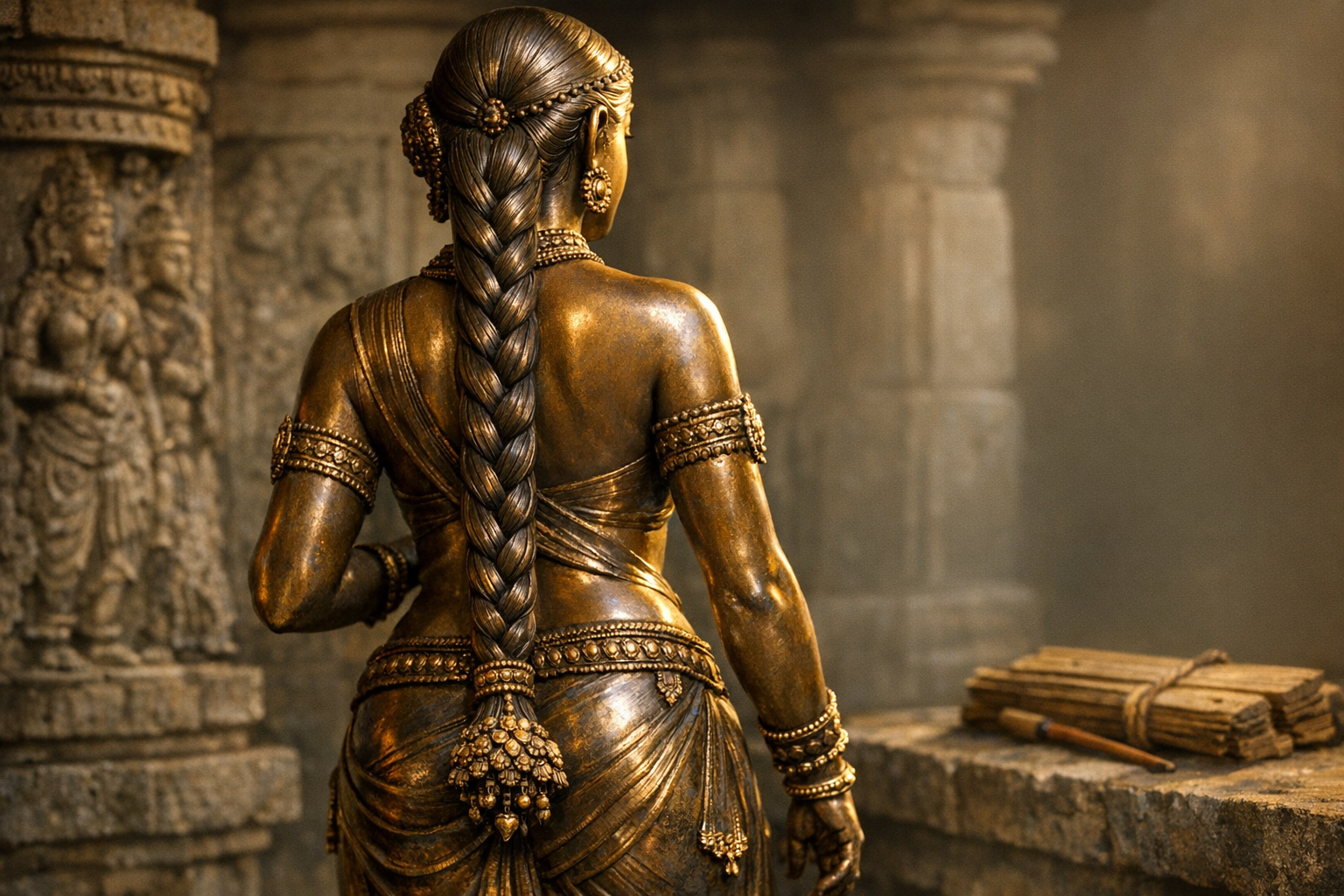
Ekaveni—literally “single braid” from Sanskrit eka (one) and veni (plait)—is among the most distinctive coiffures in Hindu sculpture, bronze casting, and temple iconography. More than a stylistic choice, the single plait functions as a visual code that communicates age, character, vow, and state of being. From early stone reliefs to Chola bronzes and later temple carvings, the ekaveni recurs with consistency, signaling a refined grammar of form sustained by Shastra, regional aesthetics, and living ritual cultures.
Classical textual traditions ground the ekaveni in a larger theory of hair as an index of identity and rasa. Discussions in the Vishnudharmottara Purana (Khilakanda III) on image-making (pratimā-lakṣaṇa) and in treatises grouped under the Shilpa Shastras (such as the Manasara and Shilparatna) align specific coiffures with icon types and life stages. Parallel prescriptions in performance texts like the Nāṭyaśāstra and later abhinaya manuals describe keśa-bhūṣaṇa (hair adornments) that also inform sculptural representation. While these sources vary by region and period, they broadly recognize a single, well-ordered braid as appropriate for youthful women (bālā, taruṇī), auspicious consorts, and celestial attendants, thereby coding the ekaveni with connotations of grace, modesty, and auspicious energy.
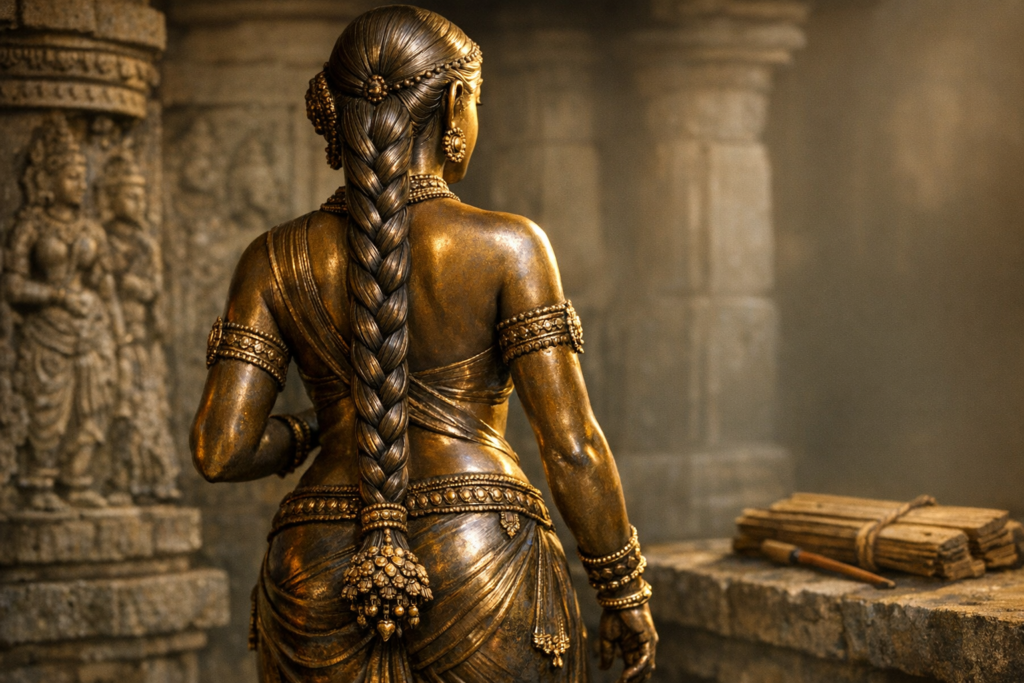
In visual terms, the ekaveni gathers the looseness of many tresses into a single axial plait that descends along the back, often finishing with a decorative tassel known across South India as a kunjalam. Sculptors emphasize the braid’s unity through rhythmic segmentation, beaded ties, and floral bindings. In metal images, especially the lost-wax bronzes of the Tamil region, the braid’s surface may carry tiny incisions that catch light in motion; in stone, Hoysala ateliers render the ekaveni as a taut cable-like form with crisply chiseled striations and a pendant terminal.
Chronologically, long plaits appear already in early Buddhist and pan-Indic reliefs at Bharhut and Sanchi, where yakshi figures sometimes display braided or massed hair as fertility signs. Gupta and post-Gupta idioms streamline the silhouette, while the Pallava, Chalukya, and later Hoysala schools refine the strand-by-strand articulation. The Chola period (c. 10th–13th centuries) in Tamilakam canonizes a paradigmatic ekaveni in bronze—the braid of a consort or youthful goddess curving elegantly with the contrapposto of the figure and finishing in a tassel that visually echoes anklets, girdles, and armlets.
Within Hindu iconography, the ekaveni frequently accompanies figures such as Parvati in the Somaskanda ensemble, Bhudevi in paired images with Vishnu, and yakshi-like attendants on doorjambs and pillars. Regional preferences modulate these choices: in some South Indian bronzes, Parvati’s braid signals youthful auspiciousness and adds a vertical counterline to the lateral sweep of her stance; in certain North and East Indian stone sculptures, attendant goddesses and donors adopt the single plait to emphasize chastity and fertility. The convention is not uniform across all depictions of Lakshmi or Parvati, but where it appears, the ekaveni consistently marks a poised, auspicious femininity.
Social and ritual semantics deepen the image’s meaning. Across many Indian communities, a long single braid historically connotes maidenly decorum, discipline of the senses, and familial propriety. Marriage rites including the venerable practice of veni-dāna and related hair-parting customs further link coiffure to life-cycle transitions. Sculptors, informed by such living codes, anchor the ekaveni to narrative states—youthful grace before marriage, dignified auspiciousness after union, or a vow-bound resolve as seen in literary and ritual tropes where hair is the site of honor and oath.
The symbolism of ekaveni can be read through the lens of aesthetic theory and yogic semiotics. The act of braiding many strands into one visually rehearses the move from multiplicity to unity, from scattered attention to ekāgratā (one-pointedness). Iconographically, the single plait evokes composure, containment of vital energy (ojas), and a centering along the body’s vertical axis, a metaphor often compared to the balancing of prāṇa within the suṣumṇā nāḍī. In a temple setting, this clarity of line mirrors the ethical and mental clarity expected of a devotee approaching darśan.
Crucially, the ekaveni is not an exclusively “Hindu” visual in the narrow sense; rather, it belongs to a broader Dharmic visual language that traverses Hindu, Buddhist, and Jain art. Buddhist reliefs render donor women and yakshi figures with single plaits that signal fertility and generosity, while Jain sculptures of Ambika and other yakshi frequently display braided coiffures embodying auspicious fullness. Although Sikh sacred practice emphasizes kesh (uncut hair) in ways distinct from ancient sculptural conventions, the shared reverence for hair as a locus of dignity and vow speaks to a unifying ethic across Dharmic traditions. Seen together, these strands of visual culture celebrate discipline, purity, and grace as common values.
Differentiating the ekaveni from neighboring coiffures aids accurate reading. The jaṭā-mukuṭa of ascetic deities like Shiva organizes matted locks into a towering mass signifying tapas rather than conjugal auspiciousness. Royal or divine crowns such as the kirīṭa-mukuṭa and karaṇḍa-mukuṭa elevate hair into jeweled tiaras. In contrast, the Andal Kondai iconography features a distinctive side bun associated with the poet-saint Āṇḍāḷ and her bridal mysticism; it must not be confused with the single plait. The ekaveni’s diagnostic features remain the unified backbone plait and its rhythmic segmentations, often resolved in a tassel.
For viewers and students of temple art, practical cues assist identification. Look for a central parting that resolves into a single braid, ties or bands at the nape, a beaded or floral kunjalam at the end, and a braid that participates in the sculpture’s overall rhythm—counterbalancing the sway of the hip line in bronzes or enhancing the vertical thrust in stone. Even when partially eroded, the terminal tassel, the regular “ropework” of the plait, or the transition from scalp to nape can confirm an ekaveni reading.
Material technique shapes how the ekaveni is perceived. In lost-wax bronze casting (cire perdue), the artisan models the braid in wax with tiny ridges and bands before investing and casting; polishing then sharpens the highlights on each segment. In chloritic schist or soapstone, as in Hoysala workshops, crisp chisels produce high-relief braids with bead-like terminations. Granite ateliers in Tamil Nadu treat the plait more schematically, relying on silhouette and selective drilling to suggest depth, which becomes especially legible under the temple’s shifting light.
Representative examples reinforce the convention’s breadth. Chola bronzes of Uma in Somaskanda groups often exhibit an ekaveni that arcs slightly and culminates in a kunjalam, aligning with anklet and girdle rhythms. Hoysala sculptures at Belur and Halebidu articulate long plaits for attendant goddesses with jewel-like precision. Eastern Indian Pala-Sena images of Ambika and yakshi figures display plaits associated with fecundity and protective grace. While not universal, these instances—widely documented across museum and temple corpora—demonstrate a resilient visual syntax.
Because iconography is always negotiated locally, variations are expected. Patronage choices, regional śilpa traditions, and shifting devotional emphases produce alternatives—loose tresses for wild, liminal goddesses; buns for poet-saints; and crowns for royal goddesses. Yet the ekaveni persists as a preferred sign for auspicious, disciplined, and serene feminine divinity and for idealized women in sacred space.
Beyond art history, the single braid resonates as living heritage. Many visitors report that, standing before a Chola bronze or a Hoysala relief, the eye follows the plait as a quiet line of focus that steadies attention, much like a mantra steadies the breath. In this way, the ekaveni performs both aesthetically and contemplatively: it pleases the eye and gently tutors the mind in unity, restraint, and grace—values cherished across Hinduism, Buddhism, Jainism, and Sikhism.
Read together—symbol, scripture, and stone—the ekaveni emerges as an elegant thread stitching art, ritual, and philosophy into a single, enduring braid. It encodes youthful auspiciousness, one-pointed resolve, and ethical containment; it bridges regions and periods; and it participates in a shared Dharmic ethos that honors discipline, dignity, and beauty as pathways toward the sacred.
Inspired by this post on Hindu Blog.







Leave a Reply
You must be logged in to post a comment.