
Among Vedic deities, Agni occupies an unrivaled position as the first invoked in the Rig Veda, where the opening hymn begins, “Agnim ile purohitam yajnasya devam ritvijam.” This concise invocation encapsulates Agni’s foundational roles: household priest (purohita), divine officiant (ritvij), and the hallowed conduit of sacrificial worship (yajna). Across millennia, the iconography of Agni evolved to convey these functions with technical precision, symbolic depth, and pan-Indic continuity.
In Vedic theology, Agni is the “mouth of the gods,” the vehicle that carries offerings (havis) to the celestial realm and returns blessings to practitioners. This mediatory role explains why sacred fire undergirds the full spectrum of rites, from domestic Agnihotra to elaborate srauta sacrifices. The idol form synthesizes this theology: every attribute, color, posture, and implement communicates aspects of divine power, ritual efficacy, and inner transformation.
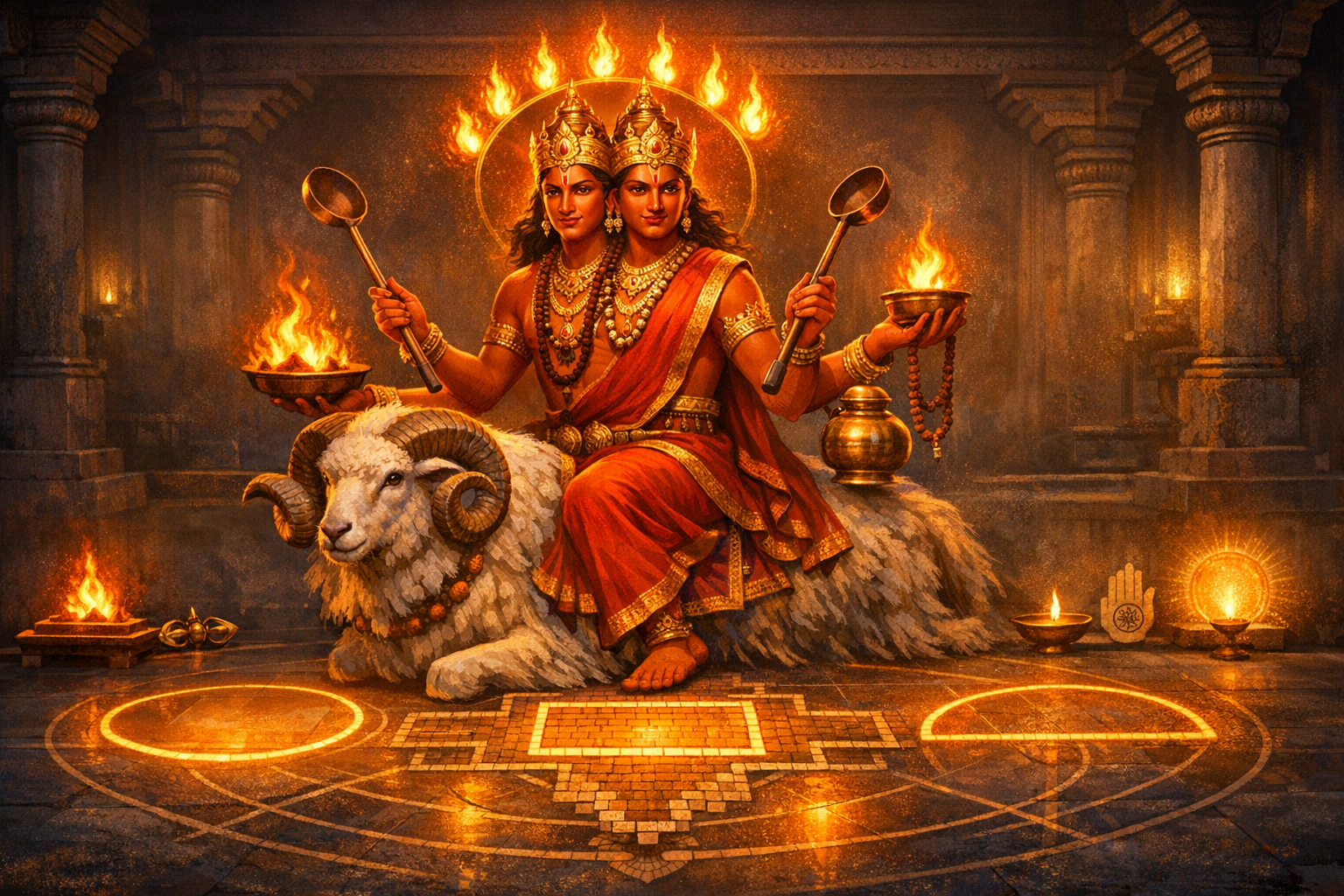
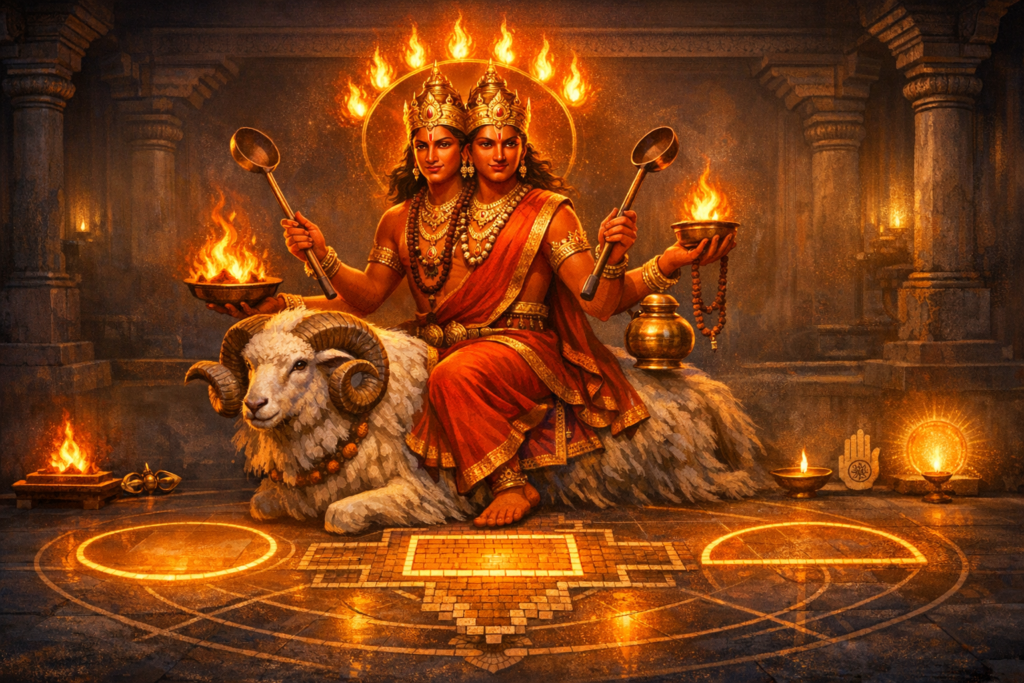
Agni’s visual identity is generally marked by a luminous red or orange complexion signifying heat (tapas) and energy (tejas). He is frequently shown with two heads (dvishiras), alluding to dual aspects—beneficent and fierce, terrestrial and celestial—and to unbroken vigilance in both ritual and cosmic spheres. Flames often crown the heads or emerge as an aureole, reinforcing the deity’s self-effulgent nature and the radiance of sacred knowledge.
Common attributes include the sruk and sruva (long-handled sacrificial ladles), a flaming pot or brazier (agnikunda), a water vessel (kumbha) used in purification, and sometimes a rosary (akshamala), symbolizing mantra-powered order within the sacrifice. Many images portray Agni with two or four arms; the multiplicity of hands reflects mastery over ritual procedures and the governance of offerings, purifications, and benedictions that define yajna.
The “seven tongues” of Agni—sapta jihvā—are a vital key to iconographic and liturgical understanding. Textual traditions name them as Kālī, Karālī, Manojavā, Sulohitā, Sudhūmravarṇā, Sphuliṅginī, and Viśvarucī. These flames, whether explicitly depicted or implied by a multi-flamed crown, symbolize differentiated capacities of the sacred fire to consume impurities, convey offerings, and reveal knowledge. Their presence signals that an image is not merely decorative; it is a technical statement of sacrificial completeness.
Agni’s vahana (mount) is typically the ram (mesha), occasionally represented as a goat in some regional idioms, underscoring strength, momentum, and the vital force that “bears” the fire’s power into action. In temple architecture, Agni appears among the Ashtadikpalas as the guardian of the southeast (Agneya), a placement that converges ritual science with spatial sanctity; the southeast corner is traditionally designated for kitchens, hearths, and homa altars in vastu practice.
Ritual practice grounds Agni’s iconography in concrete procedure. The triad of sacred fires—Gārhapatya (circular, household and perpetual), Āhavanīya (square, for offerings to deities), and Dakṣiṇāgni or Anvāhāryapacana (semi-circular or rectangular, ancillary functions)—maps directly to the pragmatic architecture of yajna. Daily Agnihotra and fortnightly/new-moon rites link domestic life to cosmic rhythms, making the household an extension of the altar and the altar a model of the universe.
Large-scale srauta constructions such as the Agnicayana—detailed in sources like the Śatapatha Brāhmaṇa and measured by the Śulbasūtras—extend this logic through sacred geometry. The falcon-shaped altar (syena-citi) and its carefully prescribed brick counts (including the canonical 10,800 lokampṛṇā bricks echoing the muhurtas of a Vedic year) integrate cosmology, time-reckoning, and ritual performance into a single, testable design. The idol of Agni, when present near such spaces, thus anchors a nexus of theology, mathematics, and liturgy.
Textual epithets—Jātaveda (knower of all births), Vaiśvānara (cosmic fire), Pāvaka (purifier)—converge in sculpture through luminous surfaces, rhythmic flames, and an emphasis on forward-facing attention. Agni’s gaze is typically alert and compassionate, indicating both the exactitude required of a ritual officiant and the universal accessibility of the sacrificial pathway. The icon becomes a visual manual: it teaches how fire purifies, transforms, and returns grace.
Puranic and temple traditions retain these Vedic essentials while amplifying them within parivara (temple retinue) and dikpala programs. On gopuras, mandapa pillars, and directional niches across regions—ranging from early Gupta and post-Gupta temples to Chalukya, Pallava, and Chola complexes—Agni can be identified by the ram mount, twin heads, and the unmistakable implements of offering. Such continuity is also visible beyond the subcontinent, for instance in Angkorian art in Cambodia, where Vedic deities, including guardians of directions, are rendered with rigorous iconometric canons adapted to local aesthetics.
The archaeological record adds contextual depth. Fire-altars discovered at sites such as Kalibangan and related settlements have often been interpreted as ritual spaces resonant with practices later articulated in Vedic texts, though scholarly debate continues over precise cultural affiliations. Iconography and altar-science together indicate that carefully tended fire—domestic, communal, and royal—stood at the heart of ancient ritual life and statecraft.
Across the broader dharmic family, fire remains a unifying symbol. In Hinduism, homa and yajna express offering, purification, and the reciprocity between humans and the divine. In Buddhism, particularly in Vajrayana and East Asian esoteric lineages, the homa or goma ritual transmits the transformative symbolism of sacred fire; the Adittapariyaya Sutta (Fire Sermon) deploys flame as a profound metaphor for insight. Jain traditions honor the tejas (fire) principle within a precise ethic of non-violence; lamps and aarti embody enlightenment and reverence without harm. Sikh scripture centers the divine light (jot) as inner illumination; households in the Indic cultural sphere often uphold lamp-lighting practices that affirm clarity, truth, and remembrance. These convergences illustrate shared values—purity, discipline, and awakening—across Hinduism, Buddhism, Jainism, and Sikhism.
For temple-goers, museum visitors, and students of Indian art, several cues reliably identify an Agni idol: the ram mount; the twin heads crowned with flames; the presence of ladles (sruk, sruva), a firepot, or a water vessel; and the deity’s southeast orientation within a dikpala scheme. When these features appear in combination, the sculpture communicates not only who is depicted but how to “read” the figure as a ritual diagram—an index to Vedic sacrifice and its philosophical core.
The spatial logic of Agni in built environments further clarifies function. Kitchens and homa-kundas in the Agneya (southeast) quadrant, the placement of sacrificial implements near this corner, and the adornment of the space with geometric yantras align domestic practice with the temple’s cosmic layout. Even in contemporary homes, a simple, well-ventilated altar that respects these principles mirrors ancient insights about energy flow, safety, and sanctity.
From a philosophical perspective, Agni is the grammar of transformation: fuel becomes flame, offering becomes prayer, and prayer becomes grace. Theologically, this is why Agni is invoked first; practically, it explains why discipline in lighting, tending, and extinguishing sacred fire is treated as spiritual training. The idol thus invites more than admiration—it invites participation in a science of self-refinement where heat becomes insight and clarity.
For researchers and practitioners, the intersection of image, ritual, and text offers a rigorous framework for study. Iconographic manuals, Brāhmaṇa and Gṛhya literature, and the Śulbasūtras converge to show how proportions, directions, sequences, and materials are codified. This codification is not inert; it adapts across regions and eras while preserving the recognizable signature of Agni—ensuring that a sculpture in a South Indian mandapa or at Angkor retains intelligibility within a shared Vedic reference system.
In sum, the Agni idol form presents a complete dossier of Vedic ritual knowledge in visual shorthand: the twin heads of vigilance, the seven tongues of discriminating flame, the ram of momentum, the ladles and vessels of offering and purification, the southeast domain of governed heat, and the altar sciences that translate cosmology into brick and measure. Read with care, the image discloses not only a deity but a discipline—one that harmonizes the dharmic traditions through the common language of sacred fire and inner light.
Inspired by this post on Hindu Blog.






Leave a Reply
You must be logged in to post a comment.