
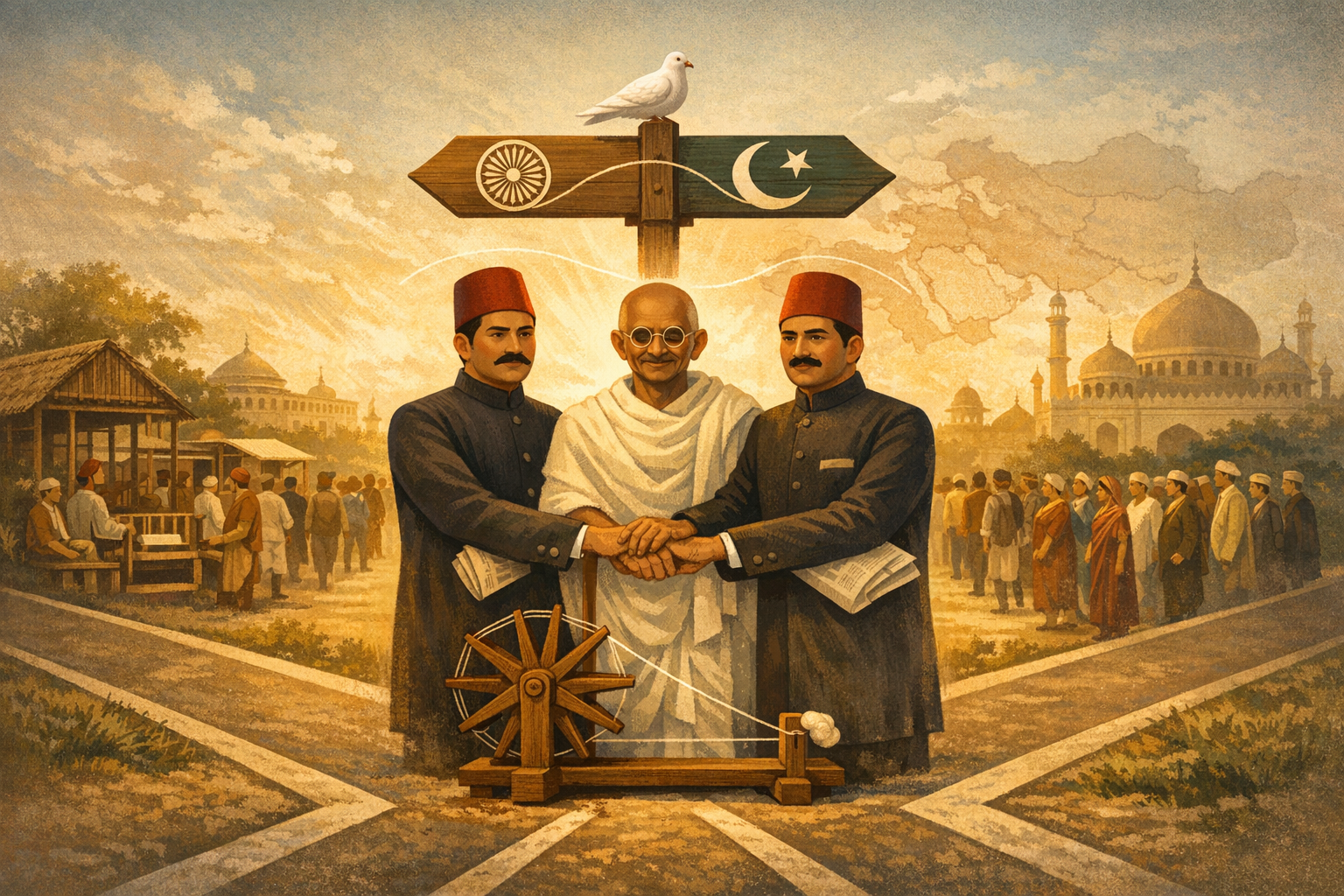
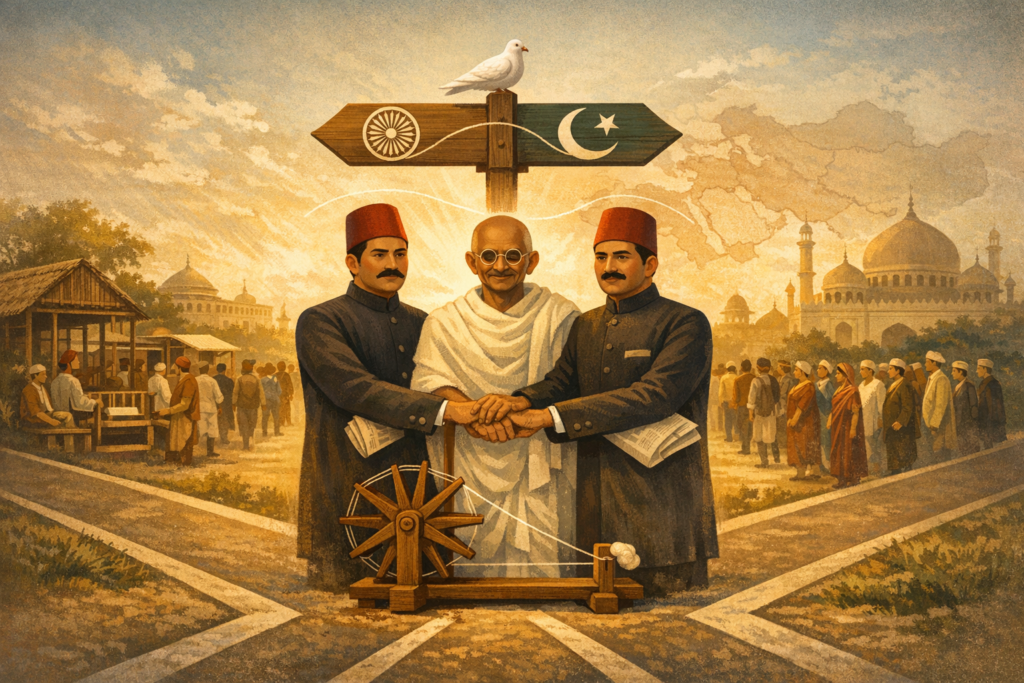
Few developments in late-colonial India were as consequential—and as debated—as Mohandas Karamchand Gandhi’s collaboration with Muhammad Ali Jauhar and Shaukat Ali during the Khilafat Movement between 1919 and 1924. The alliance brought together two currents with distinct horizons: pan-Islamic advocacy for the Ottoman Caliphate and the Indian National Congress’s drive for swaraj through Non-cooperation. Their convergence galvanized mass politics under the British Raj, but it also exposed strategic and ethical trade-offs whose repercussions outlived the movement itself.
The Khilafat agitation emerged from a global crisis. In the aftermath of the First World War, the Treaty of Sèvres (1920) dismembered Ottoman sovereignty and raised anxieties across Muslim societies about the future of the Caliph and the custodianship of Islamic holy places. In India, sections of the Ashraf (Muslim elite) and influential ulema framed the defense of the Caliphate as a civilizational duty and organized Khilafat Committees to channel that sentiment into disciplined protest and negotiation with the colonial state.
Muhammad Ali Jauhar—journalist, editor of Comrade and Hamdard, and a powerful orator—and his brother Shaukat Ali emerged as the most visible leaders of this mobilization. Their networks intersected with reformist seminaries such as Deoband and with emerging platforms like the Jamiat Ulema-e-Hind, giving the movement organizational depth and a countrywide footprint. While the Khilafat’s proximate demand was Ottoman, its Indian expression rapidly took on a broader anti-colonial character as grievances over Rowlatt legislation, censorship, and repression converged.
The geopolitical hinge of the controversy was not a single decree but a sequence: the Allied settlement that shrank Ottoman power, the contested status of the Sultan-Caliph, and, finally, the abolition of the Caliphate by the Turkish Grand National Assembly in 1924 after the consolidation of Mustafa Kemal’s republic and the Treaty of Lausanne (1923). Indian Khilafatists focused initially on pressuring Britain, believing London could shape the postwar Muslim settlement; the subsequent Turkish decision ultimately removed the movement’s lodestar.
Gandhi’s entry reframed the stakes. Convinced that ethical mass action could redeem political life, he read the Khilafat groundswell as the most promising route to Hindu–Muslim unity and to expanding Satyagraha beyond limited elites. He proposed a principled fusion: Khilafat grievances would be pursued through non-violent Non-cooperation, and Congress would align with Khilafat Committees to boycott colonial institutions, foreign cloth, and titles, while cultivating swadeshi capacity and local self-rule.
Congress sessions at Calcutta (1920) and Nagpur (1920) endorsed this synthesis. The Non-cooperation programme sought to translate moral discipline into institutional leverage: resignations from government employment, withdrawal from government schools and law courts, the rejection of titles and honours, the creation of national schools and arbitration panchayats, hand-spinning (charkha) as a symbol of self-reliance, and organized picketing of liquor and foreign-cloth shops. The framework was explicitly non-violent and anchored in the ethics of satya and ahimsa.
The early dividends were significant. Congress transformed into a mass party, with participation extending from urban associations to rural panchayats. In many districts, Khilafat Committees and Congress volunteers coordinated boycotts, raised relief, and resolved disputes, offering a template for parallel civic institutions. Reports from Bombay, Bengal, the United Provinces, and the Punjab attest to uncommon scenes of intercommunal cooperation, even as the colonial state responded with prosecutions, bans, and imprisonment of movement leaders, including the Ali brothers.
Yet structural fault lines were real. The Khilafat’s ultimate aim—preserving a transregional Caliphate—did not perfectly map onto Congress’s objective of Indian swaraj. Rhetorical styles also diverged: Khilafat oratory drew upon pan-Islamic idioms and global Muslim solidarity; Congress framing emphasized decolonization, economic autonomy, and moral regeneration. While these differences could be bridged in day-to-day campaigning, they re-emerged whenever strategy confronted crisis.
Several crises arrived in quick succession. The Hijrat movement of 1920, which urged migration to Afghanistan by those who deemed India Dar-ul-Harb under colonial domination, underscored the limits of purely symbolic protest and precipitated humanitarian distress when returnees struggled to resettle. In 1921, the Moplah Rebellion in Malabar—rooted in agrarian tensions and deep local grievances—spiraled into violence that included attacks on Hindus and reprisals against Muslims, leaving a searing imprint on communal relations. Gandhi and other Congress leaders condemned violence unequivocally, but the damage to trust was palpable.
The decisive rupture came after the Chauri Chaura incident (February 1922), when a police station was torched and policemen were killed. Gandhi suspended the Non-cooperation movement to preserve non-violence as an absolute norm. While ethically consistent with his method of Satyagraha, the decision dismayed many Khilafat leaders and a section of Congress cadres who had expected sustained escalation. The suspension loosened organizational bonds that the alliance had painstakingly built.
Repression by the British Raj—detentions, press controls, and trials—compounded these strains, even as concessions under the Montagu–Chelmsford reforms fell short of nationalist expectations. The imprisonment of the Ali brothers and the prosecution of Khilafat activists curtailed the movement’s coordination capacity at a critical juncture.
The final external shock arrived with the Turkish abolition of the Caliphate in 1924. With the institution itself extinguished, the Khilafat Movement lost its principal demand. Muslim politics in India recalibrated along multiple vectors—religious organizations such as the Jamiat Ulema-e-Hind, provincial negotiations within dyarchical institutions, and, over time, renewed investments by the Muslim League—while Congress reoriented through constructive work and new constitutional strategies, including the rise of the Swaraj Party.
Historiographical judgments on the Gandhi–Khilafat convergence vary. R. C. Majumdar and B. R. Ambedkar argued that Khilafat aims were extraneous to India’s national question and risked sacralizing political differences. Scholars such as Judith M. Brown, S. Gopal, and Mushirul Hasan have offered more nuanced readings, noting that the alliance delivered unprecedented mass mobilization, temporarily bridged communal divides, and altered the grammar of anti-colonial politics, even as it carried measurable risks. Both perspectives agree that the episode transformed Congress from a debating forum into a people’s movement and that the costs of religiously coded mobilization were not uniformly foreseen at the outset.
The central lesson is less about blame than about design. Coalitions built on ethical common ground—non-violence, truth-telling, restraint, and service—are more resilient than those built solely on conjunctural grievance. When religious idioms enter political struggle, disciplined guardrails matter: speech norms that reject demonization, institutional mechanisms that de-escalate flashpoints, and shared programmes (education, livelihoods, disaster relief) that cultivate mutual dependence rather than competitive identity.
Viewed through a dharmic lens that honors Hindu, Buddhist, Jain, and Sikh traditions, the episode underscores the enduring force of ahimsa, karuṇā, aparigraha, and seva as civilizational touchstones. These principles enable unity in diversity: they sustain solidarity without erasing difference and prioritize human dignity across communities. In practical terms, interfaith platforms rooted in these virtues can advance common goods—literacy, health, artisanal revival, and ecological stewardship—while insulating society from the zero-sum logics that colonial rule often incentivized.
Gandhi’s partnership with the Ali brothers was a high-stakes wager on moral politics. It achieved remarkable mobilization and fleeting concord, yet it also revealed how easily the language of faith can be instrumentalized, misunderstood, or turned by local tensions toward violence. The Khilafat–Non-cooperation years therefore function as both inspiration and caution: inspiration for how expansive visions of unity can animate public life, and caution that ethical means must remain non-negotiable if unity is to endure. For contemporary India and the broader dharmic world, that synthesis—firm principles, inclusive coalitions, and patient institution-building—remains the most credible path to just and lasting harmony.
Inspired by this post on Dharma Dispatch.








Leave a Reply
You must be logged in to post a comment.