
Across several decades, the books and essays of Dr. I. J. Singh have provided a clear, humane, and intellectually rigorous voice on Sikh identity, the Sikh diaspora, and interfaith engagement. These works consistently balance relatable, real-world dilemmas with a careful reading of Sikh teachings, allowing readers to navigate modern life while remaining grounded in Gurmat and the living traditions of the Panth. In doing so, the writing speaks not only to Sikhs worldwide but also to readers invested in Comparative Religion, Religious Pluralism, and the broader unity of dharmic traditions.
A defining feature of this corpus is accessibility without sacrificing depth. Complex questions of doctrine and practice are examined in a manner that welcomes both specialists and general readers. The prose models disciplined inquiry—linking personal observation with scriptural interpretation—and it encourages readers to test claims against lived experience. This approach, rooted in clarity and fairness, has earned the writing a respected place in Indian Authors conversations and within the global Sikh community.
Central to these volumes is an evidence-informed account of the Sikh diaspora. Themes such as bicultural identity, integration without erasure, and the everyday negotiations of faith in secular institutions arise repeatedly. Readers encounter rigorous discussions of language maintenance (Gurmukhi and Punjabi), generational transmission of values, and the ethics of belonging in multicultural democracies. The treatment of diaspora issues is methodical, yet empathetic—an invaluable combination for families and community leaders alike.
The writing frequently addresses practical matters that shape religious life in public spaces, including topics such as kirpan accommodation, workplace inclusion, and cultural literacy in schools. Rather than reducing these concerns to legal technicalities, the essays situate them within Sikh ethics—seva, simran, truthful living—and frame solutions that are compassionate, dialogical, and sustainable. This method strengthens civic participation and equips readers to engage confidently in Interfaith Dialogue while honoring Sikh distinctiveness.
A hallmark of the work is the articulation of Sikh ethical architecture in contemporary terms. Seva and langar are presented not as ceremonial add-ons but as fully formed social institutions that operationalize compassion, dignity, and equity. This perspective resonates with dharmic counterparts—dāna in Hinduism and Buddhism, and aparigraha in Jainism—illuminating deep affinities across traditions. By stressing Sarbat da Bhala (the welfare of all), the books demonstrate how Sikh ethics naturally advance Religious Pluralism and intercommunal trust.
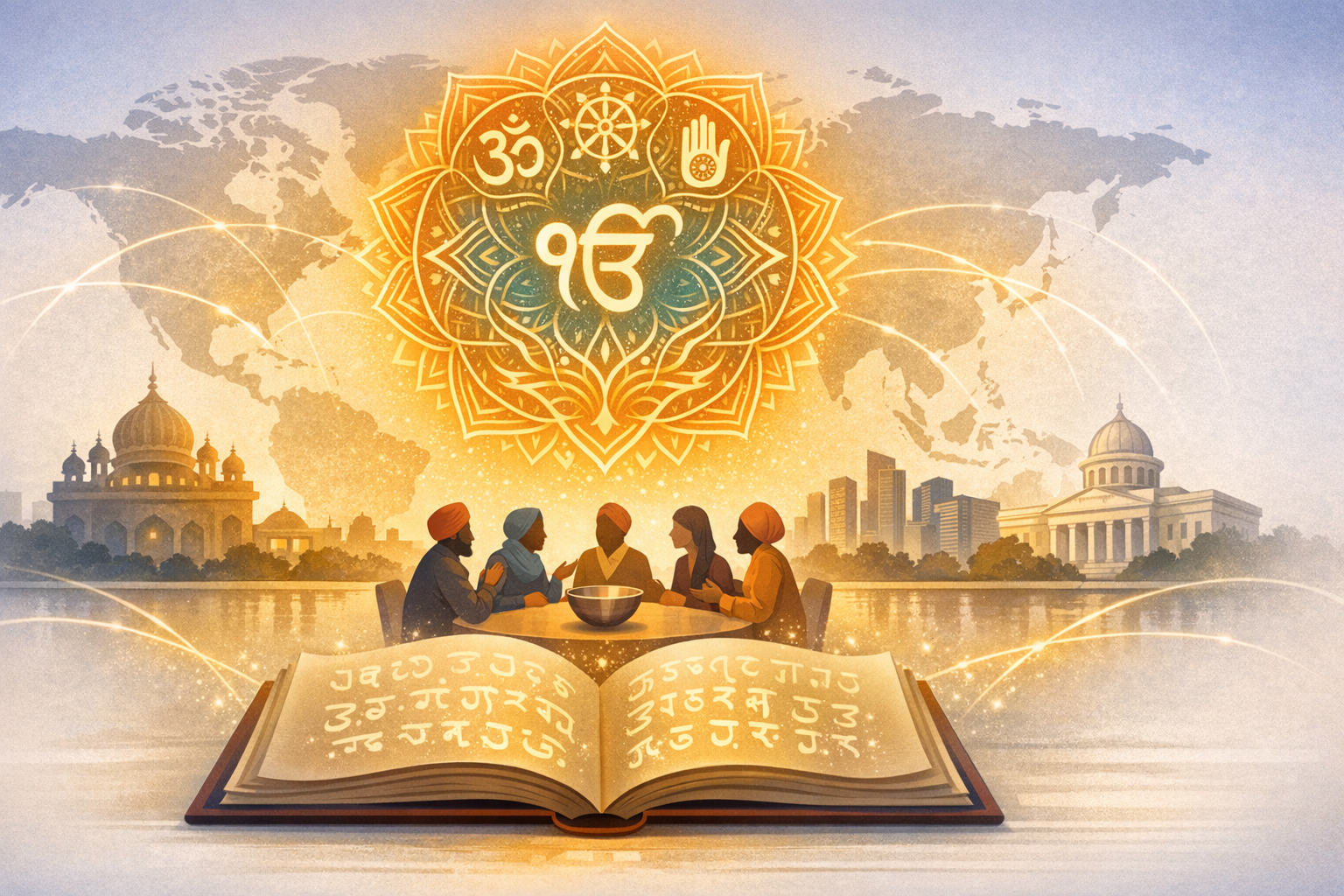
Interfaith reflection is another recurring strength. Anchored in Ik Onkar, the analysis emphasizes the unity of existence and the humility required to meet others where they stand. The writing draws constructive parallels with ideas such as Anekantavada in Jainism and the inclusive spirit evident in Hindu and Buddhist philosophies. Without collapsing differences, these texts argue for Unity in spiritual diversity as the most honest and durable basis for peaceful coexistence, intellectual curiosity, and shared moral action.
Hermeneutically, the works exemplify careful reading of Gurbani, treating translation not as a mechanical exercise but as a disciplined interpretation that respects context, idiom, and musical setting (kirtan). Attention to language and history is paired with a reminder: scripture guides the whole person—ethics, aesthetics, and intellect—so any responsible exegesis should be tested by how it refines conduct and deepens compassion. This approach helps communities avoid both over-literalism and unfalsifiable abstraction.
The volumes also consider the civic dimensions of faith through the Sikh paradigm of Miri-Piri. Rather than endorsing partisanship, the analysis explores how spiritual insight can inform just action in the public square—standing for human dignity, due process, and fairness to minorities while maintaining humility. This framing serves a broad readership concerned with the ethics of power, the responsibilities of speech, and the moral limits of force.
Education and youth formation receive substantive attention, particularly the tensions of raising children who are both deeply Sikh and fully at home in plural societies. Readers will find guidance on bilingual literacy, community mentorship, and the formation of resilient identities in the digital age. The argument is pragmatic and hopeful: when communities invest in language, liturgy, and the arts, they do more than preserve heritage—they cultivate moral imagination and civic contribution.
The books extend beyond internal community questions to advance a constructive grammar for Interfaith Dialogue. Here, Sikh concepts—such as Ik Onkar and Sarbat da Bhala—are placed in conversation with dharmic counterparts: Anekantavada’s many-sided truth, the Hindu vision of Vasudhaiva Kutumbakam, and Buddhist virtues of karuṇā and mettā. The result is an applied pluralism that invites Hindus, Buddhists, Jains, and Sikhs to discover convergences while productively learning from differences.
Methodologically, the writing demonstrates how personal narrative can coexist with academic rigor. Lived experience functions as data; scriptural reference supplies normative guidance; and comparative analysis offers perspective. This triadic method helps readers discern the difference between anecdote and pattern, between isolated conflict and systemic concern—an especially useful distinction when navigating media discourse and fast-moving public debates.
Readers will also appreciate the sustained attention to language ethics: how to disagree without contempt, how to critique a practice while respecting persons, and how to seek truth without performative outrage. These norms echo across the dharmic landscape and are indispensable for preserving community cohesion. By modeling accountable speech, the books help readers build durable habits for online engagement, community governance, and intergenerational dialogue.
Historically alert and contemporarily grounded, the essays contextualize Sikh experience within broader South Asian and global currents. They show how diasporic Sikh life is shaped by legal frameworks, labor markets, and educational systems, while remaining oriented by Guru-centered virtues. This integration of sociology, ethics, and spirituality invites scholars and practitioners alike to think systemically about Community, Culture, and Spirituality.
For those engaged in Comparative Religion, the works offer a reliable introduction to Sikh categories—guru, sangat, seva, simran, kirtan—presented alongside cognate ideas across Hinduism, Buddhism, and Jainism. The analysis resists caricature; it refrains from zero-sum claims; and it centers the pragmatic question: which practices reliably cultivate humility, compassion, courage, and truthfulness in ordinary life? This emphasis keeps inquiry grounded and outcome-focused.
In community settings, the books function as catalysts for study circles, youth forums, and interfaith salons. Their chapter-length essays are structured for conversation—each piece raises a concrete question, develops a reasoned position, and closes with implications for action. This architecture translates seamlessly into workshops, school modules, and leadership retreats, enabling practical uptake well beyond the printed page.
Ultimately, the significance of Dr. I. J. Singh’s writing lies in its steady insistence that spiritual integrity and public responsibility are not rival goods. Through Sikh ethics of seva and the universal aspiration of Sarbat da Bhala, the books show how a life shaped by Gurbani naturally supports Religious Pluralism, Interfaith Dialogue, and the unity of dharmic traditions—Hinduism, Buddhism, Jainism, and Sikhism—without erasing the authentic contours of any path.
For readers seeking guidance that is at once intellectually serious and compassionately practical, these volumes provide a durable foundation. They help families nurture bilingual, civically engaged children; they equip professionals to negotiate identity in complex institutions; and they encourage communities to build bridges grounded in truth and mutual respect. In a world eager for quick answers, this body of work offers something more enduring: disciplined hope, anchored in wisdom and animated by service.
Inspired by this post on SikhNet – News.










Leave a Reply
You must be logged in to post a comment.