

If the Amazon India portrayal of Aryabhata angered you, the immediate question is not whether you are entitled to object. You are. The harder question is whether your response will defend his legacy with the same precision, discipline, and commitment to truth that made that legacy worth defending.
A widely shared Amazon India advertisement featuring a stylized Aryabhata provoked a backlash in June 2026. Many viewers considered the treatment trivializing, online discussions carried the #BoycottAmazon call, and complaints to regulatory and self-regulatory bodies were reported. You can respond firmly without turning an arguable cultural grievance into a careless viral narrative.
First establish what you know about the advertisement

The narrow, defensible core of the controversy is clear: Amazon India used a stylized portrayal of Aryabhata, many viewers regarded it as disrespectful or reductive, and boycott appeals followed. That does not make every caption, edited clip, or allegation attached to the controversy reliable.
Before you repost the advertisement or file a complaint, preserve enough context for another person to evaluate your objection. A strong record should include:
- The complete advertisement rather than a cropped reaction clip.
- The platform, account name, direct link, and date on which you saw it.
- The exact frame, line, gesture, or narrative device you consider objectionable.
- A distinction between what the advertisement visibly depicts and what you infer about the creators’ motives.
- Any later statement or altered version, clearly dated so that it is not confused with the original asset.
Describe the depiction before judging it. A sentence such as Aryabhata is shown doing X while the product claim does Y gives a reviewer something concrete to assess. A sentence such as Amazon hates Hindu civilization asserts an intention that the advertisement alone may not establish. The second formulation may attract more engagement, but it gives the company an easy way to dismiss the entire objection as speculation.
The same discipline applies to claims about what happened afterward. Do not announce that Amazon withdrew the campaign, apologized, rejected complaints, or faced an official penalty unless you can attach a dated statement or decision supporting that claim. Cultural advocacy loses leverage when the most shareable allegation is also the least verifiable one.
Why Aryabhata cannot be treated as a generic advertising character
Aryabhata is not remembered merely because he was an ancient scholar. Living around 476-550 CE, he composed the Aryabhatiya in 499 CE. Its compressed Sanskrit verses organized demanding work in mathematics, time-reckoning, cosmology, and spherical astronomy into four sections: Gitikapada, Ganitapada, Kalakriyapada, and Golapada.
His mathematical work included a place-value framework, an alphanumeric method for representing large numbers, a sine table, and the kuttaka or pulverizer algorithm for linear indeterminate equations. A famous calculation gives a circumference of 62,832 for a circle with a diameter of 20,000, producing an approximation of pi equal to 3.1416.
His astronomy is just as important. Aryabhata explained solar and lunar eclipses through geometry, shadow, and occlusion. He used Earth’s daily rotation to account for the apparent westward movement of the stars, and his moving-boat analogy showed how observed motion depends on the observer’s frame. These were reasoned explanations of natural phenomena, not decorative curiosities.
This is why context matters. Humour is not automatically disrespectful, and historical figures need not be depicted with lifeless solemnity. The problem begins when a learned figure is emptied of his intellectual identity and retained only as an exotic costume, an ignorant foil, or a disposable prop for a sales message. If a viewer can understand the joke but cannot tell why the character is Aryabhata rather than any vaguely ancient person, the campaign is probably borrowing recognition without accepting the duty of representation.
For many Indian families, Aryabhata also belongs to the first vocabulary of civilizational science learned at school: pi, eclipses, planetary motion, trigonometry, and place value. A trivial portrayal can therefore touch something larger than personal taste. It can appear to reduce a shared memory of rigorous inquiry to a commercial gimmick.
Historical accuracy makes the cultural case stronger
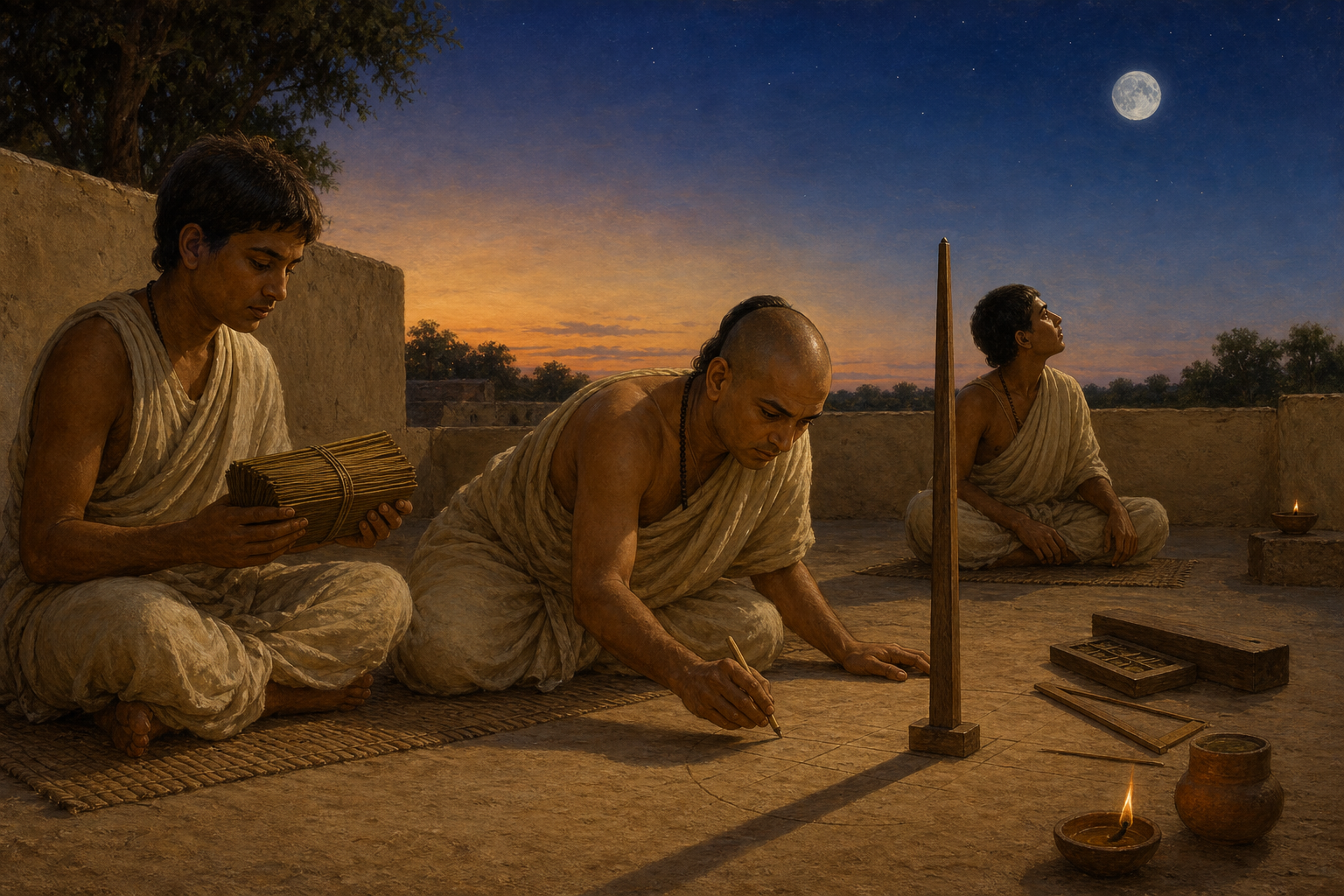
The most common mistake in Aryabhata advocacy is to answer a reductive advertisement with an inflated historical claim. The familiar declaration that Aryabhata invented zero is too blunt.
Aryabhata clearly worked within a place-value system in which an empty position mattered, but the explicit symbol for zero and systematic arithmetic rules for zero are associated more firmly with later Sanskrit mathematics, especially Brahmagupta in the seventh century. Saying this does not diminish Aryabhata. It places him accurately within a cumulative Indic tradition in which one generation preserved, tested, criticized, and extended the work of another.
That cumulative tradition continued through figures including Brahmagupta, Bhaskara I, Bhaskara II, and scholars of the Kerala School. Jain mathematicians such as Mahavira in the ninth century and Hemachandra in the twelfth also expanded Indic work in algebra and combinatorics. Buddhist centers of learning sustained astronomical discussion, while Sikh respect for vidya and truthful inquiry makes the defence of knowledge a naturally shared concern.
You therefore do not need to turn Aryabhata into a sectarian possession in order to defend him from trivialization. He represents an Indic scientific inheritance held across Hindu, Buddhist, Jain, and Sikh memory. That wider frame strengthens the objection: a global company using such a figure is engaging a civilizational legacy, not merely decorating a campaign with a Hindu-looking character.
Use three tests when you assess any commercial portrayal of an Indic luminary:
- Identity: Does the campaign preserve something historically recognizable about the person, or only use a name and costume?
- Function: Is the figure participating meaningfully in the idea, or serving as a comic or transactional prop?
- Accuracy: Could the campaign leave an ordinary viewer with a false belief about the person’s work, period, or intellectual character?
A campaign need not become a classroom lecture. One accurate line, caption, or narrative detail can establish that the creators understand whose reputation they are borrowing. Without that anchor, familiarity becomes extraction: the brand takes recognition from the culture while giving neither knowledge nor dignity back.
Turn indignation into a remedy that can be measured

If you are a concerned viewer
A boycott is a legitimate consumer choice, but a hashtag by itself does not tell Amazon what must change or how trust could be restored. Set a remedy before you escalate. Otherwise, success becomes impossible to recognize and outrage becomes permanent performance.
- Preserve the complete asset. Save the direct link and record the date, platform, and exact objection. Keep enough surrounding material to show that the disputed moment has not been cropped into a different meaning.
- State the problem narrowly. Identify the inaccurate, demeaning, or reductive element. Avoid treating humour itself as forbidden and do not attribute malicious intent without evidence.
- Explain the cultural stakes. Connect your objection to Aryabhata’s actual work: the Aryabhatiya, mathematics, eclipse theory, trigonometry, or Earth’s rotation. This shows why the portrayal matters beyond personal offence.
- Ask for a specific remedy. Possible requests include pausing the disputed asset, publishing the intended creative rationale, correcting an inaccurate element, obtaining an independent cultural review, and disclosing what review safeguard will be added.
- Use an accountable channel. Send the complaint to Amazon and, where appropriate, to the Advertising Standards Council of India. Keep the submission factual, retain the acknowledgement, and share the complaint text rather than only a slogan.
- Define your boycott conditions. Decide whether you seek removal, acknowledgement of harm, expert review, a corrected campaign, or a documented process change. State what action would be sufficient for you to reconsider.
- Add knowledge to the protest. Pair criticism with a concise, checked explanation of one Aryabhata contribution. A campaign that trivializes knowledge should not be allowed to leave the public conversation less informed than it found it.
A useful complaint can follow a simple structure: On a stated date, you saw a named asset on a specified account. At a particular line or frame, it depicted Aryabhata in an observable way. You object because that device reduced or misstated a documented part of his legacy. You request a precise remedy and attach the full context. This format is harder to ignore than a stream of abuse and easier for a standards reviewer to evaluate.
The ASCI Code discourages advertising likely to cause widespread offence, disparage a religion or community, or undermine social harmony. A standards complaint should therefore explain the likely public effect of the portrayal rather than assume that your individual reaction proves a legal offence. Regulatory action, consumer criticism, and criminal allegations are different things; do not collapse them into one claim.
Do not threaten employees, publish personal information, target unrelated customer-service workers, or abuse people who ask for evidence. None of those actions protects Aryabhata. They shift attention from the disputed creative choice to the conduct of its critics.
If you work for Amazon or another advertiser
The failure point is usually earlier than publication. Cultural review performed only after a backlash is crisis management, not stewardship. A workable review process for Indic historical figures should include:
- Cultural mapping before scripting: identify the figure’s actual work, the communities that value the legacy, and the portrayals most likely to reduce it.
- Independent expertise: use historians, Sanskritists, mathematicians, astronomers, or Indic-philosophy specialists appropriate to the subject. A general diversity review cannot substitute for subject knowledge.
- Concept testing across Dharmic communities: include Hindu, Buddhist, Jain, and Sikh perspectives when the figure belongs to a shared Indic inheritance.
- A high-risk approval gate: require senior review when a civilizational figure is being used for ridicule, parody, product comparison, or transactional persuasion.
- A documented decision: record the historical facts checked, the concerns raised, and the changes made. Add the lesson to a living cultural-sensitivity playbook.
Once controversy begins, intent is not enough. Amazon can clarify the creative objective, pause the contested asset while it is reviewed, acknowledge the effect without pretending that effect was intended, and name the process change that will prevent repetition. An educational initiative on Indic mathematics may help, but it should accompany correction of the disputed practice rather than replace it.
Respectful representation does not require sterile advertising. It requires a creative team to understand the person well enough that the wit, drama, or surprise grows from the history instead of consuming it. Aryabhata’s work offers rich material: the moving-boat analogy, a remarkably precise value of pi, eclipse geometry, and the pulverizer algorithm can all inspire imaginative communication without turning the scholar into a caricature.
Key takeaways
- The verified controversy concerns a stylized Amazon India portrayal of Aryabhata that many viewers considered trivializing; do not attach unverified claims about motive, withdrawal, apology, or punishment.
- Aryabhata’s importance rests on specific achievements in mathematics and astronomy, not on the oversimplified claim that he single-handedly invented zero.
- A strong complaint identifies the exact depiction, explains the historical or cultural harm, preserves full context, and requests a measurable remedy.
- A boycott has more force when its conditions are explicit and when criticism is paired with accurate public education.
- Advertisers using Indic luminaries need expert review before publication, cross-community testing, and an escalation gate for high-risk creative choices.
Before you share the next screenshot, find the complete advertisement and write down the one exact feature you want changed. Then attach one verified fact about Aryabhata and one remedy Amazon can actually implement. That small discipline turns cultural anger into cultural stewardship – and gives the defence of dharma a standard worthy of the knowledge being defended.
References
