
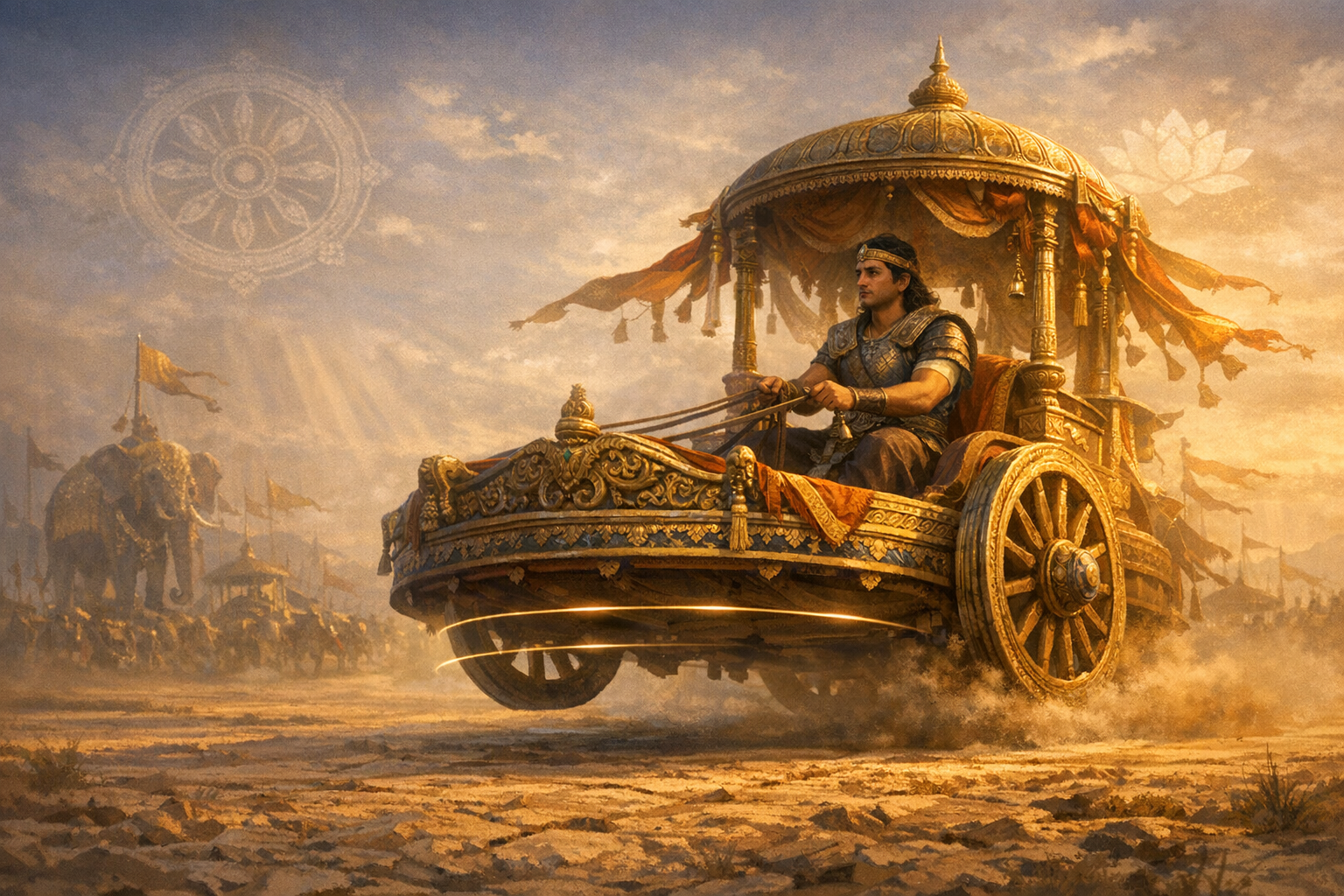
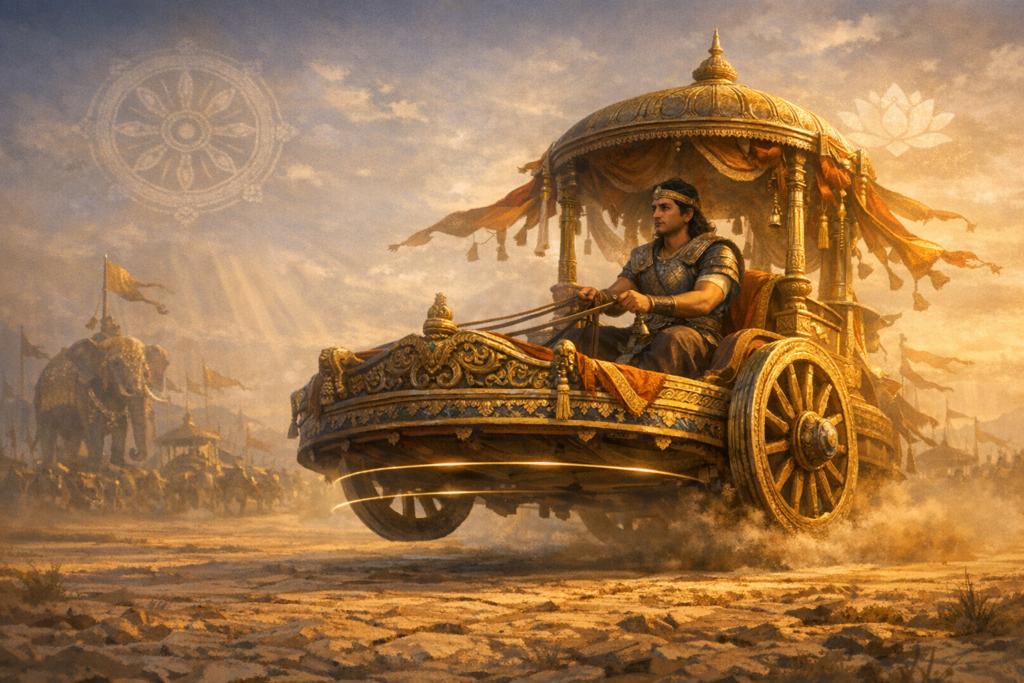
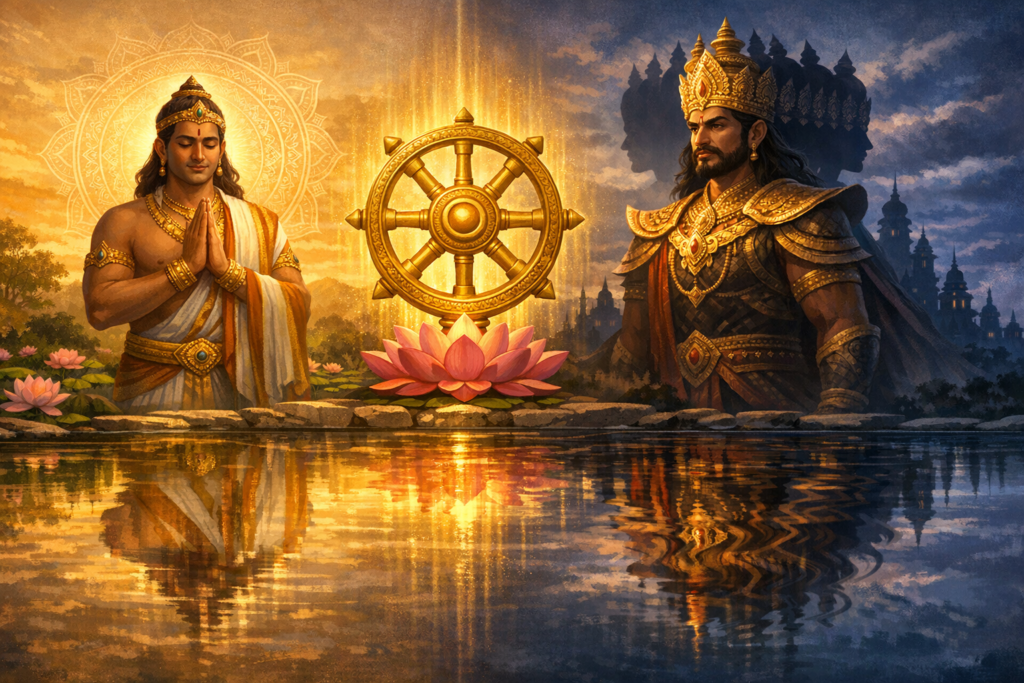
In the vast tapestry of the Mahabharata, the image of Yudhishthira’s chariot gliding four finger-breadths above the earth endures as one of the epic’s most compelling moral emblems. Tradition links this levitation to his uncompromising satya (truthfulness) and steadfast commitment to dharma. Yet, at the moment he consents to an ethically fraught stratagem in the Drona Parva, the chariot is said to descend and touch the ground. Compressed into that descent is a rigorous question that runs through the Kurukshetra War: what is gained and what is lost when righteousness must navigate the deceptions of war?
Yudhishthira, born of Dharmaraja Yama, is cast in the Mahabharata as the very measure of dharma in human form. His kingship is framed not merely as political office but as a crucible of ethical leadership. In narrative memory and commentarial tradition, the chariot’s elevation becomes a physical register of moral altitude—an index of how closely a life cleaves to truth. The motif signals that virtue is not only inward disposition; it radiates outward, shaping the world in subtle yet tangible ways.
The crucible arrives amid the Kurukshetra War, when the Pandava army faces a tactical impasse against Dronacharya. Invincible while armed and resolute, Drona can be disarmed only by breaking his inner certainty. Kṛṣṇa argues that survival of the many demands a painful expedient. Bhima then slays an elephant named Ashvatthāma, creating the pretext for a carefully worded announcement. Yudhishthira, long celebrated for unerring truth, must decide whether the burdens of rajadharma and kshatra-dharma (the obligations of rulership and warrior-ethics) can permit a sentence that is true in syllables but misleading in sense.
The battlefield stratagem hinges on a single utterance: “Ashvatthāma hatah, naro vā kunjaro vā.” The first clause is allowed to ring out clearly—Ashvatthāma is slain—while the qualifying phrase, “man or elephant,” is rendered indistinct in the din. Dronacharya, hearing what appears to be the unqualified death of his son, lays down his weapons in despair and is killed by Dhrishtadyumna. At that precise narrative instant, tradition records, Yudhishthira’s chariot, once hovering above the earth, sinks to the ground. The symbol is exacting: intention may be protective, the fact may be technically true, but truth bent toward deception extracts a metaphysical cost.
Read as an ethical instrument, the floating chariot is not a miracle to be marveled at so much as a metric to be studied. It asks whether truth is merely propositional accuracy (what one says) or existential alignment with r̥ta (cosmic order) and dharma (what one is and does). Yudhishthira’s sentence satisfies vak-satya (truth in wording) while departing from artha-satya (truth in communicative intent). The epic signals that the latter—truth in meaning, carried by clarity and right purpose—grounds the former.
The Mahabharata repeatedly distinguishes domains of duty: svadharma (one’s intrinsic duty), rajadharma (duties of governance), kshatra-dharma (warrior ethics), and apaddharma (ethics under emergency). In the vortex of war, these domains collide. Kṛṣṇa’s counsel is a classic statement of nīti (statecraft): if strict deontic fidelity to a single virtue—literal truth-telling—preserves one life only to imperil thousands, leadership may be required to accept a constrained, tragic choice. The chariot’s fall, then, is neither a condemnation of statecraft nor an absolution of deception; it is a record of moral remainder—the ethical debt incurred even when an act is arguably necessary.
This layered reasoning receives extended treatment in the Śānti and Anuśāsana Parvas, where dharma is considered plastic to context without being relativistic. Apaddharma is not license but exception: a permission carved by compassion and prudence when ordinary rules would multiply harm. Even so, the Mahabharata insists that such departures from the brightest face of virtue should be rare, fully conscious, and followed by introspection, restitution, or prāyaścitta (atonement). Yudhishthira’s post-war anxiety, his initial refusal of coronation, and the subsequent Aśvamedha Yajña can be read as attempts to balance this moral ledger.
From a philosophical standpoint, the episode juxtaposes deontological fidelity (never deceive) with consequentialist calculus (minimize harm), yet it ultimately aims past that binary. Dharma in Hindu philosophy seeks consonance with r̥ta rather than obedience to a single rule or sole outcome. The story’s pedagogy lies in how it trains judgment: discern motive, weigh consequences, honor duties across roles, and acknowledge that even a “right” decision can wound the conscience and require healing.
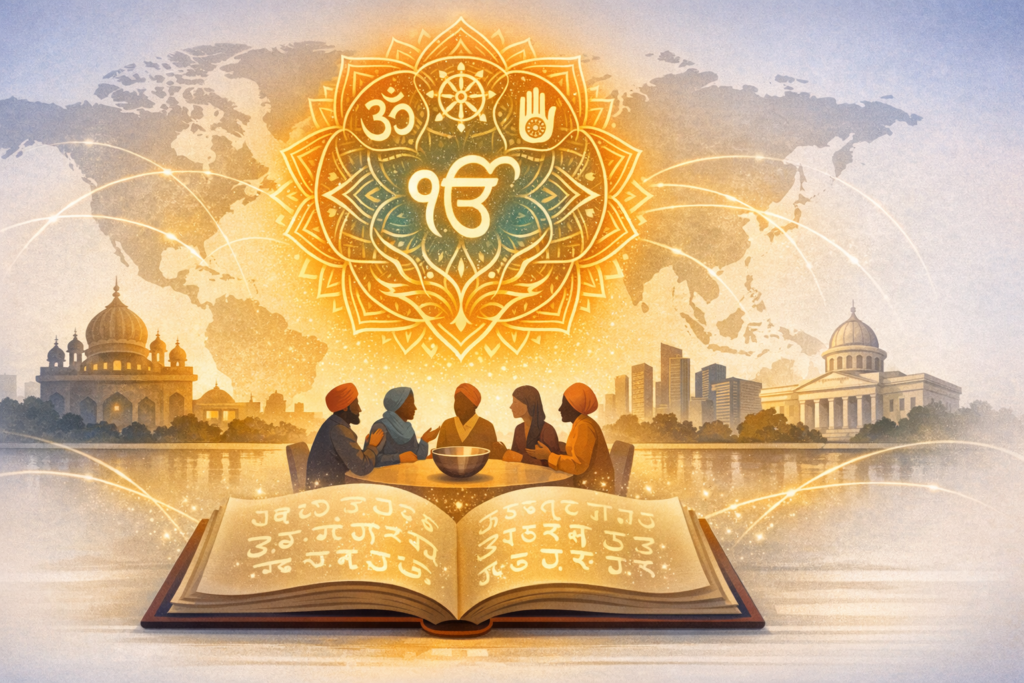
Comparative perspectives from across Dharmic traditions enrich this reading. Buddhism’s sammā-vācā (Right Speech) rejects falsehood and divisive or harmful speech, emphasizing truth that conduces to welfare. Mahāyāna discussions of upāya (skillful means) do not sanctify lying but explore compassionate pedagogy tailored to capacities and contexts. Jainism, through anuvratas (small vows), enjoins satya with rigorous attention to intention and harm—verbal violence (vāg-himsā) is censured even when the words are technically correct. Sikh thought centers sat (truth) in the Mūl Mantar and integrates dharam yudh (righteous struggle), urging courage and fairness while guarding the integrity of speech. These traditions converge on a profound unity: truth is a moral force that must heal and protect, not merely conform to literalism or expediency.
In that light, Yudhishthira’s act illustrates how Dharmic ethics treat emergencies as moral anomalies, not precedents. The shared aim—across Hinduism, Buddhism, Jainism, and Sikhism—is the minimization of suffering without eroding the primacy of truth. Where stratagems appear, they are treated as burdens to be borne with humility, not as victories to be celebrated. The chariot’s descent, therefore, is an inter-traditional lesson: even necessary speech that misleads leaves a trace upon the soul that must be acknowledged and transformed.
Symbolically, “four finger-breadths” (catur-aṅgula) is a traditional unit with rich associations in śāstra and yoga—close enough to touch and yet a distinct interval, like the fine space between intention and execution. Many readers discern in that measure a yogic metaphor: sattva (clarity) elevates, while rajas (restless action) and tamas (inertia or concealment) pull downward. When Yudhishthira bends speech away from luminous clarity, rajas necessarily enters; the chariot meets earth, and with it the limits of even the noblest human agency.
Textually, the Ashvatthāma stratagem is firmly embedded in the Drona Parva across Sanskrit recensions, while the precise image of the “levitating chariot” appears with varying emphasis in traditional tellings and commentarial streams. The critical point is interpretive rather than forensic: the tradition consistently remembers a visible sign marking an invisible shift. That collective memory functions as ethical pedagogy, binding narrative drama to philosophical instruction.
The consequences of the act are not merely external—Dronacharya’s fall or the Pandava advantage—but interior. Yudhishthira’s celebrated serenity is shaken; his heart becomes a site of argument long after the din of battle has faded. The Mahabharata captures this aftermath with extraordinary psychological acuity: dharma is not completed when an action ends; rather, action inaugurates a long work of conscience, confession, and communal mending. In this sense the epic is as much about ethical repair as it is about righteous action.
Contemporary leadership can read the episode as a study in “ethical risk.” Public safety, national security, or organizational survival may sometimes require the withholding or staging of information. The Mahabharata offers a demanding template for such situations: exhaust non-deceptive options first; ensure intent is protective and impartial; capture a clear record of reasons; limit scope and duration; and plan for transparent restitution. The spiritual dimension is equally crucial: seek counsel, accept accountability, and undertake personal practices—meditation, prayer, or seva—that re-anchor integrity.
Placing this within the wider ethics of war (dharma-yuddha), the Mahabharata never romanticizes violence. Kṛṣṇa’s counsel to Arjuna in the Bhagavad Gita is not a blank check for means; it is a call to lucid duty, inner mastery, and compassion even amid conflict. The Ashvatthāma episode operates in that same field of constrained duty. It recommends neither naiveté about evil nor cynicism about virtue, but a realism bound to the moral horizon of Sanatana Dharma.
The episode also remembers human cost with devastating clarity. Drona’s paternal grief, Ashvatthāma’s rage, and the chain of retaliations that follow underscore the principle that even strategically “useful” deception radiates suffering. Dharma and adharma are rarely split by clean lines in wartime; the epic instead sketches gradients of responsibility and harm, asking readers to attend to what violence—even of words—leaves in its wake.
From a hermeneutic perspective, the floating chariot becomes a master metaphor for moral phenomenology. When a life is aligned with truth, conduct acquires a certain lightness—actions move without friction, and trust accumulates as social capital. Deviation, however mitigated by necessity, reintroduces gravity. The image is pedagogically elegant: it teaches without didacticism, allowing philosophical insight to arrive through narrative form.
Across Dharmic traditions, the centrality of truth functions as a unifying thread. Hindu dharma’s satya, Buddhism’s sammā-vācā, Jainism’s satya-vrata and ahiṁsā of speech, and Sikhism’s sat (in Satnam) and gurmat emphasis on integrity converge on a single ethic: speech must heal, protect, and guide. Where emergency permits deviation, it must be fenced by compassion, limited by necessity, and followed by accountability. In this shared light, Yudhishthira’s decision is intelligible but not imitable as a norm; it is a sorrowful concession, not a model for ordinary times.
There is also a pedagogical humility encoded in the chariot’s fall. It reminds readers that moral stature is not a fixed possession but a living relation to truth, renewed choice by choice. The story refuses moralism and invites maturation: greatness is not perfection preserved from stain, but integrity restored after necessary compromise. The lesson dignifies struggle and calls for unity across schools of thought in the shared work of ethical repair.
For many who have faced dilemmas where stark honesty might endanger the vulnerable, this episode resonates with lived experience. It acknowledges that not all values can be maximized at once and that leadership sometimes endures a tragic arithmetic. Yet it also offers hope: through reflection, atonement, and renewed commitment to clarity, the lost altitude can be regained, and trust can be rebuilt—personally, socially, and spiritually.
In sum, the “floating chariot” is an ethical seismograph calibrated to the subtlest shifts in intention and speech. It illuminates Dharma in Hinduism by showing how truth, compassion, prudence, and courage must be held together. It fosters inter-traditional unity by harmonizing with the Buddhist, Jain, and Sikh insistence on truthful, healing speech. And it leaves a demanding, generous charge for contemporary readers: choose truth as the first resort, weigh harm with care when emergencies arise, and let conscience do the long, healing work after the dust of decision settles.
Inspired by this post on Hindu Blog.





Leave a Reply
You must be logged in to post a comment.