

Sattainathar is revered in the Tamil Shaiva tradition as an ascetic, boundary-guarding mode of Shiva consonant with Bhairava’s fierce compassion. Within the layered landscape of Tamil Nadu temples and Shaiva Siddhanta philosophy, this form embodies the power that shatters illusion (maya), upholds sacred order, and protects the thresholds—ritual, ethical, and psychological—that sustain dharmic life.
In Tamil Nadu, fierce emanations of Shiva—broadly grouped under the name Bhairava—are neither marginal nor merely terrifying. They are integral to temple liturgy, iconography, and community ethics. Sattainathar, understood locally as an austere Bhairava-type guardian, makes visible the paradox at Shaivaism’s core: the same consciousness that dances as Shiva Nataraja also stands vigilant as Kshetrapala, the field-keeper who dissolves fear and restores balance.
The epithet Sattainathar varies across regions and temple sthala-puranas. In several Tamil Shaiva lineages it denotes Shiva’s ascetic, watchful presence near the outer prakara, functionally aligned with Bhairava. In other local narratives, the name overlaps with distinct mythic roles of Shiva within a given temple-complex. This fluidity is characteristic of Tamil Shaiva practice, where theological nuance and regional memory coexist without contradiction.
Historically, Bhairava worship in the Tamil region expanded alongside Chola- and Pandya-era temple building and bronze-casting. Surviving metal and stone images from the 10th–13th centuries exhibit hallmark Bhairava features—matted locks, skull-ornaments, and the dog vahana—signaling a mature, codified guardianship cult within Shaiva Siddhanta ritual frameworks.
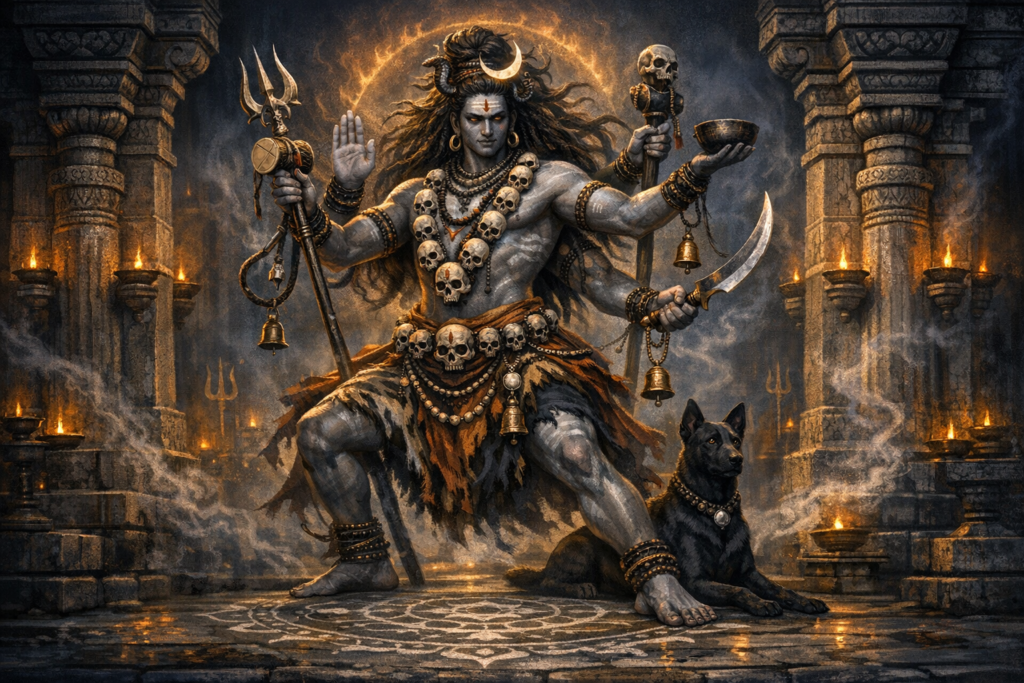
Iconographically, Sattainathar shares the Bhairava family’s visual grammar. Common attributes include the trishula (trident), damaru (drum), kapala (skull-bowl), and khatvanga (skull-topped staff). The form is frequently digambara (sky-clad) or clad in a tiger-skin, crowned with a jata-mukuta, and adorned with rudraksha and vibhuti. The dog companion symbolizes loyalty, liminality, and the transmutation of what society treats as impure into the very vehicle of protection.
The ascetic accent signified by Sattainathar emphasizes tapas (discipline), inner renunciation, and fearless clarity. The skull-bowl functions as a memento mori and as a ritual vessel for insight: mortality, accepted rather than denied, becomes a doorway to compassion. The trident articulates Shiva’s sovereignty over the three impurities (anava, karma, mala), central to Shaiva Siddhanta; the drum proclaims the beat of creation and dissolution within one continuous awareness.
Ritually, the Sattainathar-Bhairava presence guards time and space. As the kshetrapala of the outer precincts, this deity is typically saluted during circumambulation, with lamps, sesame-oil deepa, bilva leaves, and vibhuti. Many Tamil temples mark nocturnal worship on certain tithis (often Ashtami or Amavasya), aligning Bhairava’s guardianship with liminal time-bands when thresholds are considered most porous. Feeding the needy and caring for animals—especially dogs—are encouraged as living offerings that universalize the ethic of protection.
Agamic sources such as the Kamikagama, Karanagama, and Suprabhedagama, together with Purāṇic materials like the Skanda Purana, provide the ritual and theological scaffolding for Bhairava worship. While the Kashi Khanda extols Kala Bhairava as the kotwal (guardian) of a sacred city, Tamil Shaiva praxis integrates that guardian-function into local temple ecologies, where Sattainathar operates as a vigilant presence harmonized with Shaiva Siddhanta liturgy.
The symbolism coheres around boundary and transformation. Sattainathar sanctions entry into sanctity by testing integrity at the edge: truthfulness, restraint, humility, and courage. The garland of skulls is not a spectacle of violence but a map of samsara’s cycles, worn openly to teach that liberation begins when fear of endings dissolves. The dog at his feet instructs that nothing in creation is finally outside dharma’s embrace.
Across Tamil Nadu—Madurai, Chidambaram, Kanchipuram, Kumbakonam, Thanjavur, and beyond—major Shaiva temples include a Bhairava or Sattainathar sannidhi in the outer prakara. Devotees commonly complete darshan by concluding at this shrine, acknowledging that beginnings and endings, entrances and exits, are ritually safeguarded. The practice is less about appeasing terror than about aligning with vigilance, clarity, and compassionate strength.
In wider Shaiva tradition, eight Bhairavas (ashta-bhairava) correspond to the eight directions and the eight divisions of the day-night cycle, translating metaphysics into timekeeping and ethical alertness. Sattainathar can be read within this framework as an ascetic sentinel: a reminder that discipline and kindness are both states of protected awareness.
Dharmic traditions converge around this guardian motif. In Vajrayana Buddhism, Mahakala and Vajrabhairava (Yamantaka) perform parallel protective and transformative roles; in Jain practice, temple guardians and yakshas embody disciplined watchfulness; in Sikh scriptural vision, the qualities of nirbhau (without fear) and nirvair (without enmity) echo the same fearless compassion. Sattainathar thus speaks to a shared civilizational grammar of protecting truth while serving all beings.
Applied to contemporary life, Sattainathar’s teaching is study in vigilance: set ethical boundaries without anger; cross social thresholds with humility; confront inner shadows without denial. Simple observances—lighting a lamp with focused intention, honoring time-discipline, practicing dana and ahimsa, and caring for the vulnerable—translate temple symbolism into daily dharma.
From an art-historical standpoint, Sattainathar-related Bhairava bronzes and stone images from the medieval Tamil period reveal refined craftsmanship: balanced asymmetry, dynamic stance, and meticulous skull-and-serpent ornamentation. These features, recurrent across museums and active temples, indicate a continuous ritual life rather than a merely antiquarian memory.
Because Sattainathar is a living, locally inflected title for Shiva, strict one-to-one identifications with any single Sanskritic category of Bhairava can oversimplify. The safer reading recognizes functional equivalence—austere guardianship within Shaiva Siddhanta—while allowing for regional narratives that celebrate rescue, protection, renunciation, or all three at once.
In sum, Sattainathar—understood as an ascetic Bhairava within Tamil Shaiva practice—embodies fearless clarity, ethical boundaries, and liberating compassion. The form protects temples, pilgrims, and, by extension, the inner sanctum of conscience. As these meanings are contemplated and lived, the fierce becomes tender, and the guardian becomes a guide, inviting all dharmic paths to meet at the threshold of wisdom and service.
Inspired by this post on Hindu Blog.







Leave a Reply
You must be logged in to post a comment.