
Sankha Nidhi the Sacred Treasury form of Kuber occupies a distinctive place in Hindu temple tradition, where theology, aesthetics, and ritual converge on the threshold of the sanctum. Within the vast and luminous knowledge-stream of Hindu sacred art and scripture, Kuber holds a position of high importance as lord of wealth, guardian of the north, and sovereign of the Yakshas and Gandharvas. He is one of the eight Ashtadikpalas, the divine regents presiding over the directions, and his presence in temples is often made legible through the personified treasures, or nidhis, that attend him. Among these, Sankha Nidhi (the Conch Treasure) is especially significant for the way it marries symbolism with architectural placement.
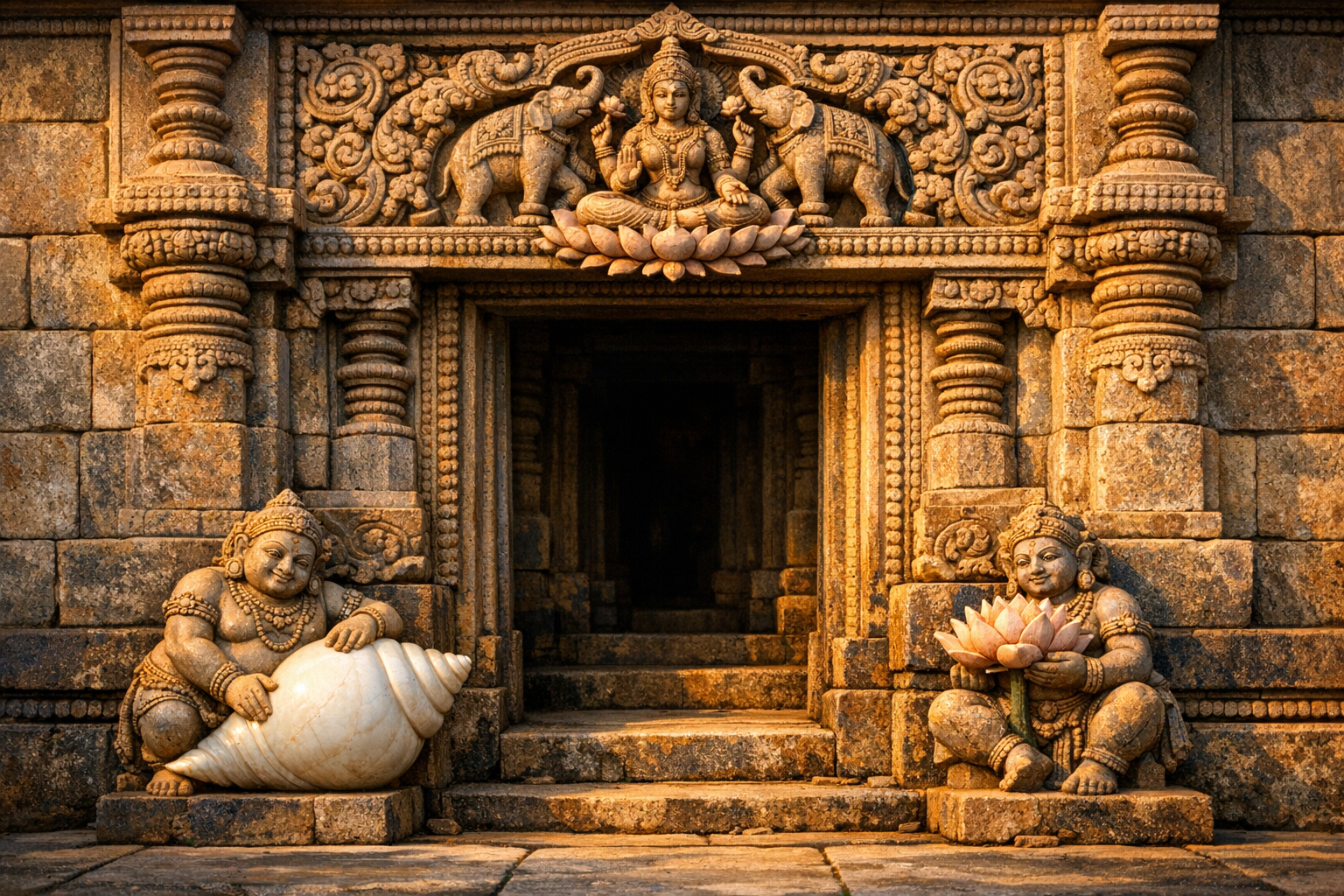
In classical iconography, the term nidhi denotes more than material riches. It refers to auspicious, inexhaustible treasuries that sustain right livelihood, collective prosperity, and dharmic order. Sankha Nidhi personifies the treasure bound to the shankha (conch), an emblem of primordial sound, vitality, and protective auspiciousness. In temple art, Sankha Nidhi commonly appears as a pot-bellied, dwarf-like yaksha bearing or supporting a conch, often paired with Padma Nidhi (the Lotus Treasure). Together, they serve as visual affirmations that wealth is sacred only when aligned to dharma and devoted to the support of ritual, learning, and community well-being.
Temple architecture manuals in the broader Śilpaśāstra corpus, including regional treatises such as Manasara, Mayamata, Śilparatna, and the Odisha-focused Śilpa Prakāśa, routinely prescribe Sankha Nidhi and Padma Nidhi on or near the door-jambs of important shrines. The placement is intentional: by situating the treasures at liminal points thresholds, adhisthānas, and jamb bases the temple broadcasts an invitation to step from the ordinary into the sanctified, with wealth re-understood as a means for inner and outer upliftment. This design logic ensures that every passage into the sacred space is guarded by auspicious wealth rather than by mere material affluence.
Iconographic cues make identification straightforward. Sankha Nidhi is typically depicted as a yaksha with a rounded belly, sometimes with a jovial expression, holding or leaning upon a prominent conch. The counterpart, Padma Nidhi, similarly holds or supports a lotus. Both figures may be rendered in gentle tribhaṅga or seated postures, and in some regional schools their forms are elongated or stylized. Their scale is often smaller than that of principal deities and dvārapālas, signaling their role as auspicious attendants rather than autonomous deities of worship.
The conch, central to Sankha Nidhi, carries layers of meaning in Hindu thought. It is associated with the life-giving waters, the generative sound that initiates creation, and the proclamation of dharma on the battlefield of life. As a temple symbol, the conch marks ritual beginnings (mangalāvarta), acts as a sonic purifier, and delineates sacred time. The nidhi associated with the conch thus encodes an ethic: may all wealth be used to commence and sustain works imbued with righteousness, learning, and compassion.
Kuber’s guardianship of the north, as part of the Ashtadikpala scheme, frames Sankha Nidhi within a cosmic map. Directional deities are not abstractions; they are integrated into architecture so that temple space mirrors sacred geography. By invoking Kuber’s nidhis at thresholds, the temple situates itself within a universe ordered by dharma and prosperity. Devotees moving past these carvings are thus subtly tutored: entry into the inner world is best undertaken with ethical clarity and generous intent.
Textual traditions provide additional depth. The Vishnudharmottara Purana and Agni Purana contain wide-ranging notes on imagery and sanctum design, while manuals such as Manasara and Mayamata specify threshold iconography. Odisha’s Śilpa Prakāśa, in particular, offers guidance on placing Sankha Nidhi and Padma Nidhi at the lower sections of the doorframes, beneath the lalatabimba that frequently carries Gajalakshmi. This vertical arrangement Treasures at the base, Lakshmi crowning the lintel composes a theological column: auspicious wealth supports and culminates in well-being, abundance, and grace.
Regional evidence reinforces the textual picture. From the temple cities of Bhubaneswar and Puri in Odisha to Chola and Vijayanagara-era doorframes in Tamil Nadu and onward to Hoysala shrines in Karnataka, the twin nidhis appear in varying styles yet with consistent intent. In Odisha’s Kalinga idiom exemplified at Mukteswara and Rajarani Sankha Nidhi and Padma Nidhi typically occupy the lowest jamb registers as balletic dwarfs. South Indian doorframes often integrate the pair into the ornamental bands that frame sancta dedicated to Vishnu and Lakshmi, while later medieval complexes sometimes stylize the nidhis into elegant, elongated figures. Despite stylistic variance, the semantic core remains: dharmic wealth ushers the devotee into sacred presence.
The theological coupling with Padma Nidhi is not incidental. Lotus symbolism links purity, generative power, and the serenity of abundance. The conch and lotus together speak to complementary values: initiative and repose, proclamation and contemplation, vigor and grace. As a pair, they remind that the stewardship of resources requires both dynamism (shankha’s call to action) and discernment (padma’s quiet purity).
The notion of Kuber’s nava-nidhi (nine treasures) varies across texts and regions, which is a hallmark of the pluralistic Hindu exegetical tradition. Lists commonly include Padma, Mahapadma, Sankha, Makara, Kachchhapa, Mukunda, Nanda, Nīla, and Kharva or Kundika, among other variants. While not every nidhi is personified in temple art, Sankha and Padma consistently are, likely due to their clear ritual and visual resonance with Vishnu and Lakshmi symbolism and their architectural suitability as liminal markers.
Material and technique play vital roles in how Sankha Nidhi is experienced. In stone, the tactile polish on the conch and the rounded modeling of the yaksha’s belly lend sensuous immediacy to the concept of plenitude. In bronze and wood, particularly in processional and doorway contexts, the sheen and grain render the figures approachable and protective. Patination over centuries testifies to collective touch and devotion silent archives of pilgrim traffic that have, in effect, performed a continuous abhisheka through time.
Ritually, the presence of Sankha Nidhi near entrances participates in prāṇa-pratiṣṭhā ecology without requiring independent worship. Priests, stewards, and devotees pass the pair en route to core rites, acknowledging often implicitly that every offering, bell-ring, and chant is nourished by resources that were once worldly but are now re-dedicated. In this way, temple economies are sacralized: offerings cycle back into anna-dāna, learning, maintenance, and the intangible wealth of collective memory.
From a semiotic perspective, the conch that defines Sankha Nidhi connects temple acoustics to cosmology. The resonance of the shankha, especially when aligned to ritual meters, marks the rupture of the ordinary and the inauguration of sacred action. Some traditions distinguish right-turning conches (dakṣiṇāvartī) as exceptionally auspicious, a motif occasionally echoed in the curvature of the sculpted conch held by Sankha Nidhi. Whether or not artisans intended a specific shell type, the emphasis on curve and spiral invariably evokes cyclical time and the return of fortune.
Comparative perspectives across the broader dharmic sphere amplify the unity of the underlying values. In Buddhism, Kuber is venerated as Vaiśravaṇa, a guardian of the north and benefactor of righteous prosperity; Tibetan and East Asian iconographies often give him treasure vases and attendants, while the conch and lotus are celebrated among auspicious emblems. In Jain sacred art, especially in Śvetāmbara traditions where the conch is counted among the Aṣṭamaṅgala, and in the ubiquitous lotus motifs across both Śvetāmbara and Digambara contexts, there is clear thematic kinship in signaling purity, auspiciousness, and the ethical direction of resources. These convergences highlight not sameness but harmony parallel articulations of shared civilizational ideals.
Because temple art is a living practice, Sankha Nidhi has also evolved. Later medieval workshop traditions sometimes abstract the yaksha’s body into rhythmic scrolls, integrate vegetal tendrils into the conch, or pair the treasure-bearers with narrative friezes. In some sites, restorations have relocated the figures to preserve doorframes, subtly altering their original alignments. Conservation-sensitive approaches now aim to document, stabilize, and, where possible, retain the nidhis in situ so that their dialog with thresholds continues uninterrupted.
For devotees and visitors, the experiential dimension is immediate. The first glimpse of Sankha Nidhi at the doorway often creates an intuitive sense that the householding duties of life earning, giving, sustaining can themselves be offerings. The figures embody a pedagogy of the threshold: before crossing into the inner world of mantra and darśana, one is reminded to transmute means into merit, possessions into provisions for the common good, and sound into silence-ready attention.
The pairing with Lakshmi imagery above the lintel further grounds this pedagogy. Gajalakshmi, flanked by elephants pouring waters of prosperity, presides as an auspicious canopy. Beneath her, Sankha Nidhi and Padma Nidhi stabilize the passage with treasuries that are as ethical as they are abundant. This vertical triptych treasures below, goddess above encapsulates a complete theology of wealth: grounded, ascending, and graced.
Scholarly consensus affirms that while exact nidhi lists, forms, and placements vary, the temple’s didactic intent remains constant. Whether following Śilpa Prakāśa’s prescriptions in Kalinga architecture, the canons of Mayamata and Manasara in the South, or localized sthapati traditions across regions, Sankha Nidhi operates as a visual sūtra. It condenses teaching into form, offering a mnemonic that even the hurried can internalize: wealth attains sanctity through right use and right orientation.
For students of art history, Sankha Nidhi is also a methodological anchor. Because the figure’s presence on doorframes spans centuries and regions, it serves as a comparative index to study workshop lineages, patronage patterns, and theological emphases. Differences in carving depth, bodily schema, and conch rendering can reveal trade links, stone availability, and shifts in ritual preference a reminder that temples are nodes in networks of artisans, merchants, monks, and pilgrims.
For conservators and community custodians, dialogue around Sankha Nidhi highlights the ethics of stewardship. Protective canopies for doorframes, careful documentation of displacement, and material-sensitive cleaning protocols are not mere technicalities; they protect the continuum of meaning that these figures sustain. As living heritage, the nidhis are not only objects to be safeguarded but partners in the ongoing ritual life of the temple.
In theological terms, Sankha Nidhi avoids the conceptual trap of equating wealth with spiritual deficit. Instead, it clarifies that resources are morally potent: they can corrupt, or they can liberate, depending on orientation. By locating the treasure at the threshold, the temple affirms a middle path that resonates across Hindu, Buddhist, and Jain sensibilities neither renouncing material means outright nor deifying them, but directing them toward the flourishing of beings and the maintenance of sacred institutions.
Practically, this symbolism guides daily observance. Householders emulate the temple’s lesson by beginning auspicious undertakings with invocations accompanied by the shankha’s note, framing income and effort as instruments of seva. Community kitchens, learning endowments, and festival funds embody Sankha Nidhi’s spirit when grounded in transparency, generosity, and shared purpose.
In sum, Sankha Nidhi the Conch Treasure of Kuber is both image and instruction. As a guardian of auspicious wealth and a herald of dharmic action, it anchors the architecture of the sacred and the ethics of the everyday. Paired with Padma Nidhi and crowned by Lakshmi, it composes a grammar of prosperity that is dignified, inclusive, and aligned to the enduring values of the dharmic traditions.
Inspired by this post on Hindu Blog.
