
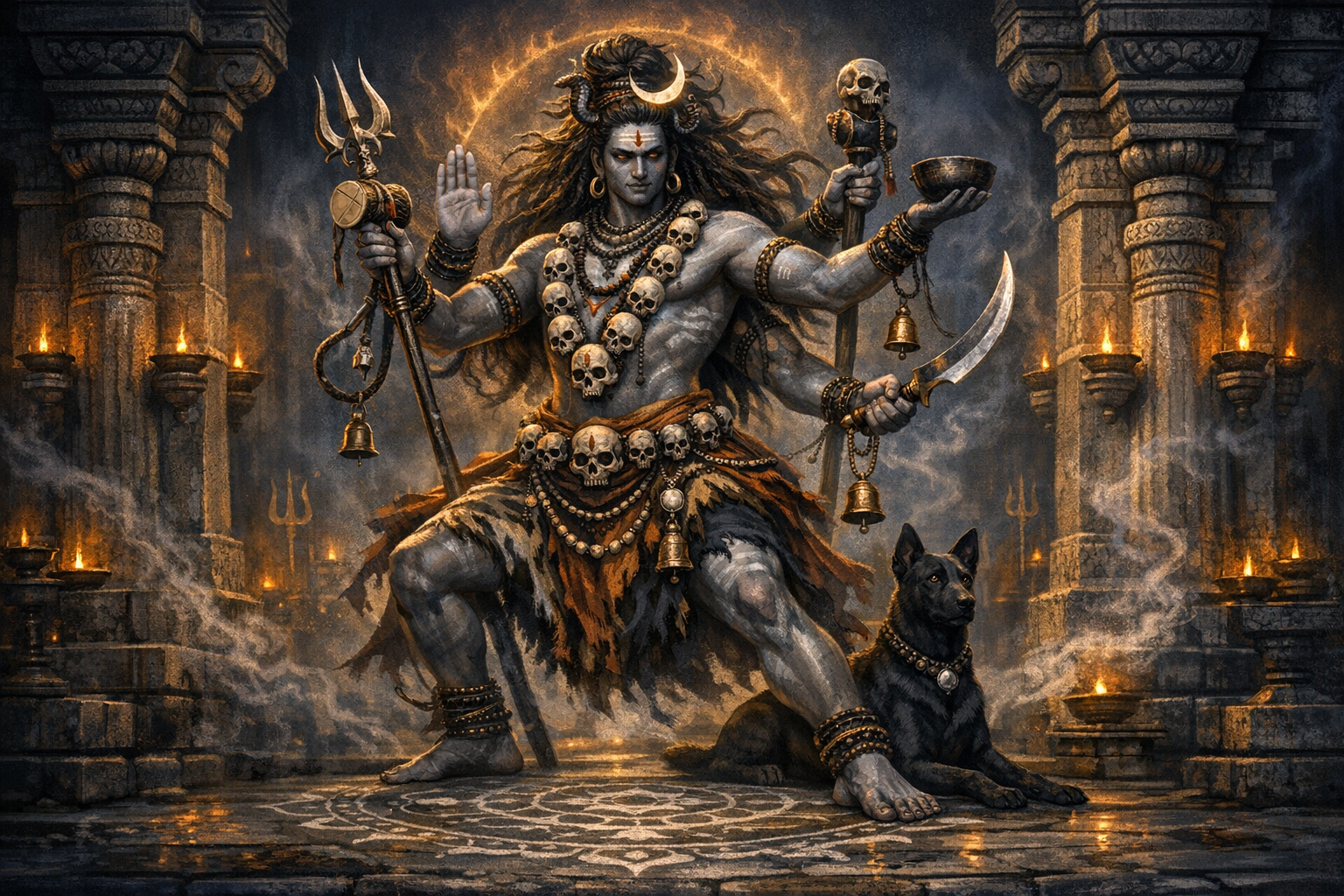
Samhara Bhairava stands among the most intense and spiritually catalytic manifestations of Shiva in the Tantric tradition. The very name Bhairava evokes the paradox of terror and transcendence: often derived from roots suggesting bhaya (fear) and rava (a piercing cry), Bhairava embodies the power that awakens, confronts, and ultimately dissolves fear. Within this matrix of fierce compassion, Samhara Bhairava is the current of destruction rightly understooddestruction as the clearing of impediments, the severance of bondage, and the opening to liberating awareness.
Across Shaiva Tantras and Agamas, Bhairava is not an aberration to be shunned but a grammar of transformation. Ugra (fierce) form does not celebrate violence; it encodes a discipline of clarity in the face of impermanence. In this disciplined vision, Samhara (the power of dissolution) is not annihilation for its own sake, but the uncompromising removal of avidyā (misapprehension) so that dharma may stand unobstructed.
Samhara Bhairava is traditionally counted among the Aṣṭa Bhairavas (Eight Bhairavas) who guard the quarters and embody eight distinct modalities of Shiva’s protective and purifying force. Textual lists and directional attributions vary across lineages and regions, yet Samhara Bhairava consistently represents the culminating, fear-dissolving potency. His presence, whether in stone, bronze, or painted icon, functions as a threshold markerwhere the aspirant acknowledges mortality, time (kāla), and change, and steps through them.
Iconographic prescriptions for Bhairava arise in several Agamas (such as the Raurava and allied Shaiva Tantras) and are refracted through regional śilpa (artisanal) traditions. While exact details differ among schools, three features recur for Samhara Bhairava: unmistakable fierceness (raudra-rasa), liminal guardianship (kṣetrapāla function), and tantric symbolism in weapons and ornaments that signify both protection and inner alchemy.
Form and stance. Samhara Bhairava is typically depicted as digambara (sky-clad), the body sacredly anointed with vibhūti (ash), signifying the truth of impermanence and the mind’s clarity beyond clinging. The stance is dynamicoften pratyālīḍha or ālīḍhaconveying poised motion rather than serenity at rest. The face may be single (eka-mukha) or multiple; three eyes (trinetra) affirm omniscient awareness, and the expression is intentionally dreadful, including protruding fangs and a lolling tongue, not to terrify the devotee but to terrify delusion.
Jata and crown. The jata-bhāra (matted locks) whirl upward, sometimes rendered as a blazing aureole. The crescent moon of Śiva, entwined serpents, and occasionally a skull (kapāla) may appear in the hair, enumerating mastery over time, vitality, and death. Flames or radiance around the head reinforce the idea of tapas (concentrated spiritual heat) that consumes obstruction.
Arms and attributes. The number of arms variescommonly four, six, or eighteach hand bearing symbols that encode the Tantric work of cutting, transforming, and guarding. Typical attributes include the triśūla (discernment that pierces the three guṇas), ḍamaru (the beat of creation and mantra), kapāla (a skull cup receiving negative tendencies for transmutation), khaṭvāṅga (tantric staff uniting cremation-ground wisdom with regal authority), khaḍga or kartarika (sword or flaying knife that severs ignorance), pāśa (noose restraining unruly impulses), and ghaṇṭā (bell that punctuates awareness). Regional images may add vajra, aṅkuśa, or shield, underscoring guardianship and indestructibility.
Ornaments and sacred attire. A serpent-yajñopavīta (sacred thread of nāga), a garland of skulls or severed heads (muṇḍamālā, often counted as 50 or 52 for the Sanskrit varṇas), bone ornaments (asthi-bhūṣaṇa), and a tiger-skin loincloth are frequent. Each detail reiterates a philosophical statement: language purified of error, animal force harnessed through dharma, and fear of death inverted into wisdom of the imperishable Self.
Vāhana and retinue. The dog (śvāna) serves as vāhana in Bhairava iconography, a loyal and liminal companion associated with vigilance at thresholds and cremation grounds. Bhūta-gaṇas, vetālas, and other chthonic attendants sometimes cluster around the image, visually encoding the principle that even shadowy forces can be brought under the governance of awakened awareness.
Kṣetrapāla role in temples. In many Śaiva temples, Bhairava stands at the perimeter or near gateways as the guardian of sacred order. In Kāśī (Varanasi), Kālā Bhairava is traditionally revered as the city’s kotwāl (chief guardian), a living memory of the deity’s temple-protector function. In Tamil temples, Bhairavar sannidhis often receive distinct observances, especially on aṣṭamī tithis, reinforcing the covenant of protection between deity, shrine, and community.
Dance and energy. Some images of Samhara Bhairava carry the kinetic undertone of tāṇḍava, where the right and left legs alternately advance with force (ālīḍha, pratyālīḍha). This dynamic grammar is not ornamental bravado; it declares that awakening is an activity, a courageous stepping-into truth that will not defer to habit or fear.
Regional ateliers and styles. South Indian bronzes (especially Chola and post-Chola lineages) favor panchalohā (five-metal) mūrtis with taut musculature and vivid gesture, while Deccan and Himalayan stone traditions favor denser volumes and deeply undercut ornament. Newar Nepal developed powerful copper-alloy Bhairava masks and images for living festivals such as Indra Jatra. Kashmir Śaivism preserves the related but distinct icon of Svacchanda Bhairava (five-faced, ten-armed), underscoring how Tantric Shaivism articulates multiple Bhairava modalities for different ritual intentions. Odisha’s stone idiom often relishes the granular detail of muṇḍamālā and nāga-ornaments, bringing the cremation-ground atmosphere into sculptural exactness.
Textual resonances and variability. While Agamic sources such as the Rauravāgama, Ajitāgama, and allied manuals offer iconographic baselines, sthapati (master sculptor) guilds transmit living variants matched to local sampradāyas. Puranic references (including passages in the Skanda and Śiva Purāṇas) amplify Bhairava’s guardianship and vow of protection. Rather than a single fixed template, Samhara Bhairava is a coherent family of visual theologies tuned to specific temples, rites, and communities.
Ritual significance in Tantrism. In Kaula and allied śākta-śaiva streams, Bhairava worship is a pedagogy of fearlessness (abhaya). Offerings may include deepa (lamps), tila (sesame), and naivedya aligned to planetary hours; in certain lineages, transgressive symbols are ritually sublimated into vows of purity and compassion. None of these gestures romanticize danger; they ritualize the bravest human actturning toward what is feared, so it loses its hold.
Calendar and observances. Bhairava Aṣṭamī, falling in the Kṛṣṇa Pakṣa of Mārgaśīrṣa in many regional calendars, is a major observance for Kālā/Samhara Bhairava. Devotees traditionally light lamps with sesame oil, offer black gram or specific naivedya, and, in some regions, feed dogs as a gesture of gratitude to the vāhana. The vrata is interpreted as a pledge to guard speech, intention, and action with the same vigilance Bhairava bears for the sacred precinct.
Psychological and soteriological reading. In a mature Tantric hermeneutic, Samhara Bhairava personifies “wrathful compassion.” The ferocity is compassion unwilling to compromise with deception. The kapāla is a mirror for egoic residues; the triśūla is discernment that punctures habitual trances; the muṇḍamālā is language reclaimed from harmful speech. Standing before the murti, devotees often report an unexpected composurethe unsettling beauty of a presence that says, “Do not flee; stand, and be free.”
Inter-dharmic resonances and unity. The fierce-guardian archetype appears across Dharmic traditions. Vajrayāna’s Mahākāla, a protector-deity in Buddhism, also wields the kapāla and kartarika to sever delusion; Jain communities in some regions venerate kṣetrapāla figures for temple protection; Sikh tradition’s Nirbhau (fearless) and Nirvair (without enmity) articulate the ethical ground of fearlessness. These parallel insights do not collapse distinctions; they illuminate a shared civilizational recognition that fear, properly met, becomes a gateway to wisdom and compassionate action.
Sculpture, materials, and proportion. Panchalohā bronzes, black basalt, chlorite, and copper alloys are common media for Bhairava icons. Śilpaśāstra canons specify tāla-māna (proportional modules), the relative placement of weapons, and the expressive curve (tribhaṅga or dynamic variants). Sthāpana (installation) follows prāṇa-pratiṣṭhā rites, after which the image is no longer merely “art” but a locus of living presenceguarded by ritual and community care.
Temple placement and ritual ecology. As kṣetrapāla, Bhairava’s niche often lies along the outer circumambulatory path or near thresholds, where devotees greet him with a brief salutation before entering the garbha-gṛha precincts. This liturgical choreography underlines a spiritual ecology: one must first align with vigilance and integrity (Bhairava), then approach auspicious stillness (liṅga or primary deity).
Reading the murti: a practical guide. When encountering a Samhara Bhairava image, three cues orient the gaze: the stance (energy direction and resolve), the right-hand implements (discernment, cutting, command), and the left-hand implements (receptivity, containment, transformation, as in the kapāla). Serpent ornaments and skull garlands are not intended to shock but to teach: vitality and mortality become adornments when seen through awakened eyes.
Conservation and respect. As historical Bhairava icons increasingly enter museums and private collections, context-sensitive curation matters. Accurate titling (distinguishing, for example, Samhara Bhairava from Svacchanda Bhairava), clear didactics on Tantric symbolism, and community consultation help preserve both tangible artistry and intangible knowledge. Ethical stewardship honors the deity’s protective vow by protecting the cultural narrative that sustains it.
Meaning and sacred significance. In any medium or style, Samhara Bhairava is a teacher of steadfastness. The image states, in visual theology, that fear is not the final word. The so-called “destroyer” dissolves only what confines. What remainsclarity, courage, and compassionbecomes the devotee’s true ornament, just as Bhairava’s garland is fashioned from language, time, and death, now transformed.
Inspired by this post on Hindu Blog.
