
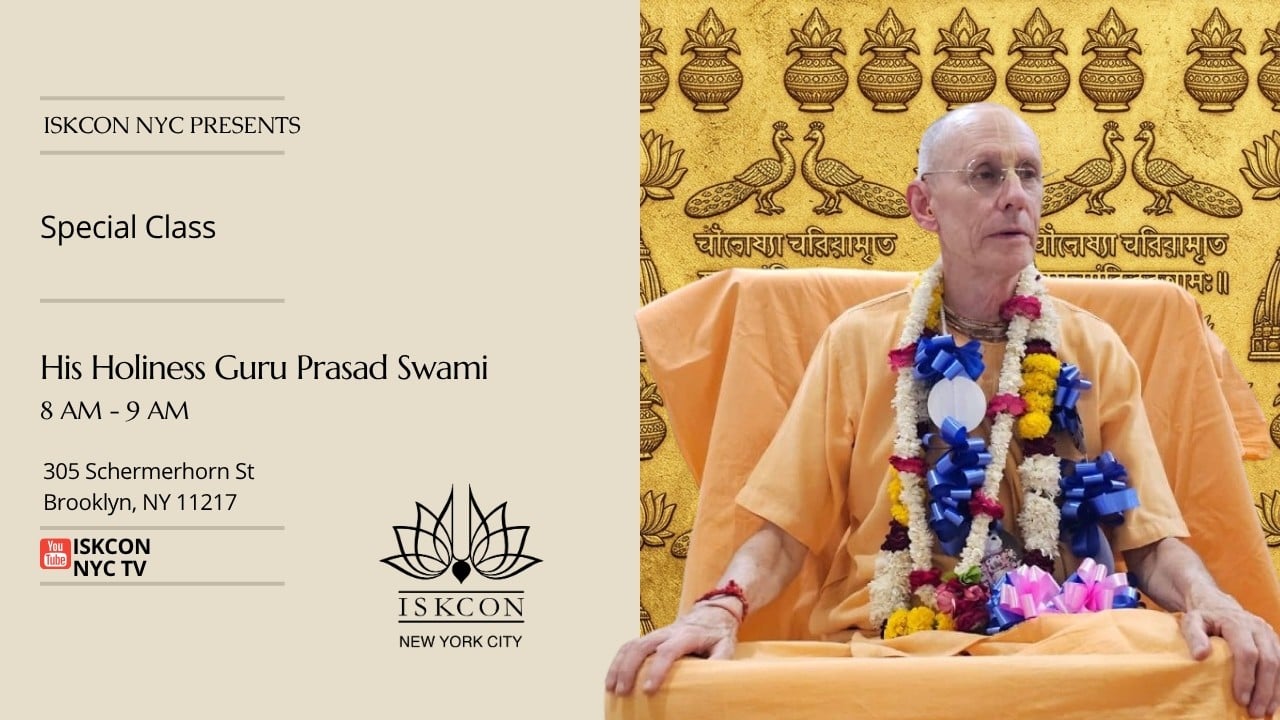
The Special Class featuring HH Guru Prasad Swami on ISKCON NYC TV offers a rigorous, text-centered exploration of bhakti as a living, verifiable science of consciousness and ethics. Presented through a Gaudiya Vaishnava lens and grounded in Sanatan Dharma, the teaching clarifies how devotion integrates knowledge, discipline, and social responsibility without sacrificing intellectual depth. The class situates personal transformation within a tradition that has long harmonized reason, revelation, and practice, making it immediately relevant for contemporary seekers across the dharmic family of Hinduism, Buddhism, Jainism, and Sikhism.
Set within the pedagogical ethos of ISKCON, the presentation aligns scriptural study with experiential verification. Foundational texts such as the Bhagavad Gita and Srimad Bhagavatham are treated not only as repositories of metaphysical insight but also as manuals for ethical decision-making, attention training, and sustainable well-being. The result is a method that respects the Guru-Shishya Tradition while speaking in the language of modern life, thereby ensuring accessibility without loss of rigor.
A central framework repeatedly emphasized is the sambandha–abhidheya–prayojana triad. Sambandha defines ontological relationshipsself, world, and the Divineclarifying identity and purpose. Abhidheya prescribes the path of practice (sadhana), especially hearing (sravana), chanting (kirtana), remembrance (smarana), service (seva), and regulated conduct. Prayojana articulates the telos of spiritual life: a state of nonsectarian love and fearlessness that naturally manifests compassion, integrity, and responsibility.
Within the Bhagavad Gita’s architecture, the class shows how karma-yoga, jnana-yoga, and bhakti-yoga are not mutually exclusive silos but progressively integrative disciplines. Karma-yoga purifies intention through selfless service; jnana-yoga sharpens discernment about the nature of self and reality; bhakti-yoga completes the journey by transforming knowledge and action into loving service. This synthesis reflects the Hindu way of life, wherein philosophy, ritual, and ethics converge to cultivate steadiness of mind and clarity of purpose.
Drawing on Srimad Bhagavatham, the instruction foregrounds bhakti as the parama-dharma that is causeless (ahaituki) and unimpeded (apratihata) when practiced with sincerity. The nine processes of devotion are presented as a flexible methodological suite: each limb can be primary or supportive depending on individual proclivity and life stage. Such adaptability underscores that spiritual pedagogy in the Bhakti Tradition is dynamic, person-centered, and outcome-focused.
Yoga in Hinduism is framed as a broad civilizational science in which asana and pranayama refine the physiological substratum for deeper contemplative work. Yet the class remains clear that attention (ekagrata), intentional sound (nama-japa and kirtan), and virtuous conduct are indispensable for lasting transformation. This is not a rejection of bodily disciplines but a hierarchical ordering: stabilize the body and breath, refine the mind through mantra, and align daily action with dharma to consolidate gains.
The Guru-Shishya Tradition emerges as a knowledge ecology rather than mere deference to authority. Parampara functions as a quality-control system for transmission: teachers preserve accurate meaning, model the discipline of practice, and mentor students through practical obstacles. Far from stifling inquiry, the lineage encourages critical examination within the guardrails of scriptural hermeneutics and ethical accountability.
Practical sadhana is outlined as a stable cycle of inputs and outcomes. Core inputs include daily sravana (systematic reading and listening), attentive nama-japa, congregational kirtan, clean diet and ethics (sattvic regulation), and seva. Outcomes to monitor include increased steadiness of mind, reduction in reactive patterns, deeper capacity for empathy, and a spontaneous inclination toward service. This process-based approach allows practitioners to self-audit progress without anxiety or performative comparisons.
Psychologically, the class highlights how rhythmic mantra recitation and breath awareness nudge the nervous system toward parasympathetic balance, aiding emotional regulation and cognitive clarity. Contemporary research on attention training and prosocial behavior is consistent with these claims, though the tradition emphasizes that spiritual intention (bhava) is the real catalyst that converts technique into transformation.
Ethics is presented as the lived grammar of realization. Ahimsa (non-violence), satya (truthfulness), and aparigraha (non-hoarding) are not abstract ideals but operational constraints that protect the gains of contemplative work. The Gita’s nishkama-karma furnishes a robust decision rule: act skillfully, accept results with equipoise, and return the fruits to the common good. In this way, inner freedom fertilizes social responsibility.
The Special Class repeatedly affirms unity across dharmic traditions. Buddhist karuna and mindful attention, Jain ahimsa and aparigraha, and Sikh seva and Naam-centered remembrance resonate with bhakti’s emphasis on compassionate service and divine remembrance. Rather than flattening differences, this approach honors distinctive practices while anchoring them in a shared aspiration for liberation, dignity, and harmonyan embodiment of Vasudhaiva Kutumbakam and unity in spiritual diversity.
Scriptural study is framed as disciplined inquiry. Texts yield their meaning through context, commentary, and community (sadhu-sanga). The method discourages proof-texting and encourages triangulation: cross-referencing passages, consulting acharyas, and testing insights in daily life. Such triangulation reduces bias, sharpens comprehension, and protects against ideological drift.
Common obstaclesdistraction, guilt about inconsistency, and mechanical repetitionare addressed with pragmatic counsel. Distraction is met with gentle redirection and improved routines; guilt is replaced by responsibility and renewed effort; mechanical repetition is countered by cultivating gratitude, meditating on meaning, and serving in community to reignite purpose. Progress is non-linear, but sincerity and steadiness compound.
Congregational kirtan is highlighted for its collective amplifying effect. Synchronized sound, shared intention, and ethical camaraderie foster resilience and belonging, qualities that are indispensable in an age of isolation and information overload. The Hare Krishna maha-mantra is presented as a precise phonetic and semantic technology for remembering the Divine, accessible regardless of background or prior training.
Time and sacred rhythmsEkadashi observances, festival days, and morning practicesfunction as architecture for attention. Aligning with these rhythms lightens cognitive load, creating predictable windows for study, practice, and service. Such temporal design transforms aspiration into reliable habit, safeguarding momentum through life’s fluctuations.
For students, professionals, and family caregivers alike, the pedagogy is eminently adaptable. Short, high-quality practice windows, strategic digital hygiene, and micro-acts of seva make sadhana realistic amid demanding schedules. Over time, these modest commitments accumulate into a durable disposition of clarity, compassion, and courage.
Socially, the class locates spiritual life within lokasangrahathe Gita’s vision of upholding the world. Service is not an afterthought but a test of realization: how one speaks, spends, eats, works, and votes becomes a field for dharma. This outward expression naturally converges with Sikh seva, Jain environmental care rooted in non-violence, and Buddhist compassion in action, demonstrating how inner practice reforms public life.
Philosophically, the teaching preserves the distinctives of Vedic philosophy while welcoming dialogue. Differences in metaphysical vocabulary need not obstruct shared action for the common good. Where traditions overlapethical commitments, contemplative methods, community servicecooperation becomes natural, and unity strengthens without erasing identity.
In sum, the Special Class by HH Guru Prasad Swami advances a robust, evidence-sensitive vision of bhakti that is intellectually serious, ethically demanding, and emotionally nourishing. It honors the Guru-Shishya Tradition, draws from the Bhagavad Gita and Srimad Bhagavatham, and invites learners from all dharmic paths into a shared project of inner refinement and outer service. The measure of success is not argument won but hearts steadied, communities healed, and a civilization reoriented toward wisdom and compassion.
Inspired by this post on Dandavats.
