Goddess Kaveri, also known as Cauvery and affectionately remembered as Ponni in Tamil country, stands in South Asian sacred geography as a living river and a compassionate mother. In Hindu tradition she is described as the daughter of Sage Kavera and the consort of the revered sage Agastya, yet her presence extends beyond genealogy into a continuous, life-giving flow from the Brahmagiri hills to the Bay of Bengal. Sculptures, bronzes, inscriptions, and temple rites together form a coherent visual and ritual grammar that crystallizes her status as both a divine person and a perennial tirtha, a crossing to auspiciousness and merit.
Textual memories of Kaveri cluster in regional mahatmyas and pan-Indic sources. The Skanda Purana preserves a Kaveri Mahatmya that extols her sanctity, associating her compassion with the welfare of beings across yugas. Local sthala-puranas and festival manuals in Karnataka and Tamil Nadu situate her as a protective mother whose descent is meant to nourish agriculture, purify communities, and anchor temple life. Within this textual field, the sculptural image of Kaveri functions as scripture in stone, a didactic and devotional presence that guides pilgrims and residents alike.
Geographically, Kaveri rises at Talakaveri in Kodagu, traverses Karnataka through Srirangapatna and Shivanasamudra, and diffuses into a temple-studded delta in Tamil Nadu before meeting the ocean near Poompuhar. Art along this course registers her personality: the stately dignity of stone in Chola heartlands, the lyrical delicacy of Hoysala soapstone in Karnataka, and the public monumentalism of coastal shrines that greet the sea. The river’s hydrology and the region’s agrarian cycles thus inform stylistic choices and ritual calendars, making sacred geography a practical key to reading her images.
Multiple narrative strands shape her persona. One well-known account recounts Kaveri dwelling in Agastya’s kamandalu, later to flow freely for the good of the world; another remembers Ganesha appearing as a bird to tip the vessel, releasing the river at Talakaveri. In Tamil traditions, Kaveri petitions for the honor of embracing Sri Ranganatha at Srirangam, thereby securing an abiding ritual bond between the deity, the island temple, and the river that encircles it. These stories, echoed in festivals and liturgy, determine the iconographic choices artisans make when they render the goddess in stone and metal.
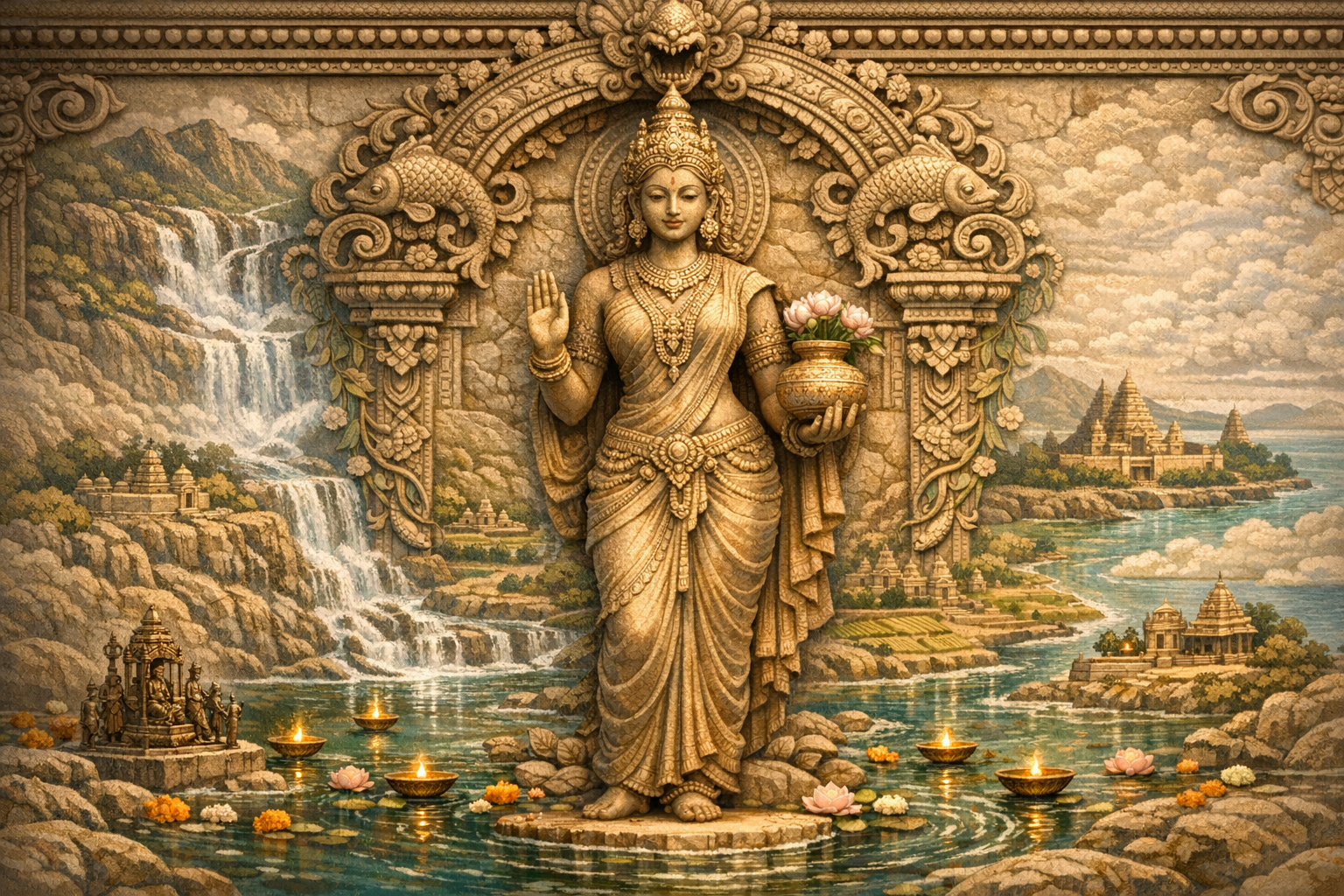
Shilpa Shastra treatises provide the technical vocabulary for Kaveri’s representation. Across regional manuals, river goddesses are prescribed in graceful stances such as samabhanga or tribhanga, with soft modeling that suggests fluidity. Ornamentation tends to favor aquatic idioms: kirtimukha and makara toranas, undulating foliage, and fish motifs along friezes. The face is composed in saumya bhava, a gentle, protective mood; the hair often rises in a karanda-mukuta; and bodily measurements follow tala and hasta norms that ensure rhythmic proportion and visual flow consistent with a river deity.
Attributes commonly associated with river goddesses help identify Kaveri in situ. A kumbha or water pot in hand signifies abundance and the inexhaustible source; lotuses may appear as held attributes or as basal motifs beneath the feet. Attendants and aquatic creatures accompany her in pilaster niches, while the makara, the mythic aquatic hybrid, can serve as a framing emblem above or below the figure. Jewelry is rich yet not heavy, echoing the Shilpa ideal of flowing ornament that never stiffens the body’s lyrical line.
Placement within temple architecture is a decisive clue. In Dravidian Temple Architecture, river goddesses often appear as parsvadevatas in niches along the prakara or on doorjambs that mark liminal thresholds, where water’s purificatory symbolism is most apt. In the Kaveri basin, Kaveri Amman images and sanctums occur in shrines closely tied to the river’s course and confluences, complementing the more pan-Indic pairing of Ganga and Yamuna that frequently flank sanctum doorframes in both northern and southern temples.
Chola Dynasty sculpture in the Kaveri delta, especially from the tenth to twelfth centuries, emphasizes poised elegance, refined surface finish, and economical but potent attributes. Female divinities are modeled with subtle torsion and diaphanous drapery carved as fine ridges, an artistic decision that suits the watery identity of Kaveri. At sites such as Thanjavur, Darasuram, and Gangaikondacholapuram, aquatic motifs and inscriptional references to riverine abundance allow a careful viewer to correlate sculptural programs with the region’s dependence on Kaveri’s sediment-rich floods.
Hoysala sculpture in Karnataka, working primarily in chloritic schist, brings a filigreed precision to aquatic and vegetal ornament. Makara arches, bead chains, and pendant lotuses cascade with a jeweler’s intricacy over brackets and doorframes. In temples where Kaveri’s sacred status permeates local worship, this ornamental language complements depictions of the goddess as a benign, ever-flowing presence who binds communities through ritual bathing, vows, and seasonal thanksgiving.
Metal images expand the language of stone. Panchaloha bronzes of Kaveri Amman, employed in the movable economy of processions, allow the goddess to circulate beyond the sanctum to riverbanks and embankments. The smooth sheen of metal captures the glint of water and the play of lamplight during evening aratis, making the goddess’s identity as a river both visually immediate and ritually accessible.
Ritual life along the river is inseparable from her image. Aadi Perukku in Tamil Nadu celebrates the river’s swelling bounty; offerings of flowers, lamps, and cooked rice are made along the ghats, and families invoke Kaveri as a guardian of fertility, livelihood, and harmony. In Kodagu, the autumnal observance of Kaveri Sankramana commemorates her sacred rise with domestic worship and community rites. During Pushkaram cycles and temple Theerthavari days, the sculpture becomes a focal point for collective memory, linking the murti inside to the living waters outside.
Srirangam exemplifies the theological depth of this bond. Local narratives affirm that Kaveri won the boon to embrace Sri Ranganatha, and temple ritual responds by integrating river worship into the liturgical year. The island geography, formed by the bifurcation of Kaveri and Kollidam, gives sacred geography an architectural body; processional routes, ceremonial river entries, and inscriptions together affirm the river’s maternal custody of the deity and the community.
Sites where Kaveri’s idol or presence is particularly explicit include Talakaveri in Kodagu, with shrines to Kaveramma, Agastyeshwara, and Ganapati; the Kaveri Amman traditions of the coastal Poompuhar region; and numerous Kaveri-side temples in Mayiladuthurai, Kumbakonam, and Thiruvaiyaru. At Bhavani Kooduthurai, where Kaveri meets Bhavani and Amaravathi, sacred confluence festivals highlight the river’s syncretic role as a federator of local deities and communities. In each setting, sculpture, ritual, and hydrology triangulate to make divine presence tangible.
Across Dharmic traditions, veneration of sacred waters offers a unifying ethic. Hindu iconography personifies rivers like Kaveri as compassionate mothers; Buddhist art and ritual often invoke naga and water symbolism to signify protection and purification; Jain literature uses the term tirtha as a ford, metaphoric and real, guiding ethical crossing; and Sikh practice centers around sarovars associated with remembrance and equality. This shared water reverence strengthens inter-traditional solidarity and inspires collaborative stewardship of rivers as living heritage.
A technical reading of Kaveri’s image benefits from attention to three planes: form, placement, and context. Form asks what attributes and ornaments are present and how they cohere to an aquatic identity; placement asks where within Temple Architecture the image appears and how thresholds or processional pathways amplify meaning; context asks which rituals, inscriptions, and local festivals activate the idol’s presence in lived time. When these planes align, the viewer can distinguish Kaveri from other river goddesses with confidence.
Several iconographic signatures recur. The kumbha is almost always auspicious and inexhaustible; lotus motifs link the goddess to purity and generative power; makara frames signal the river’s liminality and strength. Gentle mudras such as abhaya and varada articulate protection and giving, consistent with Kaveri’s role in agriculture, health, and social continuity. When the sculpture presides over seasonal rites like Aadi Perukku or appears in festival bronzes during Theerthavari, the image assumes a civic function as well as a devotional one.
Inscriptions from the Chola and post-Chola periods reinforce this reading by documenting endowments for lamps, embankment repairs, and irrigation maintenance linked to Kaveri’s bounty. The practical attention to canals, sluices, and tank desiltation underscores a theological point etched in stone and ritual alike: worship of the river goddess entails responsibility for the river. Conservation thus becomes sadhana, a disciplined offering.
Preserving Kaveri’s sacred art today calls for collaboration across scholars, temple communities, and environmental practitioners. Documentation of sculptures and doorframe river pairs, careful reading of local sthala-puranas, and support for intangible heritage like festival songs and women’s domestic rites together sustain the cultural ecosystem. Equally vital is ecological restoration that treats the river as a living deity, aligning Dharmic reverence with contemporary science for water quality, biodiversity, and climate resilience.
In sum, the idol form of Goddess Kaveri in Hindu sculptures is a refined confluence of Shilpa Shastra canons, regional styles, ritual calendars, and sacred geography. Whether encountered as a stone figure under a makara-torana, a bronze during riverside procession, or a sanctum image venerated by families in Aadi, the icon communicates a single message in many dialects of form: the river is mother, the mother is refuge. That message, shared across Dharmic traditions in kindred ways, invites both devotion and stewardship as inseparable acts of cultural and spiritual continuity.
Inspired by this post on Hindu Blog.