On the first Friday following the Madhya Pradesh High Court’s recent directives concerning the Bhojshala complex in Dhar, the precinct hosted uninterrupted Hindu worship throughout the day. Local reports indicated that the customary congregational Friday namaz did not take place at the monument on that date, with authorities facilitating alternative arrangements to preserve public order during a sensitive transition.
Public discourse framed the moment as historically unprecedented, often summarized as “the first Friday in 700 years” without Friday namaz at the site. While the phrase conveys the depth of perceived change, rigorous chronological verification across medieval and early modern centuries remains complex; it is therefore prudent to treat the figure as a symbolic approximation rather than a definitive metric.
Beyond headlines, the development carries layered implications for heritage governance, interfaith relations, and civic peace. For many families across dharmic traditions, spaces associated with Saraswati are living reminders of shared civilizational commitments to learningreflected in ideals such as jnana in Hindu thought, prajna in Buddhist discourse, anekantavada in Jain philosophy, and the Sikh ethic of sarbat da bhala.
For much of the past two decades, site management sought a precarious balance: supervised Hindu access on specified daysmost prominently Tuesdaysand congregational Muslim prayers on Fridays, alongside Archaeological Survey of India (ASI) conservation responsibilities. The High Court’s verdict reconfigures that balance, at least in the interim, and has prompted tighter protocols at a monument that is both sacred and archaeologically sensitive.
Historically, Bhojshala is widely associated with the Paramara ruler Raja Bhoja (c. 11th century CE) and with a scholastic and devotional milieu centered on the veneration of Mata Saraswati. Epigraphic references and stylistic features signal an early medieval intellectual hub in Malwa, aligning with broader patterns of temple-based learning in western and central India.
Architecturally and epigraphically, the precinct is a palimpsest. Scholars note Paramara-era stonework with Sanskrit inscriptions, subsequent Indo-Islamic construction phases linked in public discourse to the Kamal Maula complex, and colonial as well as postcolonial interventions. Such multi-layering requires conservation methods that protect fabric from all periods while permitting dignified devotional use.
In this context, the Madhya Pradesh High Court’s directives have functioned as a legal inflection point. Although the order’s full operational contours will be understood over time, the first Friday that followed saw continuous Hindu worship under close supervision. Authorities emphasized adherence to law-and-order guidelines and ASI norms while redirecting Friday congregational prayers to ensure a peaceful environment.
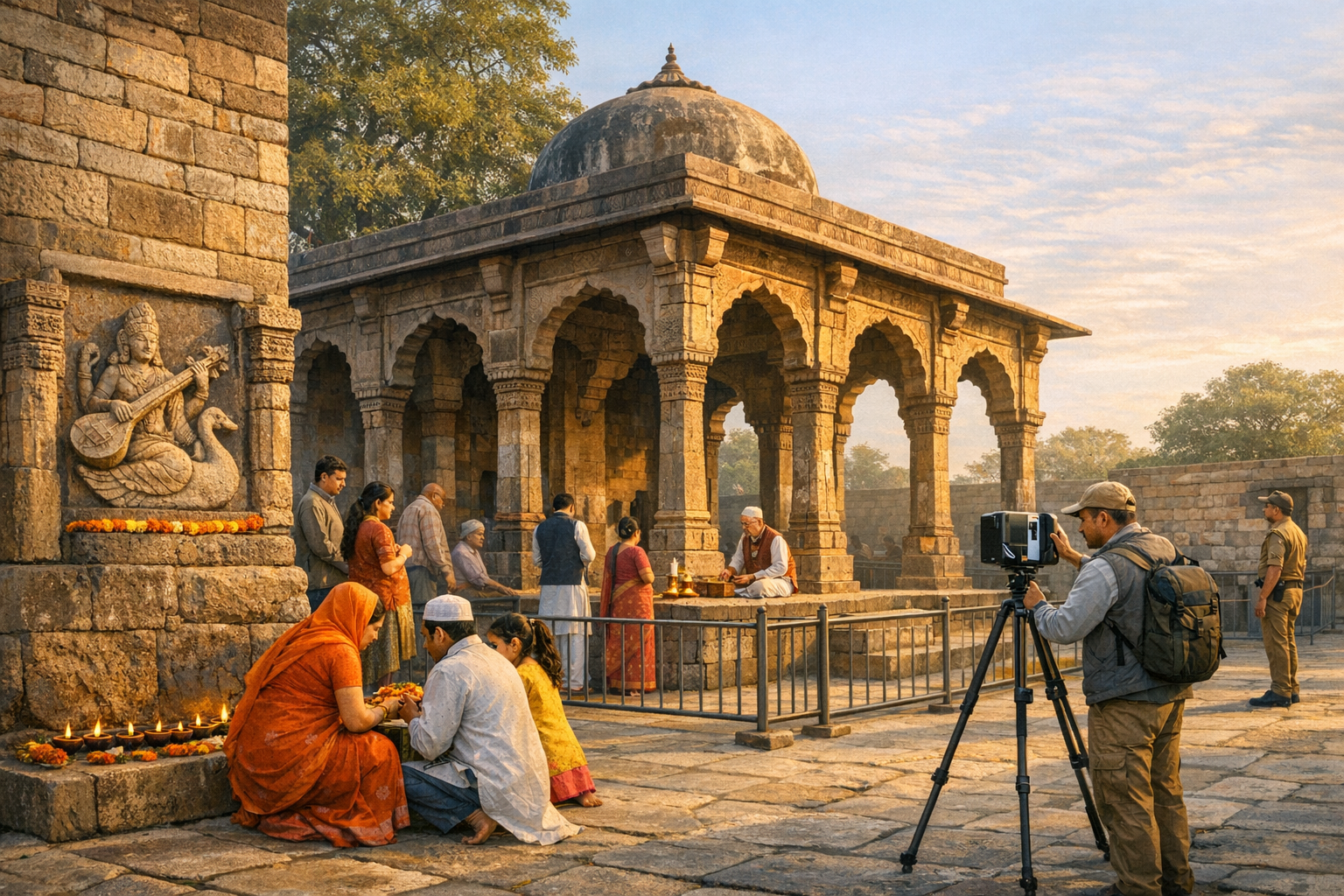
Accounts from devotees describe a day marked by solemnity rather than triumphalismlong queues, soft recitation of Saraswati invocations, and a palpable awareness that heritage and harmony must travel together. Many residents emphasized civility, noting that respectful conduct at sacred sites is itself an offering.
Equally important is the recognition that Muslim communities in Dhar maintain deep historical connections to the precinct’s later layers. A forward-looking approachrooted in constitutional guarantees of religious freedom, the dharmic ethic of non-harm, and a commitment to dialoguecan safeguard dignity for all while placing conservation and scholarship at the center.
Technically, a best-practice path includes non-invasive documentation (3D photogrammetry, laser scanning, and, where appropriate, ground-penetrating radar), high-resolution epigraphic photography, petrographic and condition assessments for stone members, and digital archiving. Publishing a transparent, peer-reviewable site dossier would align with ASI protocols and international conservation standards tailored to India’s legal and cultural context.
From a site-operations standpoint, measures such as calibrated visitor caps, segmented circulation paths, protective barriers around vulnerable carvings, multilingual interpretive signage that explains the site’s multi-century layering, and time-segmentation where required can reduce friction while enhancing both safety and sanctity.
Administratively, a multi-stakeholder liaison groupcomprising ASI officials, local representatives of Hindu and Muslim communities, district administration, heritage scholars, and law-enforcement observerscan function as a conflict-prevention and confidence-building platform. Clear standard operating procedures, grievance redressal windows, and real-time coordination on major observances (e.g., Vasant Panchami or large Friday gatherings) can pre-empt flashpoints.
Given the propensity for rumor in high-sensitivity settings, authoritative public communication is essential. Periodic ASI and district bulletins, proactive myth-busting, and open-data publication of non-invasive survey outputs can anchor discussion in verifiable facts rather than conjecture.
Ultimately, the test for any verdict or protocol at Bhojshala is twofold: Does it advance conservation and verifiable knowledge, and does it deepen the culture of mutual respect? Meeting both tests is possible when communities and institutions act with empathy, restraint, and fidelity to law.
The first Friday after the High Court’s order will be remembered as a turning point, not only for uninterrupted Hindu worship but for the collective responsibility it places on society. A measured pathhonoring faith, protecting heritage, and prioritizing harmonyoffers the most sustainable future for Bhojshala and for the broader ideal of unity-in-diversity that animates dharmic traditions.
Inspired by this post on Hindu Jagruti Samiti.