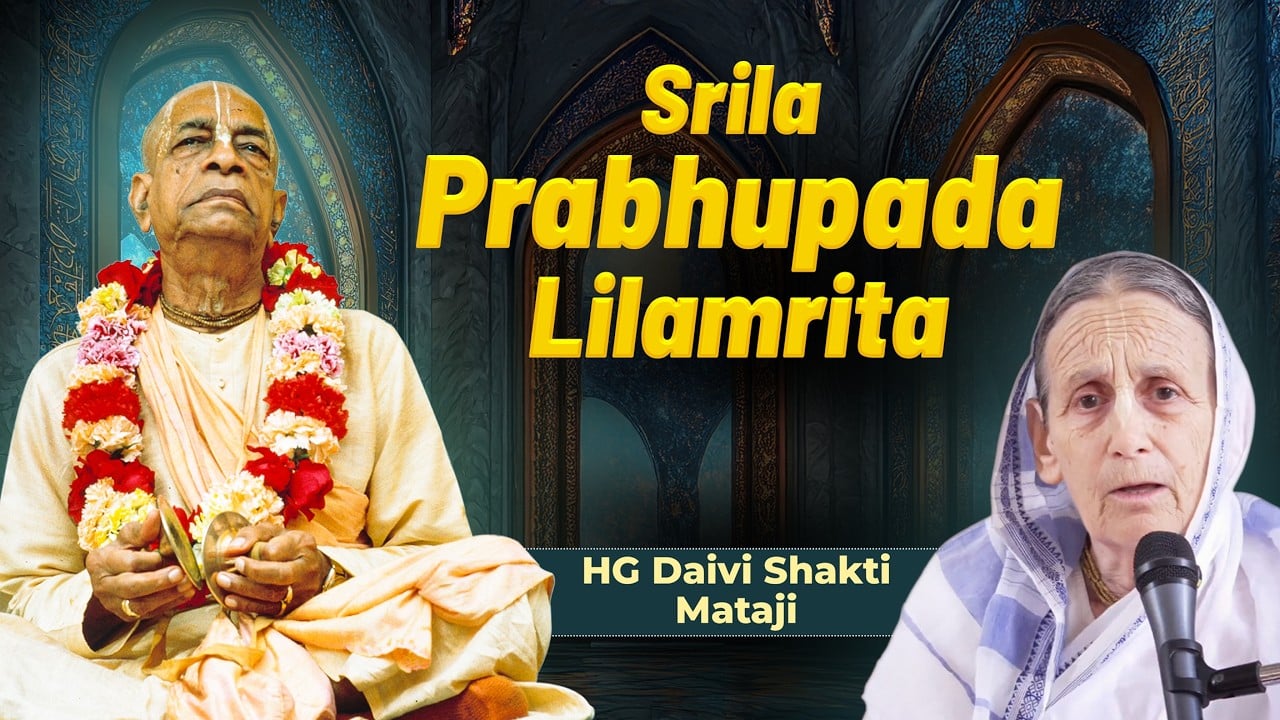
On 24.05.2026, a focused Vrindavan discourse centered on Srila Prabhupada Lilamrita highlighted how a rigorously compiled spiritual biography can function as both history and sadhana. Framed by the presence and reflections of HG Daivi Shakti Mataji, the session drew attention to the text’s distinctive blend of devotional inspiration and documentary precision, situating A. C. Bhaktivedanta Swami Prabhupada’s global mission within Gaudiya Vaishnava theology and the living heritage of ISKCON (International Society For Krishna Consciousness).
Srila Prabhupada Lilamritaoriginally authored in multiple volumes and later abridgedpresents a chronologically faithful account of Prabhupada’s life: formative years in Bengal, spiritual resolve under Srila Bhaktisiddhanta Sarasvati’s guidance, transoceanic voyage to the United States in 1965, the 1966 incorporation of ISKCON in New York, subsequent worldwide expansion of the Hare Krishna Movement, prolific translation and commentary on Bhagavad-gita and Srimad-Bhagavatam, and the Vrindavan years that framed his final pastimes. Published by the Bhaktivedanta Book Trust, the work balances narrative flow with extensive referential scaffolding.
From a historiographical perspective, the text integrates oral histories, letters, memoranda, contemporary media reports, temple records, and eyewitness accounts. This source-matrixcross-checked where possibleanchors the narrative in verifiable documentation while acknowledging the devotional register of Vaishnava remembrance (smarana). The method is neither purely positivist nor merely hagiographic; rather, it occupies a productive middle ground where evidence-based reconstruction and bhakti-centered meaning-making cohere.
Philosophically, the biography situates Prabhupada’s mission within the Gaudiya Vaishnava framework of acintya-bhedabheda (simultaneous oneness and difference), ascertained through the triadic epistemology of guru, sadhu, and shastra. This hermeneutic informs the editorial stance of “as-it-is” translationstriving for fidelity to Sanskrit and Bengali source-texts while prioritizing accessibility for modern readers. Readers encounter not only a human itinerary of perseverance and service, but also a doctrinal architecture: the ninefold processes of bhakti (navadha-bhakti), the discipline of sadhana-bhakti, and the ideal of guru-nistha (steadfastness toward the spiritual preceptor).
Within this structure, pivotal narrative arcs gain analytical depth. The Jaladuta crossing emerges as an inflection point where renunciate intent meets transnational modernity. The 1966 founding of ISKCON is examined as a novel synthesis of traditional monastic discipline and institutional outreach suited to an urban, post-industrial milieu. Book publication becomes both theological expression and infrastructural strategydisseminating Shastra while building a durable, self-replicating educational ecosystem through Bhaktivedanta Book Trust.
Vrindavan’s role in the biography is central and not merely geographic. The setting functions as a spiritual index for the entire narrative: a locus of Rasika remembrance, a living archive of Gaudiya memory, and an ethical horizon for service (seva). The Krishna-Balaram Mandir exemplifies how sacred geography can be translated into institutional formliturgical cycles, prasadam distribution, scriptural classes, and kirtanwithout diluting the contemplative intensity of the dham. In this light, Lilamrita is not only about reaching the world from Vrindavan but about returning the world to Vrindavan’s ethos.
HG Daivi Shakti Mataji’s role in such presentations is instructive for pedagogy. By foregrounding the interplay between text and lived practice, she highlights how biography cultivates virtues indispensable to bhakti-yoga: resilience under austerity, clarity of purpose (nishta), compassion expressed through preaching and service, and scriptural literacy that resists both sentimental reductionism and sterile scholasticism. The emphasis falls on cultivating daily habitshearing (sravana), chanting (kirtana), remembrance (smarana), and service (seva)that mirror the biography’s internal cadence.
In academic terms, Srila Prabhupada Lilamrita offers a case study in modern religious movements that is directly relevant to scholars of Indian intellectual history, diaspora studies, sociology of religion, and transnational print culture. It documents how classical Vedic tradition translates into the contemporary public spherethrough temple networks, literature distribution, festivals such as Ratha-yatra, and digital mediawhile preserving doctrinal continuity with Vaishnava saints and the guru-shishya tradition.
Importantly, the narrative resonates with a broader dharmic ethos that encourages unity in diversity. The values emphasizedahimsa, compassion, self-discipline, interiority, service to society, and reverence for sacred knowledgefind parallels across Hinduism, Buddhism, Jainism, and Sikhism. Without collapsing distinctions, such readings encourage mutual recognition: mantra-japa finds kinship with Sikh simran; Vaishnava seva aligns with Sikh seva; the ethical rigor of Jain and Buddhist traditions echoes the Vaishnava stress on self-restraint and mindfulness. This convergence affirms Vasudhaiva Kutumbakam while honoring each path’s integrity.
Methodologically, Lilamrita models how primary sources can be integrated with theological interpretation without instrumentalizing either. The text’s editorial transparencycitations, context-setting, and acknowledgment of oral testimonyinvites readers to evaluate claims while engaging the transformative aims of bhakti. Such balance is particularly valuable for classrooms, study circles, and interfaith dialogues that seek responsible, text-centered understanding of the Hare Krishna Movement.
For practitioners, a structured approach enhances uptake: pair chapters of Srila Prabhupada Lilamrita with selected readings from Bhagavad-gita and Srimad-Bhagavatam; conclude with reflective prompts that connect narrative episodes to daily sadhana. For researchers, map key events against archival materials (where available) and trace how doctrinal commitments shaped organizational choices. For community leaders, draw operational lessons from Prabhupada’s publishing-first strategy, emphasis on congregational kirtan, and insistence on accessible education in Vedic tradition.
Taken together, the Vrindavan session underscores a simple but generative insight: biography, when carefully sourced and theologically situated, can serve as an instrument of personal transformation and civilizational continuity. Srila Prabhupada Lilamrita invites readers to see history as a practicean opportunity to align knowledge, devotion, and servicewhile nurturing dharmic unity across traditions. In that spirit, the text remains a vital bridge between the sanctity of Vrindavan and the complexities of the contemporary world.
Inspired by this post on Dandavats.