Across the 1970s, as the Intelligent Design (ID) discussion slowly emerged in Western philosophy of science, a parallel set of reflections developed among scientists influenced by Vedic philosophy. Guided by A.C. Bhaktivedanta Swami (1896–1977), a vocal critic of strictly materialistic reductions of life and consciousness, this cohort organized inquiry through the Bhaktivedanta Institute (BI), founded in 1973. Their central question remains relevant: can contemporary science, operating under methodological naturalism, also accommodate deeper metaphysical explanations consistent with Vedic philosophy and harmonious with the wider dharmic family of Hinduism, Buddhism, Jainism, and Sikhism?
The Bhaktivedanta Institute drew researchers such as the chemist Dr. Thoudam Damodara Singh (Bhaktisvarupa Damodara Swami) and the mathematician Dr. Richard L. Thompson (Sadaputa Dasa), who sought to interrogate the explanatory reach of Darwinism and allied materialist frameworks. In 1976, amid new biophysical characterizations of bacterial motility, Thompson offered a concise summary of the intuitive appeal of design reasoning: “We’d like to argue that the chance and molecular forces theory won’t explain things like this, but to say that there is an intelligent designer would be a sensible explanation.” While brief, that statement captured a major thrust of BI’s workprobing whether empirical findings can be interpreted within a Vedic framework that emphasizes intelligible order, purpose, and consciousness alongside efficient material causes.
The bacterial flagellummore precisely, its rotary motor in bacteria such as Escherichia coli and Salmonellaprovided a compelling case study for this dialogue. By the mid-1970s, careful experiments had clarified that bacterial motility involved a nanoscale rotor–stator assembly driven by a proton-motive force (or, in certain marine species, a sodium gradient). Contemporary structural biology continues to resolve subunits such as the rotor ring (MS ring), the switch complex (C ring, with FliG, FliM, and FliN), and stator complexes (for example, MotA/MotB in proton-driven systems), as well as the export apparatus and hook–filament modules that transmit torque to generate propulsion. The motor can reverse direction rapidly, achieve rotation rates of several hundred revolutions per second, and deliver torques on the order of 10^3 pN·nm, all coordinated by regulatory networks that respond to chemotactic signals.
Within ID discourse, this integrated nanomachine has been used to illustrate the concept of irreducible complexity, suggesting that many core parts must co-occur for function, and thus are unlikely to have arisen solely via incremental selection on partial intermediates. A related design claim posits specified complexity: patterns that are both highly improbable under chance and independently specified by functional constraints may signal design. In this reading, the flagellar system appears as a tightly coupled information-rich assembly whose origin calls for more than undirected processes.
Evolutionary biology, by contrast, has developed a growing suite of models for stepwise and modular assembly via mutation, selection, and exaptation. Homologies between components of the flagellar basal body and the Type III secretion system (T3SS) have been proposed, with debates over directionality and shared ancestry. Comparative genomics reveals lineage-specific variations, accessory proteins, and multiple motility solutions across lifesuch as the archaellum in Archaea and type IV pili-based twitching motilityindicating that molecular machines can diversify under evolutionary pressures. High-resolution cryo-electron microscopy and tomography have mapped intermediate states, conformational changes, and dynamic remodeling, enriching accounts of how complex molecular assemblies can arise and adapt over deep time.
For a Vedic-informed philosophy of science, these two narratives need not be treated as mutually exclusive antagonists. Vedic thought commonly employs a multi-level causal language that includes not only material and efficient causes (upādāna and nimitta kāraṇa) but also form and purpose, framed through concepts such as ṛta (cosmic order), dharma (sustaining principles), and citi-śakti (conscious potency). In such a schema, evolutionary mechanisms can still operate robustly within a wider intelligible order. The question then shifts from a binary choicedesign versus evolutionto an inquiry into how different layers of causation interlock: physicochemical regularities, stochastic exploration under selection, and the intelligibility or purposiveness of nature’s patterns.
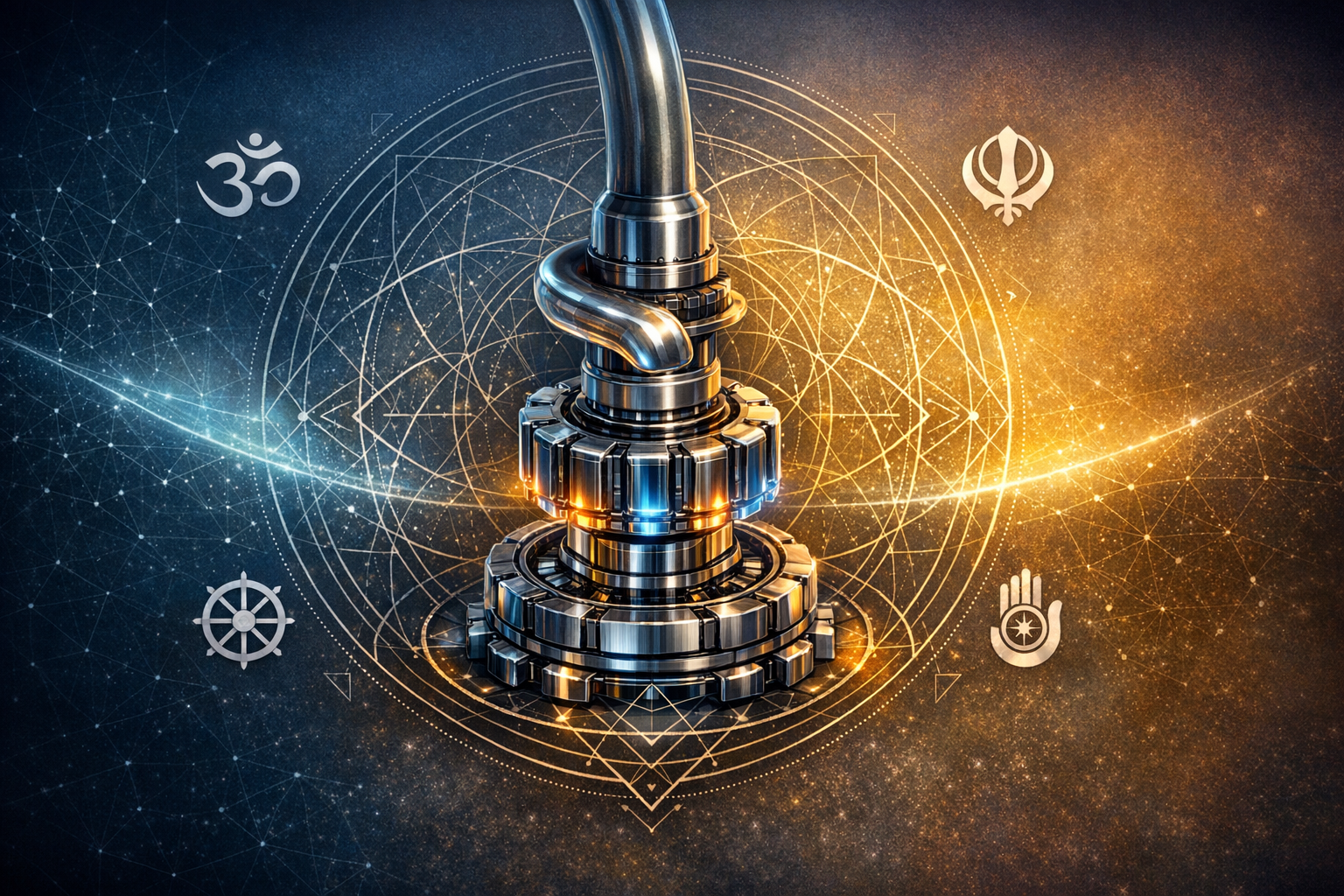
Crucially, this layered approach aligns with the unifying ethos of the dharmic traditions. Buddhism’s pratītya-samutpāda (dependent origination) offers a rigorous analysis of causal interdependence without requiring a personal designer, yet affirms an intelligible web of conditions. Jainism’s anekāntavāda (many-sidedness) encourages multi-perspectival analysis, allowing empirical, logical, and metaphysical standpoints to be valid within their domains. Sikh thought emphasizes hukam (Divine Order) as the pervading principle that grounds cosmic lawfulness. Within Hindu darśanas, Nyāya-Vaiśeṣika analyze causal categories with philosophical precision, Sāṅkhya explicates the interplay of puruṣa and prakṛti, and Vedānta explores the relation of Brahman to the world. Together, these traditions foster a respectful, integrative discourse in which scientific accounts are neither dismissed nor absolutized.
In that spirit, the Bhaktivedanta Institute’s research program explored how to reconcile scientific rigor with Vedic metaphysics and a broader philosophy of consciousness. BI convened dialogues and produced studies examining the limits of mechanistic explanation, the status of information in biology, and the role of observer and consciousness in scientific theorizing. Publications by affiliated scholarsas in discussions of mechanistic and nonmechanistic science, or reappraisals of Puranic cosmography in light of astronomysought to meet contemporary science on its own methodological terms while broadening the interpretive horizon.
Methodologically, one fruitful path has been to adopt explanatory pluralism. Biological phenomena often require multiple descriptive languages: molecular biochemistry for mechanisms, systems biology for network-level dynamics, ecology for population contexts, and information theory for functional constraints. Vedic categories can add a complementary metaphysical vocabulary for intelligibility and value, provided these are not substituted for empirical work but used to interpret its findings. This pluralism avoids a zero-sum contest and instead encourages consiliencebringing independent lines of evidence into a coherent picture.
The flagellum illustrates this pluralism in practice. At the mechanistic level, its torque generation, switching behavior, and assembly pathway are amenable to biophysical and genetic dissection. At the systems level, chemotactic signaling integrates environmental inputs and intracellular states. At the evolutionary level, gene duplication, divergence, horizontal transfer, and co-option plausibly contribute to innovation and complexity. At the metaphysical level, one may still ask whether the emergence of such ordered, information-bearing systems is best seen as an intelligible unfolding within a meaningful cosmos. Each layer can be respected without collapsing one into the other.
Origin-of-life (OOL) research further sharpens these questions. Prebiotic chemistry has demonstrated nucleotide, amino acid, and lipid synthesis under plausible geochemical conditions, while ribozyme engineering and protocell models reveal potential pathways toward heredity and compartmentalization. Yet persistent challenges remainrobust routes to homochirality, efficient information copying with fidelity, coupled energy transduction, and the coordinated integration of metabolism and genetics. ID arguments sometimes treat these bottlenecks as potential design signatures; a Vedic lens can instead regard them as pointers to the depth of nature’s intelligibility, encouraging humility about current models while sustaining empirical investigation.
Importantly, a Vedic and dharmic synthesis neither displaces evolutionary science nor reduces metaphysics to a scientific hypothesis. Rather, it reframes inquiry around a hierarchy of explanations. Efficient and material causes explain how processes occur; formal and purposive accounts can elucidate why patterns and values matter. This echoes classical Indian epistemology (pramāṇa), where perception, inference, and testimony each contribute distinct but compatible knowledge. Such a framework supports a disciplined science that remains open to questions of meaning, value, and consciousness.
Ethically, this synthesis advances unity across the dharmic traditions and orients science toward service and stewardship. Ahimsa, seva, and dharma naturally align with conservation biology, planetary health, and responsible technology. Seeing life as intrinsically meaningfulwhether articulated via Brahman, hukam, the luminous mind, or jīvastrengthens commitments to dignity, compassion, and ecological responsibility without prescribing a single sectarian metaphysic.
Historically, the Bhaktivedanta Institute helped elevate this conversation by engaging mainstream scientists, convening symposia, and encouraging rigorous scholarship from within a Vedic worldview. Figures like Dr. Thoudam Damodara Singh and Dr. Richard L. Thompson exemplified a style of inquiry that took both empirical evidence and Vedic philosophy seriously, seeking bridges rather than battle lines. Their efforts resonate today as new toolscryo-electron microscopy, single-molecule biophysics, and large-scale comparative genomicscontinue to reveal the intricacy of living systems.
When read charitably and rigorously, the early BI reflections on the bacterial flagellum anticipated questions that remain vibrant: What is the most comprehensive explanatory framework for complex biological organization? How should science relate to metaphysics in a way that is both disciplined and humane? The resulting dialogue need not be a referendum on identity or exclusivity. It can, and should, be a collaborative, dharmic pursuit of knowledge that honors diverse paths while welcoming shared discoveries.
Thus, a modern Vedic approach to Intelligent Design invites a transdisciplinary ethos. It encourages biologists to press further into mechanisms, historians and philosophers of science to clarify assumptions, information theorists to refine measures of complexity and function, and scholars of the dharmic traditions to articulate how metaphysical insights bear on meaning and ethics. The aim is not victory in a culture war but the cultivation of wisdomknowledge that is true, integrative, and conducive to the flourishing of all beings.
In this integrative light, design can be understood not as a rival to evolution but as a contemplation of intelligibilityof why nature is amenable to mathematics, why life is so saturated with information, and why consciousness can know the world at all. A.C. Bhaktivedanta Swami’s initiative through the Bhaktivedanta Institute, and the subsequent reflections by scientists in that lineage, remain valuable precisely because they call for this wider horizon. The conversation they catalyzed continues to encourage unity across Hinduism, Buddhism, Jainism, and Sikhismaffirming that rigorous science and profound spirituality can mutually deepen, rather than diminish, each other.
Inspired by this post on Dandavats.