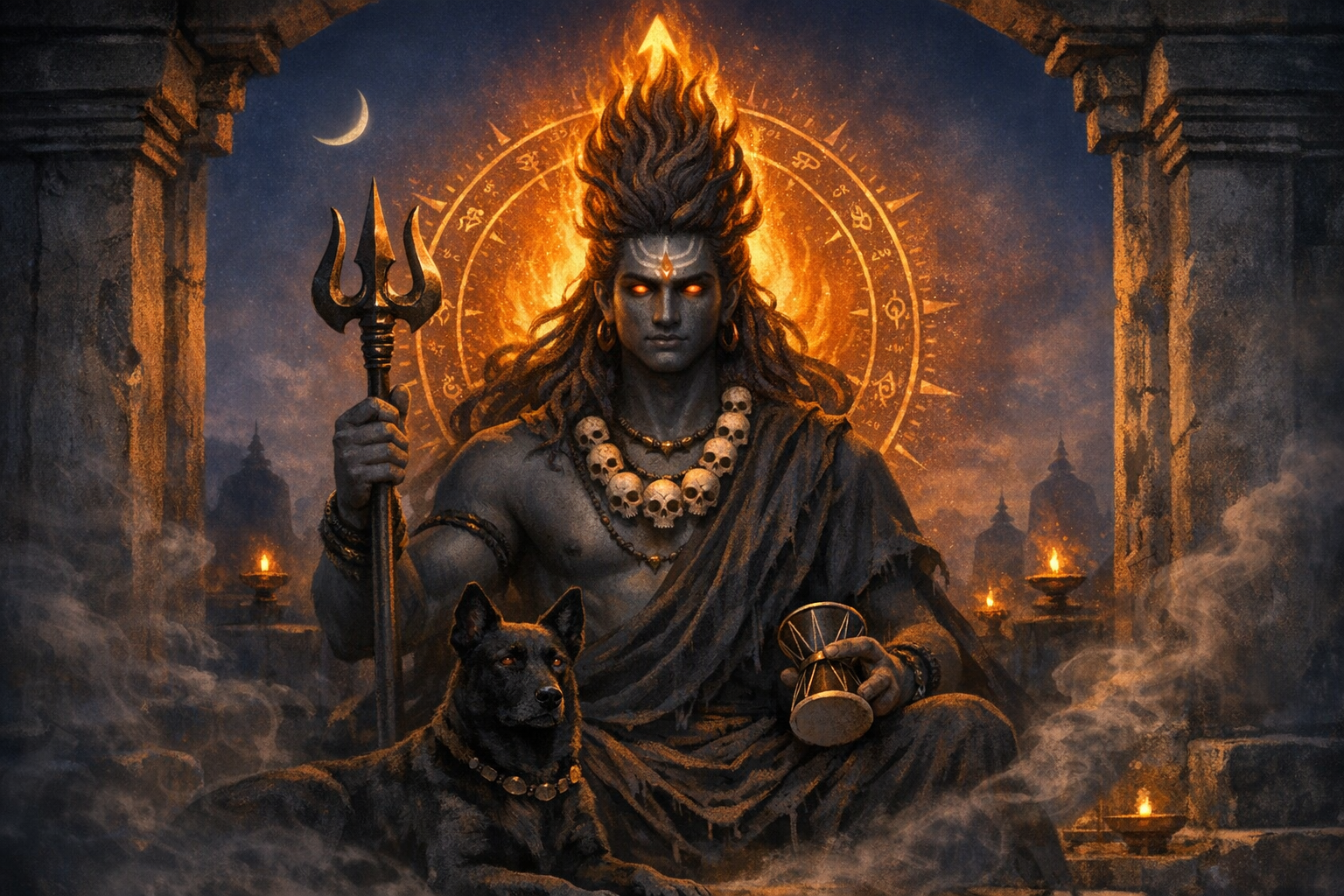
The wild, flame-like hair of Bhairava has long been read as a “matted flame”a visual paradox in which ascetic restraint and eruptive power converge. In the spectrum of Shiva’s fierce manifestations, Bhairava stands out by design: dark-skinned, semi-nude, garlanded with skulls, eyes incandescent with wrathful compassion, and crowned by an upward-surging mass of jata that resembles tongues of fire. This iconographic complexat once austere and incendiaryannounces a form that refuses to be domesticated by convention.
Classical Shaiva sourcesacross the Agamic, Tantric, and Purāṇic corporaconsistently emphasize Bhairava’s jata as a primary carrier of meaning rather than an aesthetic excess. The Skanda Purāṇa (Kāśī Khaṇḍa), which extols Kālabhairava as the guardian of the sacred city, provides the ritual and theological backdrop against which the icon’s upward-rising hair is understood: vigilance, time (kāla), and purificatory fire synthesized into a single, unsettling presence. In this reading, hair is not incidental; it is text.
Fire is the first key. Descriptions of Bhairava often employ imagery of jvalan (blazing) and tejas (radiance), mapping the jata to the flames of tapasthe disciplined heat generated by ascetic practice. Unlike the rhythmically flung locks of Naṭarāja, which frame the cosmic dance of creation and dissolution, Bhairava’s locks surge vertically and almost violently, signifying an intensified mode of saṁhāra (withdrawal) and a concentrated field of transformative heat. Where the dance diffuses, Bhairava condenses.
Time is the second key. As Kālabhairava, the Deity personifies the governance and limit of temporal process itself. The upward-thrusting hair reads as the arrow of time, a living aureole of inevitability in which the past combusts into presence. This is why traditions situate Bhairava at liminal thresholdscity gates, cremation grounds, the edges of orthodoxywhere time’s pressure is felt most acutely and ethical attention is demanded most urgently.
Transgression is the third key, but it is not lawlessness. The unbound hair, in Indic semiotics, indexes the ascetic refusal to submit to mere social groomingan outward sign of inward freedom. Within the Kapālika and Aghora lineages of Shaivism, the cremation-ground setting and the skull ornaments do not negate purity; they invert the terms of purity and pollution to recover a non-dual insight in which all phenomena are equally permeated by Śiva. Bhairava’s hair is thus an ethical pedagogy: it unsettles to awaken.
Yogic physiology offers a complementary lens. Traditional accounts describe the upward movement of prāṇa as udāna-vāyuthe vector of ascent associated with clarity, courage, and release. Interpreters in the tantric and yoga traditions often read Bhairava’s flame-like jata as the exteriorized sign of awakened inner fire (sometimes correlated to kuṇḍalinī) pressing toward the cranial aperture (brahmarandhra). This is a symbolic hermeneutic rather than an anatomical claim; it encodes interior yogic states in a language of visible form.
The hair also converses with the older Vedic and Purāṇic imagery of rivers and vitality coursing through the jata of Śiva. Where the tranquil bearing of Gaṅgā within Śiva’s matted locks signifies containment of cosmic forces, Bhairava’s hair is the same motif in a different register: not containment but ignition, not placid flow but combustive presence. The connotation shifts from management to enforcement, from benevolent shelter to searing clarity.
Iconographic manuals and regional sculptural idioms reinforce this code. Ashta Bhairava groupingstraditional lists often include Asitāṅga, Ruru, Chanda, Krodha, Unmatta, Kapāla, Bhīṣaṇa, and Saṁhāracommonly emphasize hair that rises, flares, or bristles, each nuance mapping to a directional guardianship, weapon, or rasa (aesthetic savor) of fierce protection. The dog as vāhana (vehicle) adds a further stratum: hair that stands on end in alertness, ready to guard the threshold of dharma.
This semiotics is not confined to textual exegesis; it is felt in practice. Pilgrims in Kāśī frequently report a visceral quiet in the sanctum of Kālabhairavaan atmosphere that “combs” the mind into alert stillness even as the Deity’s hair refuses to be combed. In South Indian temples where Bhairava (often as Vairavan) stands sentinel at outer precincts, the sculpted jata reads to devotees as a visual mantra: be wakeful, be clear, be unafraid.
A comparative dharmic lens amplifies the motif and its unifying potential. In Vajrayāna Buddhism, Mahākālaclosely related in function and aura to Bhairavais depicted with upward-leaping hair encircled by flames, embodying the jñānāgni (wisdom fire) that incinerates obscurations while safeguarding the path. Jain communities venerate protective deities such as Nakoda Bhairav, whose iconography and lore similarly underline vigilant guardianship at sacred thresholds. Sikh tradition venerates unshorn hair (kesh) as one of the Five Ks, a living vow (vrata) of alignment with hukam (divine order); here, too, hair signifies consecrated power and ethical presence. Across Hinduism, Buddhism, Jainism, and Sikhism, hair emerges as a shared sacred signan embodied vow, a discipline of energy, and a marker of spiritual attentiveness.
The psychological function of Bhairava’s untamed hair is as important as its theology. In aesthetic theory, the raudra rasa (fierce savor) provokes awe and salutary disquiet that can dislodge habitual clinging. When the hair in the icon shoots upward like a blaze, it externalizes that affect, directing it toward ethical clarity rather than spectacle. By design, it is the “shock that steadies.”
Ritual repertoires mirror these insights. On observances like Kālabhairava Aṣṭamī, devotees emphasize vows, vigilance, and accountability. Oil lamps with sharp, flame-shaped wicks, stern recitations of protective mantras, and circumambulation at liminal hours transpose the visual language of the icon into lived practice. The upward fire of the jata becomes the upward resolve of the devotee.
Ethically, Bhairava’s hair may be read as a critique of complacency. It refuses ornamental softness, insisting on the heat required to clarify intention, to protect what is sacred, and to cut through self-deception. In the idiom of kṣātra dharma (the ethic of protective courage) found across dharmic traditions, the ungovernable hair paradoxically teaches disciplined guardianship.
In urban and rural India alike, this teaching is not abstract. Temple courtyards recount stories of individuals who felt seen at life’s thresholdsmourning, transitioning, choosingunder the gaze of Kālabhairava’s red eyes and the furnace of his locks. The untamed jata meets untamed circumstance; the icon’s posture of watchfulness becomes a model for communal responsibility and personal integrity.
Taken together, the symbolism of Bhairava’s hair integrates multiple strata: Vedic-Purāṇic memory (the mastery of elemental forces), tantric yogic ascent (the disciplined rise of inner fire), aesthetic pedagogy (the fierce savor that steadies), civic protection (guardianship of thresholds), and inter-dharmic resonance (hair as consecrated vow across Hinduism, Buddhism, Jainism, and Sikhism). It is a compact theology in flame-form.
Thus the “matted flame” of Bhairava does not celebrate chaos; it sanctifies clarity. It visualizes the energy required to meet time fully, to cross thresholds wisely, and to live wakefully in a world that forever changes. In that rising blaze, devotees recognize both a warning and a benediction: do not sleep, and do not fear.
Inspired by this post on Hindu Blog.