
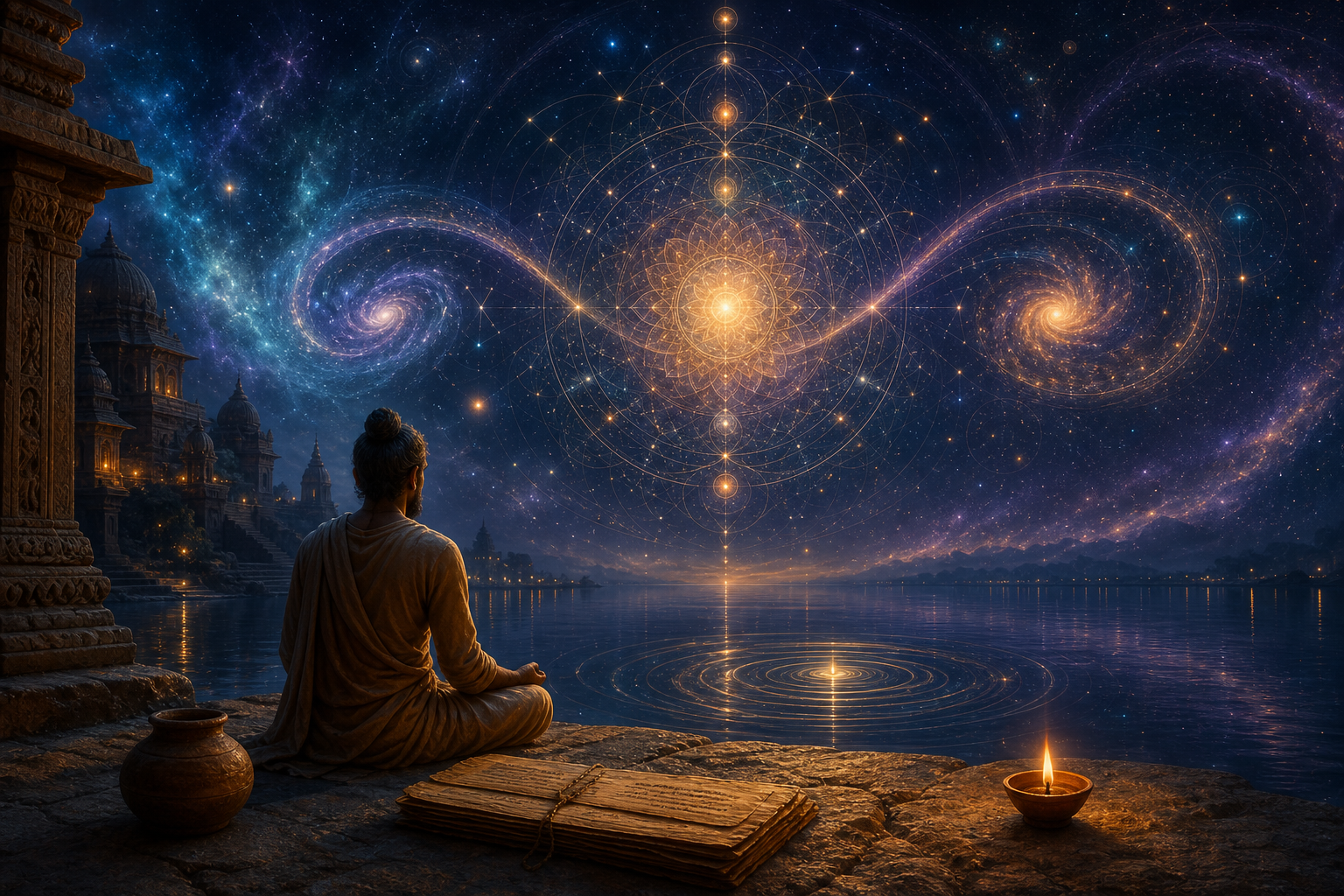
The question, “If everything has been created by God, then who created God?” is one of the most persistent doubts in spiritual inquiry. It appears simple, even childlike, yet it touches the deepest areas of Hindu philosophy, metaphysics, logic, and lived spirituality. The question assumes that everything must have a maker, and then applies that assumption to God. In dharmic thought, however, the matter is more subtle: the Divine is not treated as one more object inside the universe, waiting to be explained by another cause.
Sri Sri Ravishankar’s response to this doubt, as preserved in the source passage, begins by challenging the assumption behind the question: “Who told you that everything was created by God?” This is a significant move. Rather than entering a mechanical chain of creator, creator’s creator, and creator’s creator’s creator, the response asks the seeker to examine whether the very categories of creation and destruction are adequate for understanding ultimate reality. What is real at the highest level may not fit into the same causal framework used for pots, houses, bodies, stars, or biological life.
In ordinary experience, every manufactured thing appears to have a maker. A clay pot has a potter, a building has an architect, and a book has a composer. From this practical observation, the mind often concludes that the world too must have a maker in exactly the same way. The difficulty begins when the same logic is extended indefinitely. If God made the world, who made God? If another being made God, who made that being? This produces an infinite regress, where explanation is always postponed and never completed.
Dharmic philosophy resolves this by distinguishing between conditioned things and the unconditioned ground of existence. Conditioned things arise, change, decay, and disappear. They depend on time, space, material causes, and supporting conditions. The ultimate principle, whether called Brahman, Paramatma, Ishvara, Purusha, Shunya, Dharma, or by another philosophical name depending on the tradition, is not merely another conditioned thing. It is the basis by which conditioned reality is known, sustained, or transcended.
In Advaita Vedanta, Brahman is described as unborn, undying, infinite, and self-existent. The Sanskrit term often used in this context is anadi, meaning beginningless. A beginningless reality is not an event in time; therefore, it does not require a prior event to produce it. The question “who created Brahman?” is treated as a category mistake, because creation itself belongs to the realm of name, form, causation, and change, while Brahman is the reality that makes all such experience possible.
This does not mean that Hindu philosophy simply avoids the question. It means that the question is refined. Instead of asking who manufactured God, the inquiry becomes: what is the nature of ultimate reality? Is reality fundamentally material, conscious, relational, personal, impersonal, or beyond such classifications? The Upanishads repeatedly turn the mind from external speculation toward direct discernment. The concern is not only cosmology but realization: what must be known so that fear, confusion, and existential restlessness come to an end?
The phrase “what is there is there,” reflected in the source passage, points toward this contemplative orientation. It does not mean that reasoning is useless. Rather, it suggests that reality is not dependent on mental labels of creation and destruction. A wave rises and falls, but water remains. Forms appear and disappear, but existence itself is not created in the same way a table is created. The world of forms is dynamic; the ground of being is not another form within that dynamic field.
Different Hindu darshanas approach the issue in distinct ways. Nyaya philosophy, with its rigorous logical method, argues for Ishvara as an intelligent cause who orders the universe. Vedanta sees Brahman as the ultimate reality, with different schools explaining the relationship between Brahman, Ishvara, jiva, and jagat in different ways. Samkhya classically explains existence through Purusha and Prakriti without depending on a creator God in the same sense. Mimamsa gives great emphasis to the eternality and authority of the Veda and historically contains debates about whether a creator deity is philosophically necessary. This diversity is not a weakness; it is one of the strengths of Hindu intellectual tradition.
Bhakti traditions answer the same question through devotion. For a devotee of Krishna, Shiva, Devi, Rama, Vishnu, or another chosen form of the Divine, Bhagavan is not an object produced by something else. Bhagavan is svayambhu, self-existent, or eternally present. The form may be personal, loving, and relational, but it is not limited like a finite person. Devotion does not eliminate philosophy; it gives philosophy an emotional and spiritual center. The heart seeks not only an explanation of existence but also a relationship with the sacred.
The Bhagavad Gita offers a particularly important bridge between metaphysics and devotion. Sri Krishna speaks of the Divine as unborn and imperishable while also manifesting in the world for the protection of dharma. This allows Hindu thought to hold together transcendence and immanence. The Divine is beyond birth, yet can be experienced within history, ritual, meditation, mantra, temple worship, ethical life, and inner transformation. Such a view prevents the question of God’s origin from becoming merely abstract.
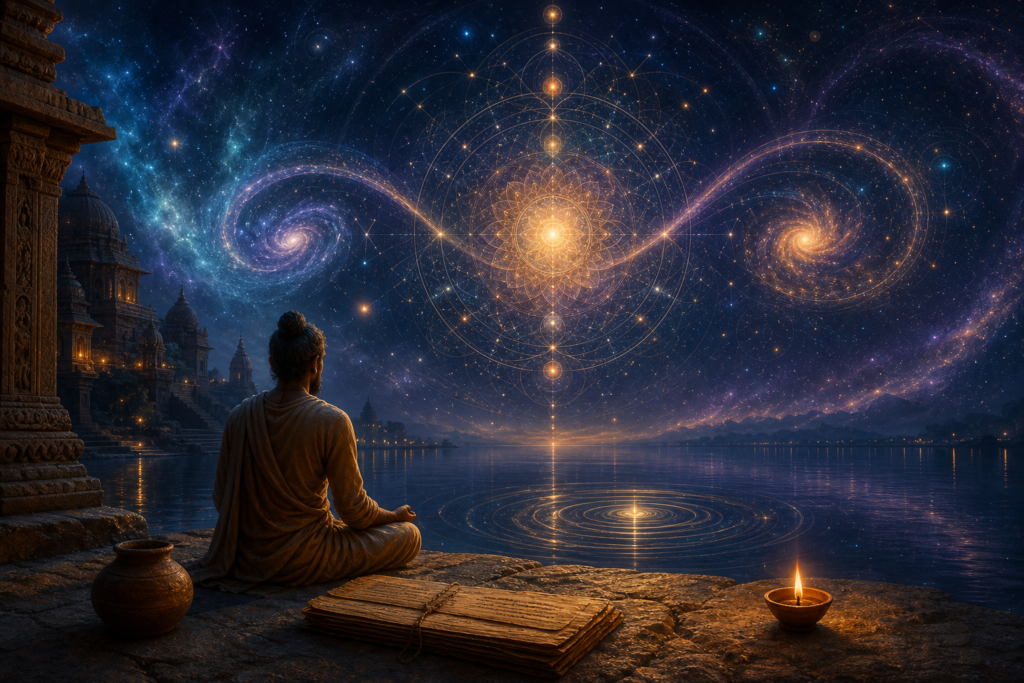
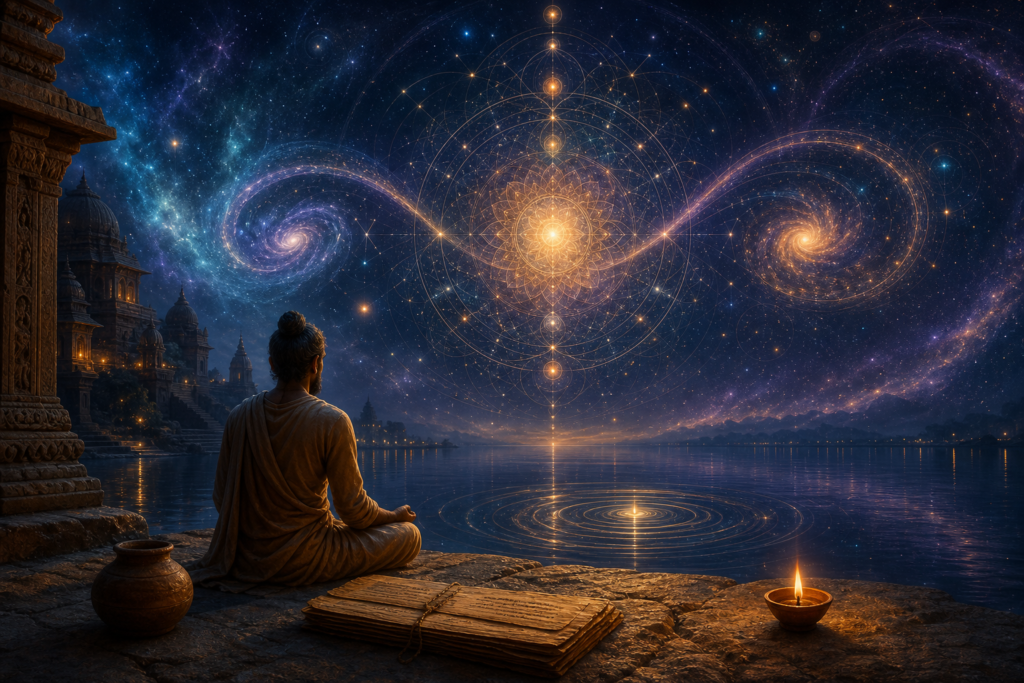
The Upanishadic insight is even more radical: the deepest truth is not separate from the consciousness by which the question is being asked. When a seeker asks, “Who created God?” the inquiry can mature into “Who is the one asking?” This is not a dismissal of intellectual doubt. It is an invitation to examine the witness of thought itself. Thoughts arise and subside. Doubts arise and subside. Emotions arise and subside. But the witnessing awareness by which they are known is more stable than the mental events passing through it.
This is why the question has a powerful psychological dimension. Many seekers ask it not merely to win a debate but because they are trying to make sense of existence, suffering, death, and moral order. A child may ask it with innocence. A skeptic may ask it with intellectual pressure. A devotee may ask it during a period of confusion. In all cases, the question deserves respect. Dharmic traditions generally do not require blind suppression of doubt; they encourage doubt to become inquiry, inquiry to become reflection, and reflection to become direct insight.
From a technical philosophical standpoint, the question depends on the principle of causality. But causality itself functions within time. One event precedes another; one condition gives rise to another result. If ultimate reality is beyond time, then asking for a temporal cause of that reality is logically misplaced. It is like asking what is north of the North Pole, or what color the number seven is. The grammar of the question is intelligible, but the category being applied is unsuitable.
This is also why many Hindu thinkers distinguish between empirical truth and ultimate truth. At the empirical level, bodies are born, plants grow, planets form, and civilizations rise and fall. At the ultimate level, existence itself is not “made” in the way a human artifact is made. The Mundaka Upanishad, Taittiriya Upanishad, Chandogya Upanishad, and other texts use different metaphors to discuss emergence, dependence, and realization, but their shared concern is to move the seeker beyond superficial material explanation toward the nature of being itself.
The term God can also create confusion because it carries different meanings in different traditions. In some theologies, God is imagined mainly as a supreme external ruler who creates the universe from outside it. In many Hindu contexts, the Divine may be understood as the inner self, the cosmic order, the personal Lord, the impersonal absolute, the power of Shakti, the sustaining Vishnu, the dissolving Shiva, or the all-pervading Brahman. The question “who created God?” therefore cannot be answered well until the meaning of God is clarified.
When God is treated as a finite object, the question becomes unavoidable. Any finite object can be examined through cause, composition, location, and origin. But Hindu philosophy does not reduce the Divine to a finite object. Brahman is not a being among beings; Brahman is being-consciousness itself in Advaitic language. Ishvara is not a creature within the cosmos; Ishvara is the intelligent order associated with the cosmos in several theistic schools. Devi is not merely one goddess among many imagined personalities; Shakti is the very power through which manifestation unfolds.
Here, dharmic traditions show a remarkable capacity for unity within diversity. Buddhism does not generally frame liberation around a creator God, yet it deeply investigates causation, impermanence, suffering, and the end of ignorance. Jainism speaks of beginningless reality, karma, jiva, and liberation without depending on a creator deity. Sikhism speaks of Ik Onkar, the One Reality, unborn, self-existent, and beyond fear. Hinduism contains multiple schools ranging from non-dual Vedanta to devotional theism. These traditions differ, but all resist the simplistic idea that ultimate truth must be explained as a manufactured object.
This shared dharmic instinct is valuable today because public debates about religion often become trapped in crude oppositions: belief versus disbelief, science versus spirituality, creator versus creation. A more mature approach recognizes that the Indian knowledge systems developed sophisticated reflections on causality, consciousness, language, perception, liberation, and reality. The question of who created God is therefore not an embarrassment to spirituality. It is an opening into philosophy, comparative religion, and contemplative practice.
Modern science also helps clarify the issue, though it does not replace metaphysics. Cosmology studies the development of the observable universe, including models of cosmic expansion, matter, energy, and physical law. But science, by its method, investigates measurable phenomena. It does not finally settle whether consciousness is reducible to matter, whether existence has an ultimate ground, or whether spiritual realization reveals a dimension of truth not captured by instruments. A dharmic response can respect science while also noting that metaphysical questions require philosophical tools.
The strongest form of the question may be stated this way: if every effect requires a cause, and the universe is an effect, then the universe requires a cause; but if God is also an effect, God too requires a cause. The dharmic answer is that ultimate reality is not an effect. It is not assembled, produced, born, or manufactured. It is the necessary or self-existent principle by which contingent realities are possible. This is why the language of “unborn,” “beginningless,” “eternal,” “self-luminous,” and “imperishable” appears so frequently in Hindu scriptures and spiritual teachings.
Yet academic clarity should not strip the question of its spiritual tenderness. Many people encounter this doubt during moments of vulnerability: after loss, during illness, while questioning inherited beliefs, or while trying to reconcile religious upbringing with modern education. A sensitive dharmic response does not shame the doubt. It says that doubt can be a doorway. When handled with humility, doubt prevents superstition and deepens understanding. When handled with arrogance, it becomes another form of bondage. The difference lies in whether the question is used to seek truth or merely to close the mind.
Sri Sri Ravishankar’s brief teaching, therefore, is best understood as a redirection of attention. The mind wants a linear story: first there was nothing, then God appeared, then God made everything. Dharmic thought often begins from a different intuition: existence is not nothingness accidentally becoming something; reality is beginningless, and forms arise within it. Creation and destruction are movements within the field of manifestation, not necessarily events that apply to the absolute itself.
This insight also changes how spiritual practice is understood. Meditation, japa, pranayama, seva, puja, svadhyaya, and satsang are not merely acts performed to please a distant creator. They are disciplines that refine perception. They help the seeker move from conceptual argument to experiential understanding. A person may intellectually accept that Brahman is beginningless, but the restless mind still feels separate, anxious, and incomplete. Practice gradually transforms that intellectual position into lived insight.
The question “who created God?” can thus be answered at several levels. Logically, an infinite regress cannot explain ultimate reality. Metaphysically, the Divine or absolute is not a created object. Scripturally, Hindu traditions describe Brahman, Ishvara, and the Supreme Consciousness as unborn and eternal. Devotionally, the Divine is experienced as the ever-present source of love, order, and grace. Practically, the question becomes meaningful only when it leads to self-inquiry, ethical living, and spiritual maturity.
A balanced answer also avoids dogmatism. Hindu philosophy does not force every seeker into one formulation. A devotee may say that Narayana is eternal. A Shaiva may say Shiva is anadi and ananta. A Shakta may say Devi is the primordial power. An Advaitin may say Brahman alone is ultimately real. A Sikh may speak of the One who is unborn and self-existent. A Jain or Buddhist may frame the issue without a creator God but still affirm beginningless processes and the path to liberation. The shared wisdom is that the deepest truth cannot be reduced to a manufactured entity.
For contemporary readers, this offers a practical lesson in intellectual humility. Not every question is solved by extending ordinary assumptions into extraordinary domains. The mind must learn which tools are appropriate for which level of reality. Causality is indispensable in daily life and scientific study, but it may not be the final key to the unconditioned. Language is powerful, but it can also create illusions when words are applied beyond their proper field.
The most fruitful response, then, is not to silence the question but to deepen it. Instead of asking only who created God, the seeker may ask: What is meant by God? What is meant by creation? Does causality apply beyond time? What is the nature of consciousness? What remains unchanged while thoughts, bodies, and worlds change? These questions carry the discussion from debate into darshana, from curiosity into wisdom, and from borrowed belief into direct reflection.
Ultimately, the dharmic answer is profound because it refuses to make God a small object inside a large universe. The Divine, in its highest understanding, is not a thing that began. It is the ground, presence, consciousness, law, love, and mystery through which beginnings and endings become intelligible. Creation and destruction belong to the world of changing forms. The Supreme Reality, however named, is not created in that sense. It is recognized, realized, and lived.
Inspired by this post on Hindu Pad.


Leave a Reply
You must be logged in to post a comment.