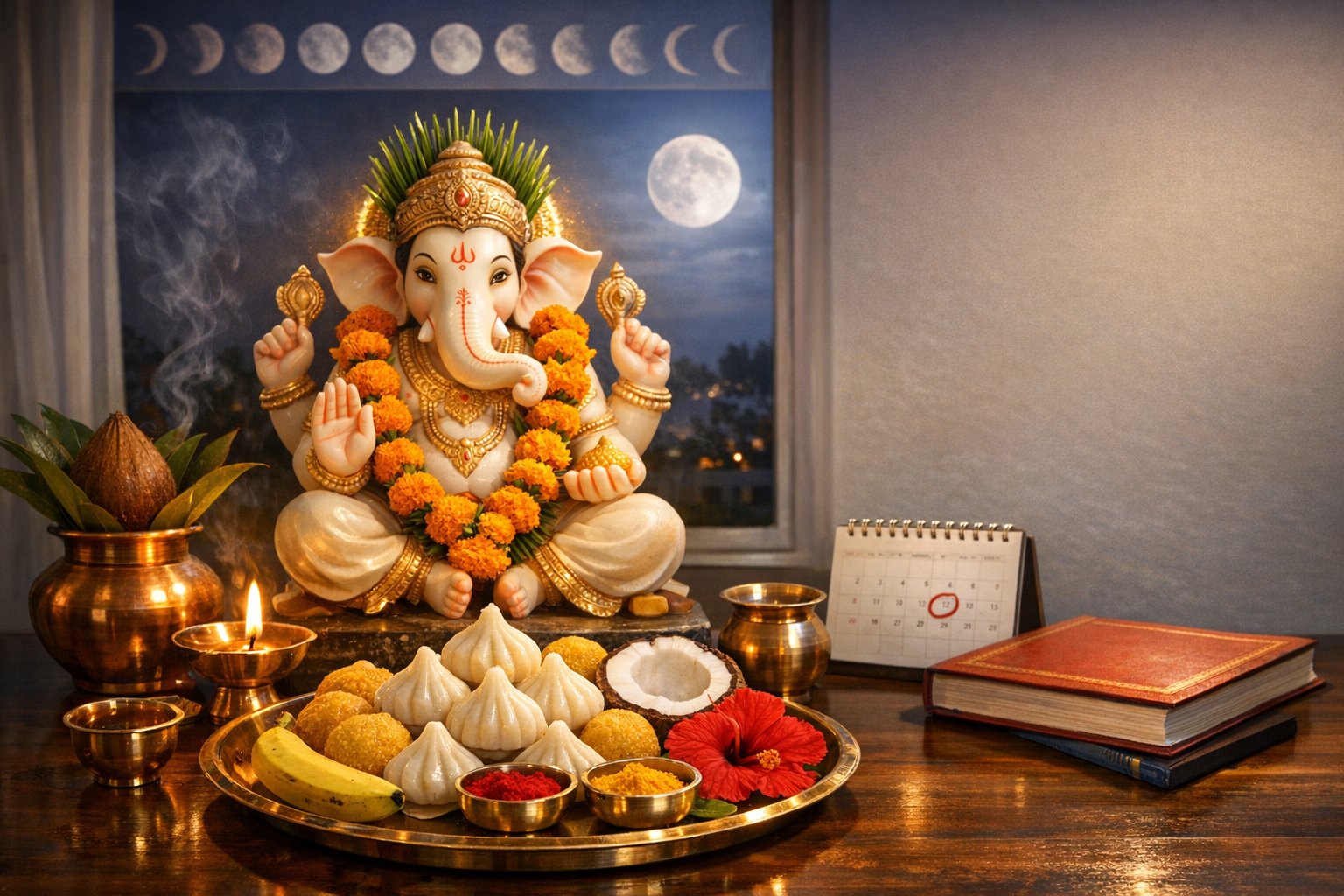
Sankashti Chaturthialso known as Sankashtahara Chaturthi, Ganesha Sankat Chauth, and in some regions as Chavithioccurs every lunar month on the Krishna Paksha Chaturthi, the fourth lunar day after the Full Moon. Across diverse Hindu communities, this vrata is observed in honor of Lord Ganesha, Vighneshwara, the remover of obstacles, with the central intention of alleviating “sankat” (difficulties) through disciplined fasting, focused prayer, and contemplative ritual.
In June 2026, Sankashti Chaturthi falls on Wednesday, June 3, 2026. As per North Indian Hindi calendars, the observance corresponds with the Krishna Paksha Chaturthi of Adhika Jyeshta Mahina. This placement within an intercalary month underscores the lunisolar precision maintained by the traditional Hindu calendar to keep lunar months aligned with the solar year.
For Sankashti Chaturthi, the most authoritative timing rule is that the vrat is observed on the date when the Chaturthi tithi prevails at local moonrise (Chandrodaya). Because tithis are defined astronomically and may begin or end at any clock hour, the calendar date for observance can differ by location. Devotees therefore rely on regional panchangs or trusted almanacs to determine both the tithi alignment and the exact moonrise time for concluding the fast.
The occurrence in Adhika Jyeshta Mahina (Adhik Jyeshta Maas) is a result of an intercalation mechanism known as Adhika Maas. In the lunisolar framework, when the lunar cycle runs ahead of the solar cycle, an extra lunar month is inserted to restore seasonal alignment. As a result, a given vratasuch as Sankashti Chaturthimay sometimes be observed during this intercalary window, without diminishing its spiritual or ritual efficacy.
Regional calendar conventions also inform the way this date is referenced. In the Purnimanta system used in much of North India, the month is counted from Full Moon to Full Moon, while in the Amanta system prevalent in parts of South India, the month runs from New Moon to New Moon. While nomenclature can vary, the vrat itself remains anchored to Krishna Paksha Chaturthi and to the moonrise criterion. In many Telugu- and Kannada-speaking households the day is also called Sankashti Chavithi, preserving the same devotional core.
Traditional observance emphasizes upavasa (fasting), vrata-sankalpa (a formal intention for the day), and puja to Lord Ganesha. Many devotees maintain a day-long fast, partaking only of phalahara or strictly saatvik items according to family and regional practice, and break the fast only after sighting the Moon and completing Ganesha puja. Offerings often include durva grass, red flowers, and naivedya such as modaka, laddoo, or seasonal fruits, symbolizing gratitude and purity of intent.
Customary puja vidhi typically includes cleaning the shrine area, lighting a lamp, and invoking Ganesha with dhyana and pranama. Recitation of Ganesha stotras is widely practiced; among these, the Sankashta Nashana Ganapati Stotra is popular, alongside chanting of the mantra “Om Gam Ganapataye Namah.” Devotees offer 21 blades of durva grass, perform archana with Ganesha Ashtottara Shatanamavali, and conclude with arati. The moonrise rite includes offering arghya to Chandra and then resuming the Ganesha worship before breaking the fast, honoring the tithi-at-moonrise rule that defines this vrata.
Spiritually, Sankashti Chaturthi is revered as a disciplined pathway for resolving impediments, deepening clarity, and cultivating steady devotion to Vighnaharta. Many households enrich the observance with readings on Lord Ganesha’s iconography and narratives, including reflections inspired by the Mudgala Purana’s eight manifestations of GaneshaVakratunda, Ekadanta, Mahodara, Gajanana, Lambodara, Vikata, Vighnaraja, and Dhumravarnaeach illuminating distinct modes of removing obstacles and restoring balance.
From a calendrical perspective, a tithi is the 12-degree increment of the angular distance between the Moon and the Sun; hence, each tithi’s start and end time shifts month to month and varies by geography. For Sankashti Chaturthi, what matters for devotional timing is not the civil date alone but the presence of the Chaturthi tithi at local moonrise. Because moonrise times differ even between nearby cities, precise local panchang data is indispensable for accurate and timely observance.
Devotees frequently describe a calm, reflective atmosphere in the hours leading to moonrise. Families often gather for collective japa, quiet reading of Vrat Katha, and the preparation of simple naivedya. Children participate by arranging modaka or offering durva, and many practitioners report that the rhythmic cadence of stotra recitation and the focused silence of fasting help foster mental steadiness and emotional poise, outcomes that tradition associates with Ganesha’s grace.
Contemporary practice also integrates health-conscious approaches to fasting. Tradition encourages moderation, sattvik foods, and adequate hydration for those who observe phalahara. Individuals who are elderly, pregnant, nursing, or managing medical conditions typically consult physicians and follow compassionate adaptations sanctioned by their family and community traditions. Charity (annadana), care for animals, and environmental responsibility are frequently woven into the vrata as acts of dharma.
The devotional ethos of Sankashti Chaturthi resonates with the wider dharmic family. The discipline of fasting and mindfulness parallels Buddhist uposatha reflections, the rigorous tapas of Jain upavasa and pratikraman, and the Sikh emphasis on simran and seva. These convergences point to a shared commitment to inner clarity, ethical action, and universal goodwillaffirming unity among dharmic traditions while honoring each path’s unique expressions.
To prepare meaningfully for Sankashti Chaturthi in June 2026, practitioners confirm the Krishna Paksha Chaturthi alignment and local moonrise time, assemble puja materials such as durva, flowers, and simple naivedya, and set a clear sankalpa oriented toward removing obstacles with humility and compassion. Many also earmark time for stotra recitation, quiet meditation, and a small act of charity, maintaining a serene domestic atmosphere conducive to prayer.
In summary, Sankashti Chaturthi in June 2026 is observed on Wednesday, June 3, 2026, corresponding to the Krishna Paksha Chaturthi of Adhika Jyeshta Mahina in North Indian Hindi calendars. Grounded in the principle that the vrat concludes after moonrise, this sacred observance invites disciplined fasting, thoughtful puja vidhi, and heartfelt remembrance of Lord Ganesha’s protective presence. Observed with accuracy, devotion, and inclusivity, it becomes a profound monthly occasion for personal renewal and dharmic unity.
Inspired by this post on Hindu Pad.