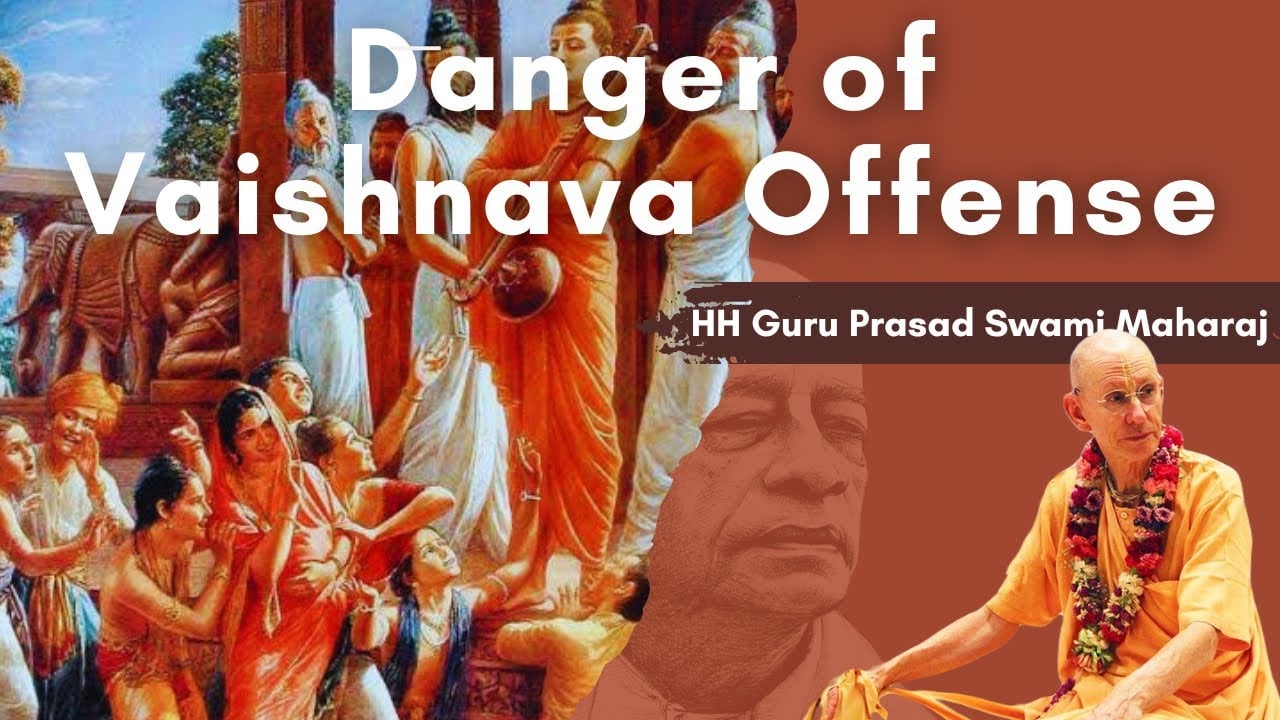
Srimad Bhagavatam (SB) 11.1.13–15 preserves a terse but searing account that generations of practitioners have regarded as a civilizational warning: a group of Yadu youths mock revered sages by disguising Samba as a pregnant woman and demanding an oracle. The sages, discerning the deception, pronounce a curse that a deadly iron club will be born and bring about the destruction of the Yadu dynasty. In a lucid exposition drawing on this passage, HH Guru Prasad Swami Maharaj (@ISKCONVrndavan) emphasizes the doctrine of Vaishnava aparādhaoffense against devoteesas a first-order spiritual hazard with cascading social, ethical, and karmic consequences.
At the narrative level, the episode is striking for its economy and power. Giddy with prosperity and prestige, the young Yadus take aim at the most sacrosanct resource of Dharmathe integrity of saintly personsand weaponize ridicule as entertainment. The sages’ verdict is immediate: from this theatrically staged “pregnancy” would issue an iron club whose fragments would one day be the instruments of the dynasty’s undoing. SB 11.1.13–15 thus initiates the chain of causation that culminates in the internecine tragedy at Prabhasa, when reeds arising from the powdered club become the very weapons by which the Yadus perish.
Textually, these verses are pivotal because they connect a seemingly trivial mockery to irreversible collective karma. In subsequent narrative developments, attempts to neutralize the cursegrinding the club to powder, casting it into the seaprove futile. What appears to be a technical remedy fails because the moral and spiritual cause remains unaddressed. The Bhagavatam’s didactic arc is unambiguous: once the sanctity of saintly persons is violated, the moral fabric frays and destiny ripens inexorably.
The theological grammar here centers on Vaishnava aparādha. Traditional Vaishnava literature often glosses aparādha as apa + rādha“that which obstructs what pleases the Lord.” Offending those devoted to Bhagavan is treated as the paradigmatic obstruction, because such devotees embody and extend the Lord’s compassion in the world. Within Gaudiya Vaishnava pedagogy, this insight is reinforced by the well-known list of offenses to the holy name, whose first item condemns blasphemy of devotees as spiritually ruinous. SB 11.1.13–15 brings that doctrine out of abstraction and into lived history.
The social-ethical dimension is equally important. The Yadu incident anatomizes how pride (mada), intoxication with group identity, and a culture of derision converge. Ridicule masquerades as wit; moral clarity is outsourced to instant amusement; deference to wisdom is replaced by performative cleverness. The sages’ curse is not vindictive retribution but a mirror of moral causality: when a community converts reverence for saints into a stage for humiliation, it seeds the conditions for its own rupture.
This passage also clarifies why traditions insist on the protective discipline of humility in bhakti. Humility is not mere sentiment; it is a cognitive guardrail that prevents careless transgression against those who carry Dharma. In the Bhagavatam’s pedagogy, honor toward saintly persons sustains the ecosystem of wisdom. Dishonor degrades it, and degradation eventually expresses itself as social conflict, leadership failure, and institutional collapse.
SB 11.1.13–15 further engages the perennial question of determinism and responsibility. The iron club’s fate dramatizes how karmic seeds, once sown, mature despite technological, political, or procedural countermeasures. The Yadus successfully pulverize the club; yet destiny adapts, and the powdered iron re-emerges as lethal reeds. The text’s hermeneutic invites a practical inference: the most effective risk mitigation is moral and spiritual rectification, not merely technical containment.
Placed within the wider Dharma family, this warning resonates well beyond Vaishnavism. In Buddhism, slandering members of the Sangha is classed among grave moral transgressions with heavy karmic weight; the ethic of sammā-vācā (right speech) exists precisely to prevent harm to the community of practice. Jainism codifies restraint in speech through anuvratas and samitis, explicitly discouraging ridicule and verbal himsa (violence) that can injure the dignity of ascetics and householders alike. Sikh tradition strongly condemns nindā (slander) of sants and the Guru’s sangat, highlighting humility (nimrata), seva, and simran as safeguards. Across these traditions, reverence toward saintly persons is not optional piety; it is foundational to collective flourishing.
Importantly, the ethic signaled by SB 11.1.13–15 is inclusive and unifying: the gravity of aparādha is not confined to a single path. When any dharmic community demeans its exemplarsbe they rishis, bhikkhus, munis, or santsit undermines the very sources of compassion, knowledge, and restraint that sustain civilizational health. In this sense, the passage serves as a charter for inter-dharmic respect and mutual protection of each other’s holy persons and institutions.
For practitioners, the safeguards are practical and actionable. First, cultivate disciplined speech: truth (satya) yoked to compassion (dayā) and non-harm (ahiṁsā). Second, normalize deference to wisdom: when in doubt, err on the side of respect, both in-person and online. Third, institutionalize apology and repair: when an offense occurs, seek forgiveness promptly, serve those offended, and undertake concrete restorative action. Fourth, elevate exemplars: retell histories that model humility toward saints, thereby shaping communal reflexes in alignment with Dharma.
The Bhagavatam itself furnishes a canonical control case in the “Story of Durvasa Muni and King Ambarisha.” There, a powerful ascetic commits offense toward a devotee, only to discover that refuge lies not in further assertion of power but in seeking the devotee’s forgiveness. The narrative symmetry across these episodes reinforces a single principle: the spiritual ecology is ordered such that honor toward devotees safeguards everyone; dishonor imperils even the mighty.
In contemporary terms, the most immediate theatre for this ethic is digital culture. Derision, parody, and performative outrage often produce rapid social rewards. Yet SB 11.1.13–15 counsels a countercultural discipline: refrain from mocking saintly persons across Hinduism, Buddhism, Jainism, and Sikhism; do not incentivize content that profits from their humiliation; respond instead with reasoned critique that preserves dignity. The result is not intellectual timidity but moral clarityvigorous debate without personal denigration.
Remedy, when needed, is also clear. Traditional Hindu praxis endorses prāyaścitta (atonement), seva to the Vaishnavas, dedicated recitation of the holy name with humility, andmost cruciallydirect reconciliation with those offended. Closely allied virtues in other dharmic traditions include confession, renewed discipline in right speech, and acts of service to the community. Repair is never merely private sentiment; it is a public reweaving of trust.
HH Guru Prasad Swami Maharaj’s explication of SB 11.1.13–15, delivered within the devotional context of ISKCON Vrndavan, aligns with this wider dharmic consensus: humility is the guardian of power; reverence is the guardian of knowledge; restraint in speech is the guardian of community. The fall of the Yadu dynasty is not a historical curiosity but a curricular unit in spiritual statecraft, teaching how civilizations preserve their own interior order.
Ultimately, the “danger of Vaishnava offense” is best understood as a systemic risk. It degrades devotion, corrodes institutions, and, over time, invites disorder that no external sophistication can avert. The antidote is both simple and demanding: honor those who carry Dharma, across every lineage in the broader dharmic family, and make humility the default setting of public and private life. In doing so, communities secure not only spiritual progress in bhakti but the social peace that Dharma promises.
Inspired by this post on Dandavats.