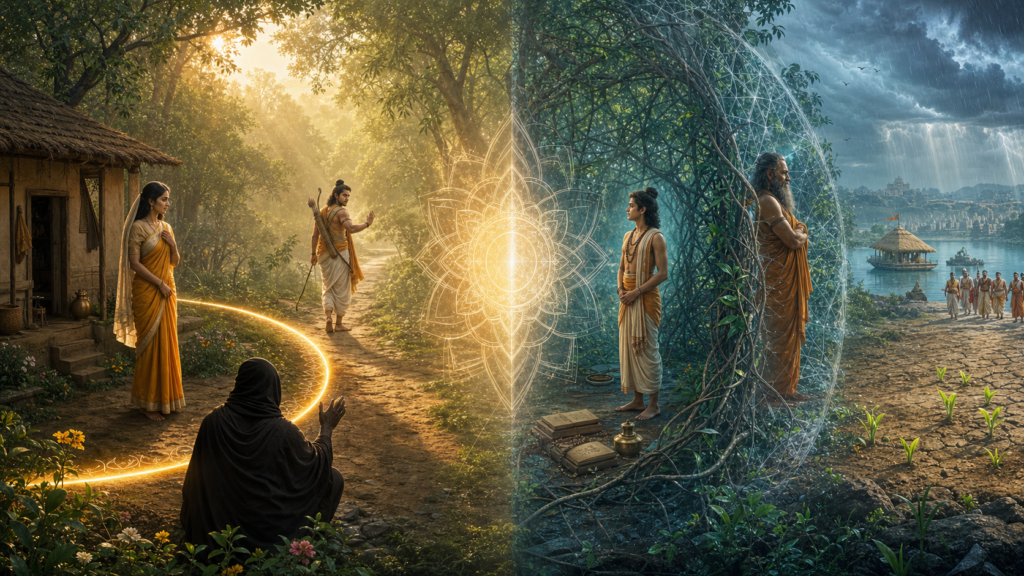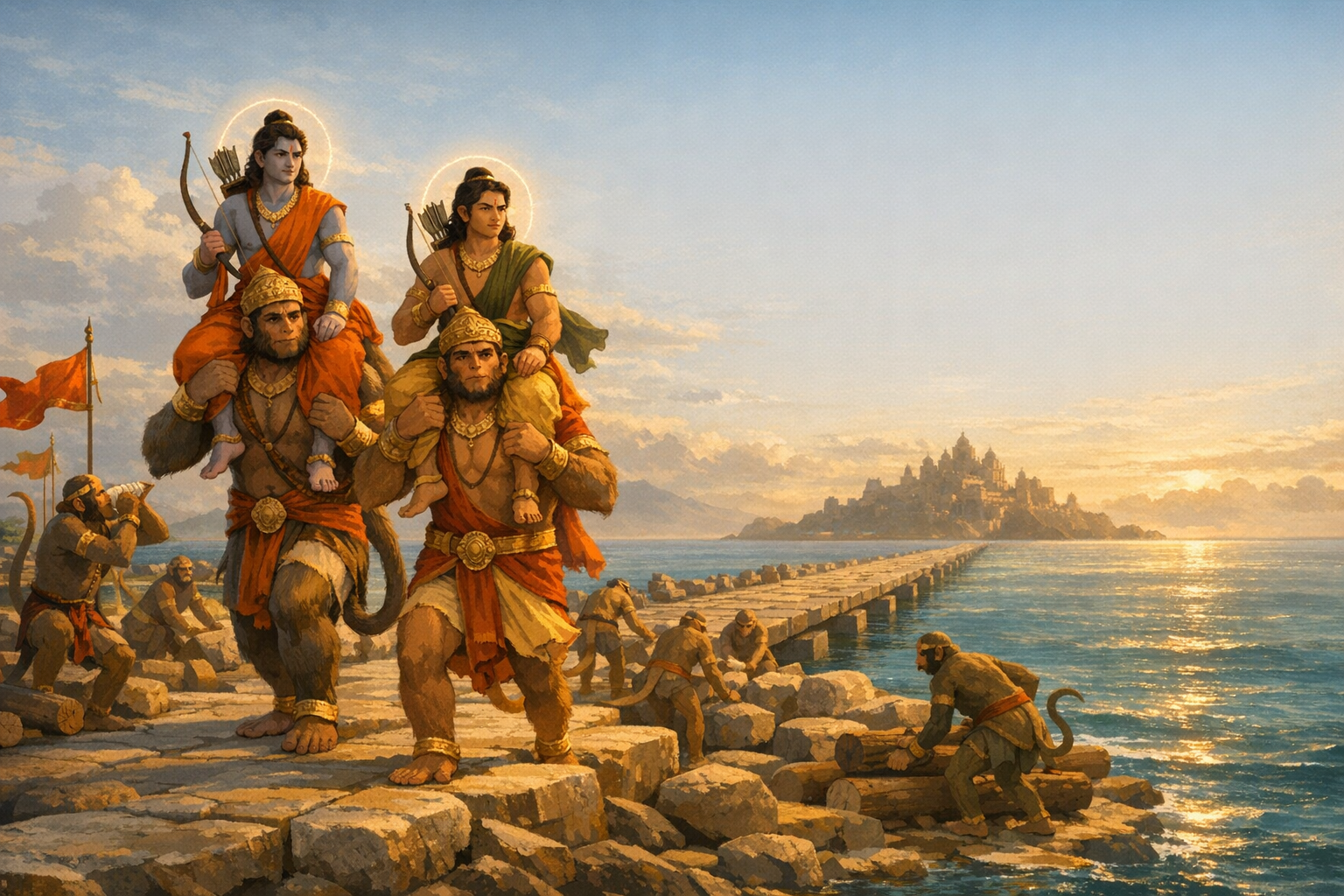
Rama’s march to Lanka in the Yuddha Kanda marks a decisive transition in the Ramayana: from the grief of separation to the discipline of strategy. Following Hanuman’s return from Lanka with news of Sita’s presence in Ashoka Vatika and the token of the chudamani, the Vanara coalition transformed intelligence into action. The campaign became at once a military enterprise, an ethical undertaking (dharma-yuddha), and a spiritual journey anchored in devotion and leadership.
Hanuman’s reconnaissance supplied concrete topographical and tactical intelligence: the fortifications of Lanka, its multiple gates, deep moats, elevated ramparts, and a martial culture under Ravana accustomed to surprise tactics and sorcery. This intelligence guided the planning rhythm of the Vanara armyemphasizing mobility, deception-resilience, and the need for a stable crossing of the ocean that would preserve troop morale and logistical continuity.
On reaching the northern shore of the ocean, Rama adopted a dharmic protocol rarely discussed in modern readings of epic warfare: ritual diplomacy with the environment. He observed a fast of three days, seeking the ocean’s cooperation as a sentient principle (Samudra Deva). When silence persisted, a single arrow demonstrated resolve without wanton harm, prompting the ocean to emerge, acknowledge Rama’s purpose, and advise an engineering solution. The moment fused ecological reverence with realpolitik, underscoring that in dharma-yuddha, power is yoked to restraint.
The construction of the setu (Rama Setu) under Nala’s supervision was an extraordinary feat of ancient engineering. Naladescended from Viśvakarma in the traditioncombined design with command-and-control, while Nīla coordinated mass labor and materials. The Ramayana portrays a modular, assembly-line approach: vanaras carrying logs and boulders, stabilizing courses, and creating a causeway reportedly completed in several days. Classical descriptions give grand dimensions (often rounded in yojanas), yet the abiding point is organizational excellence: survey, staging, throughput, and quality checks that allowed an entire army to cross safely.
Later devotional lore adds that stones inscribed with “Rama” floated; Valmiki’s account emphasizes Nala’s skill. Read together, these streams offer complementary lenses. The first celebrates bhakti as a world-shaping force; the second affirms human ingenuity as a dharmic instrument. Their convergence reflects a civilizational insistence that faith and skill are not adversaries but allies.
Vanara army organization combined charismatic authority with distributed leadership. Sugriva assigned sectors and vanguards based on capability; Angada, Nala, Nīla, Jāmbavān, Sushena, Rishabha, Gavaya, and others commanded distinct groupings. Without chariots or heavy cavalry, this light, high-mobility force weaponized agility, signal roars, and leaping shock tactics. Logisticswater, fruit, and foraged supplieswere managed in moving echelons; commanders coordinated by audial calls and landmark-based rendezvous, suited to forest and littoral terrains.
Crossing the setu was as much psychological as it was physical. The sight of a transoceanic roadwayraised by cooperation, command, and devotionbecame narrative proof that dharma, when well led, builds literal bridges. The Vanara army’s disciplined advance shook Lanka’s confidence even before the gates were tested; noise, banners, and rhythmic drumming signaled intent and unity.
Siege operations unfolded in coordinated phases: encampments outside Lanka’s gates, calibrated provocations, parley attempts, and messenger diplomacy. Angada’s famed embassy to Ravanabold, ethical, and uncompromisingset the tone: return Sita, honor dharma, avert catastrophe. Ravana refused, and the conflict escalated. Subsequent engagements included magical entanglements (such as the serpent weapon), countered by providential intervention, and later, surgical strikes against commanders like Kumbhakarna and Indrajit, illustrating the blend of valor and counter-sorcery that typifies Yuddha Kanda battles.
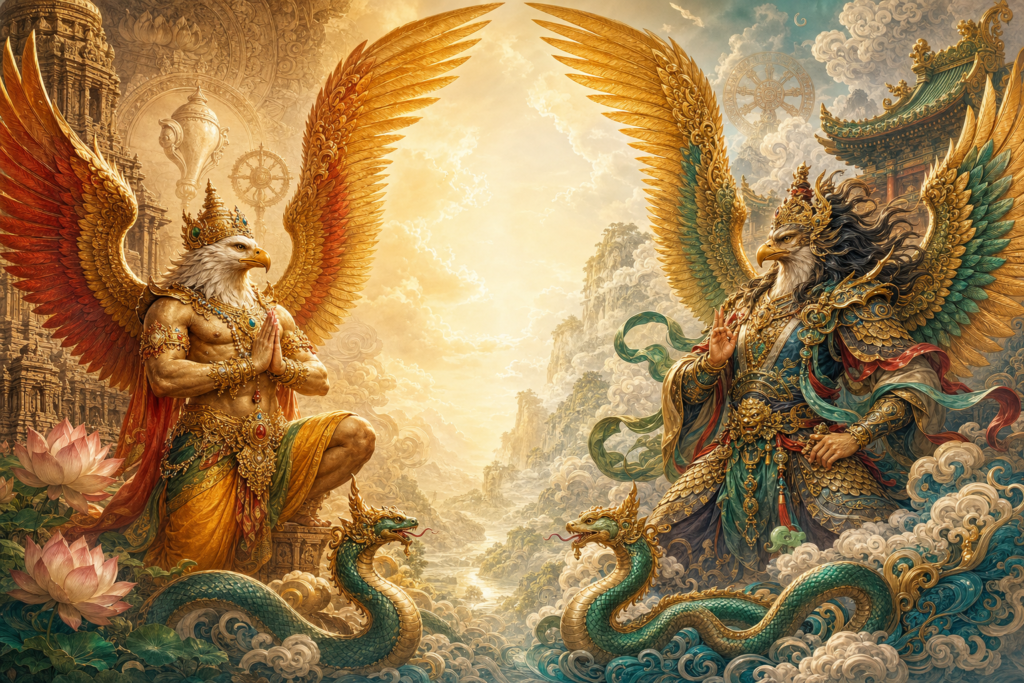
Within this broader campaign sits a striking devotional-iconographic motif: “Rama riding on Hanuman and Lakshman on Angada.” A critical textual note is essential. The Valmiki Ramayana does not explicitly narrate Rama mounted on Hanuman or Lakshmana on Angada during the march or the siege. However, later vernacular retellings, temple processions, regional performing arts, and Southeast Asian Ramayana traditions (such as the Thai Ramakien) often visualize the Lord borne by his devotees. The image crystallizes a theological insight treasured across bhakti lineages: Bhagavan advances through the sevā (service) and śakti (strength) of bhaktas.
Processional practice reinforces this reading. In many temples, the utsava-mūrti of Sri Rama or Vishnu rides on the Hanuman vahana during specific festivals, ritually affirming that devotion carries the Divine into the world. South Asian miniature paintings and regional theatre likewise portray Hanuman shouldering Rama in scouting scenes or in triumphal progress, while Angada, as Bali’s lion-hearted son and a foremost field commander, personifies courage sturdy enough to “bear” Lakshmana’s mission. As symbolism, the motif is not a trivial embellishment but a doctrinal meditation: the devotee becomes the Lord’s vehicle.
Strategically interpreted, the motif also encodes command philosophy. When leadership “rides” on the loyalty and competence of trusted lieutenants, organizations cross impossible seas. Hanuman’s unwavering devotion and intelligence made him the ideal bearer of high-stakes tasks; Angada’s fearlessness and royal pedigree equipped him for spearhead roles. In this light, the motif teaches a principle of mission command: leaders empower exemplary talent, and exemplary talent, in turn, carries leaders’ intent to the objective.
Across the dharmic spectrum, the Lanka campaign resonates with shared ethical themes. The Buddhist Dasaratha Jataka preserves the arc of virtue, renunciation, and righteous conduct; the Jain Paumacariya recasts the narrative through ahiṃsā-focused statecraft and moral discipline. Sikh traditions, while not retelling the Ramayana, praise maryada (moral restraint) and shaurya (valor) that echo Rama’s code. Read together, these streams underscore unity-in-diversity among Hindu, Buddhist, Jain, and Sikh lineages: dharma obliges strength to be just, power to be measured, and victory to be clean of cruelty.
The storied bridge, identified in cultural memory with the chain of shoals between the Indian subcontinent and Sri Lanka, illustrates how sacred geography can invite multiple ways of knowing. Geological studies explore natural formation processes, while devotees revere the site as Rama Setu. An academically responsible approach acknowledges both domains: scientific inquiry and sacred significance. The Ramayana’s enduring power lies in enabling these registers to coexist without erasing each other.
Leadership lessons from the Yuddha Kanda remain practical. Intelligence precedes action; diplomacy precedes force; environmental respect precedes exploitation. Capability is arranged to mission; logistics are the silent enabler; morale multiplies strength. Above all, humility governs power: Rama’s appeal to the ocean before coercion, and his honoring of Vibhishana’s counsel despite political risks, exemplify dharma-rājya principles relevant to governance, institutions, and community life today.
For contemporary readers, the image of Rama “borne” by Hanuman and Lakshmana “borne” by Angada can be read as a civic ethic: communities move forward when service-minded strength shoulders the common good. Bridge-buildingliteral in the epic, social in the presentdepends on trust, shared purpose, and reverence for higher ideals. In that sense, the Vanara army’s march to Lanka remains a living syllabus for ethical strategy and interfaith harmony across the dharmic family.
Seen in its fullness, Rama’s march to Lanka is simultaneously history-in-epic memory, strategy in sacred verse, and devotion rendered into collective action. Whether studied as Yuddha Kanda’s operations research, as bhakti’s iconography where the bhakta becomes the vahana, or as a tapestry uniting Hindu, Buddhist, Jain, and Sikh ethical intuitions, the narrative teaches that the surest way across any ocean is to align strength with dharmaand to let devotion carry leadership further than force ever can.
Inspired by this post on Hindu Blog.