
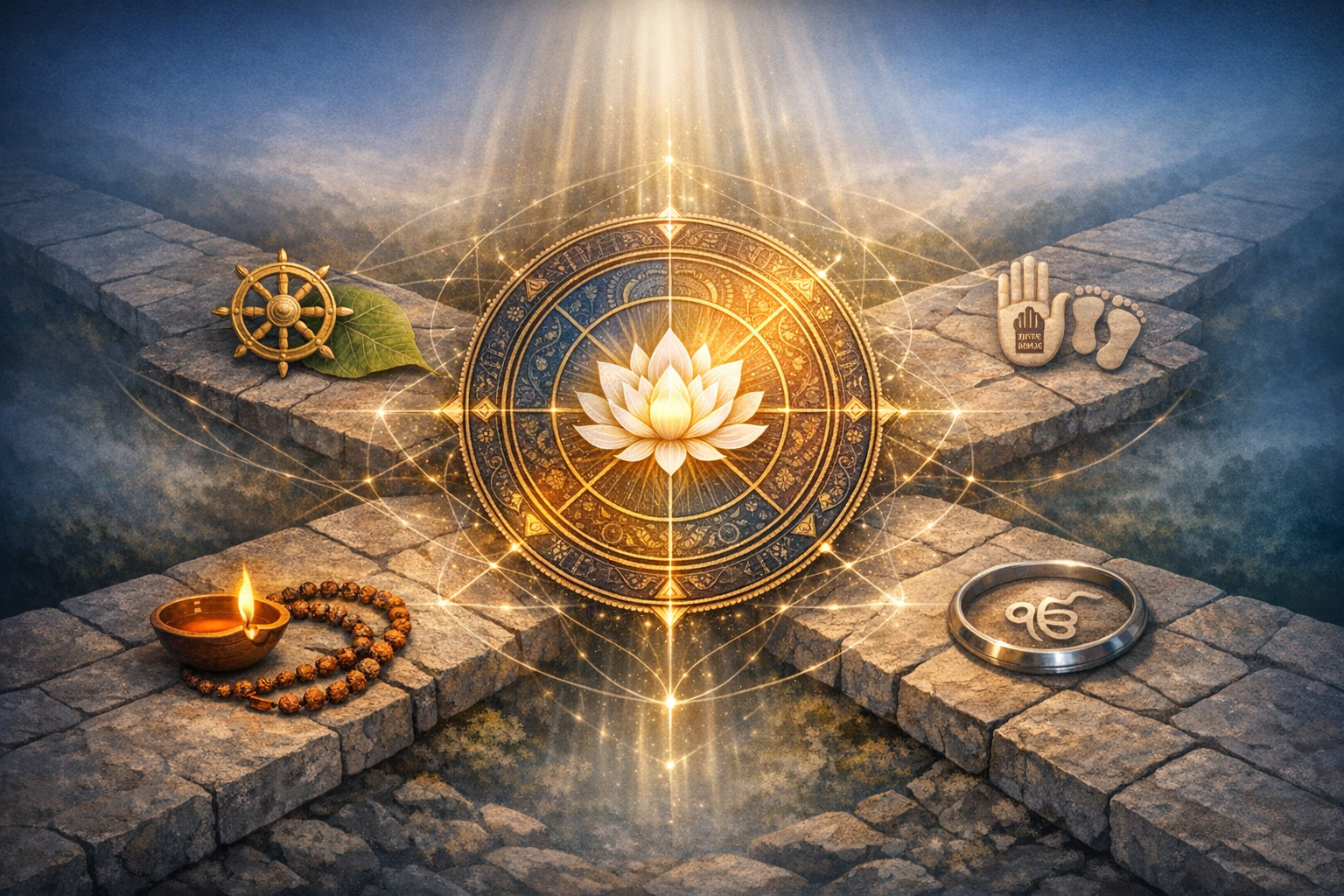
The question “Does God really exist?” appears most urgently when life feels heavy with loss, injustice, or uncertainty. Within the dharmic knowledge systems of Hinduism, Buddhism, Jainism, and Sikhism, this inquiry is not dismissed as naïve, nor reduced to dogma. Instead, it is reframed through Dharma, karma, and soteriological practice, asking what kind of reality is ultimate, what drives the moral order, how suffering arises, and how liberation is realized. Rather than a single doctrinal answer, these traditions offer a spectrum of rigorously reasoned perspectives and pragmatic pathways that meet seekers where they are.
One classical lens in Hindu thought positions the present age within a cyclical framework of Yugas. According to this cosmology, moral clarity and spiritual capacity wax and wane across Satya, Treta, Dvapara, and Kali Yuga. The current era, Kali Yuga, is portrayed as ethically fraught and cognitively distracted, yet also uniquely generous: small acts of remembrance, devotion, meditation, and service yield disproportionately transformative results. This is the spirit of Yuga Dharmathe Dharma fit for the agethrough which the world’s functioning can be understood without fatalism and with renewed responsibility.
Characterizations of Kali Yuga in puranic literature are diagnostic, not despairing. They chart an atmosphere where restlessness, division, and instrumental reasoning overshadow contemplative depth. Yet the same sources insist that accessible disciplinesnāma-japa (repetition of the Divine Name), kīrtana, satsanga, ethical restraint, and sevaare potent medicines. In other words, the age is challenging but not spiritually closed; its Yuga Dharma broadens entry points to transcendence.
When suffering is taken as the starting point, the inquiry often shifts from “Does God exist?” to “What explains pain, injustice, and apparent randomness?” Dharmic frameworks converge on a precise response: causality. The law of karma, central to Hinduism, Buddhism, and Jainism (and echoed in Sikh teachings through Hukam), reframes suffering not as divine punishment but as the unfolding of interdependent causes and conditionssome proximate and obvious, others remote and subtle.
Karma in these systems is morally charged causation across lifetimes (saṁsāra). It accounts for disparities in experience without imputing cruelty to the Divine. In Sikh thought, Hukamthe all-pervading orderencompasses moral causality while centering grace (nadar) and remembrance (simran). Buddhism articulates dependent origination (pratītyasamutpāda), emphasizing that dukkha has specific, knowable conditions and therefore a path to cessation. Jainism’s analysis extends to karma as a subtle material influx (karma-pudgala) binding to the soul (jīva), which can be exhausted through austerity and right conduct. Across these traditions, suffering becomes intelligible and actionable.
Any serious answer to the existence of God also turns to epistemology: How is truth known? Indian darśanas detail pramāṇasreliable means of knowledgesuch as perception (pratyakṣa), inference (anumāna), and trustworthy testimony (śabda). Questions of ultimate reality are not left to sentiment; they are approached by rigorous reason, disciplined contemplation, and deference to time-tested revelation (śruti) where appropriate.
Nyāya philosophy, for instance, advances carefully reasoned arguments for Īśvara. One strand (kāryāt) infers an intelligent cause from the world’s ordered effects, while another (āyojanāt) points to the purposive coordination of means and ends. These are not simplistic “gaps” arguments but structured inferences built on a theory of causation, error analysis, and debate-tested criteria for valid reasoning.
Classical objections are robust and instructive. Pūrvamīmāṁsā questions the necessity of a creator given the sufficiency of Vedic injunctions to order ritual and social life. Buddhist schools reject a permanent controller on ontological and soteriological grounds, arguing that positing a creator does not resolve the regress of causes and introduces metaphysical commitments that do not aid liberation. Nyāya responds by clarifying the asymmetry between contingent effects and a non-contingent intelligent cause, while Vedānta reframes the debate by distinguishing absolute and empirical levels of truth.
Vedānta offers multiple, rigorously developed positions. Advaita Vedānta identifies the absolute (paramārthika) reality as non-dual Brahmanpure consciousness (cit) that is existence (sat) and bliss (ānanda). Īśvara (the Lord) operates as Brahman reflected through māyā at the empirical (vyāvahārika) level, sustaining moral order and the law of karma while guiding seekers toward knowledge (jñāna) that dissolves the subject–object duality. Texts such as “tat tvam asi” and “sarvam khalvidaṁ brahma” emphasize identity with the Absolute rather than separation from it.
Viśiṣṭādvaita and Dvaita Vedānta, conversely, affirm a real distinction between the Supreme Person and the individual soul, aligning closely with the devotional theism of the Bhagavad Gita. Here, Īśvara is not only the ground of being but also the intimate indweller (antaryāmin) and the compassionate responder to devotion (bhakti). Famous teachingssuch as “mām ekaṁ śaraṇaṁ vraja” and “yo me bhaktaḥ sa me priyaḥ”frame a personal relationship without denying philosophical depth.
Dharmic responses to the problem of suffering therefore diverge without contradicting the unifying telos of freedom (mokṣa, nirvāṇa, kevala-jñāna). In Advaita, suffering is born of avidyā (misapprehension), dissolved by knowledge. In the bhakti schools, it is outlived through surrender, love, and grace. In Buddhism, it is ended by cultivating insight into impermanence, non-self (anātman), and dependent origination. In Jainism, it is purified through right faith, knowledge, and conduct, and through non-violence (ahiṁsā) in its most exacting form. In Sikhism, it is borne and transformed through remembrance of Ik Onkar, alignment with Hukam, and seva.
Buddhist thought sidesteps the creator-God question as neither necessary nor sufficient for liberation. The Four Noble Truths diagnose dukkha and prescribe the Noble Eightfold Path, whose contemplative and ethical disciplines can be tested experientially. Compassion (karuṇā) and wisdom (prajñā) together verify the path, with śūnyatā (emptiness) dissolving reification and loosening clinging. The “existence of God” becomes less a metaphysical verdict and more a practical irrelevance on the road to awakening.
Jainism articulates a plural-angled realism via anekāntavāda and syādvāda, acknowledging that ultimate truth can be meaningfully predicated from multiple partial standpoints. This philosophical humilitydeeply compatible with the blog’s commitment to unitydiscourages absolutism and fosters inter-traditional dialogue. Deities may be honored as perfected beings (tīrthaṅkaras), but no supreme creator is posited; the cosmos is beginningless and governed by laws that allow liberation through ethical self-mastery.
Sikh teachings crystallize metaphysical depth with ethical immediacy: Ik Onkar is the One Reality, immanent and transcendent, approachable through Naam, realized through grace, and lived through Hukam. Suffering is held within an unbroken field of meaning; resilience, humility, seva, and community (sangat) become the grammar of spiritual life. The Divine is as near as the breath, yet vaster than thoughtneither distant abstraction nor sectarian possession.
Across these dharmic streams, a unifying principle emerges: spiritual diversity is not a threat to truth but an instrument of it. Varied temperaments, capacities, and historical conditions necessitate varied pathsjñāna, bhakti, karma-yoga, rāja-yoga, meditation, selfless service, and contemplation. This is not relativism; it is calibrated pluralism, as precise as it is generous. The goal is shared: freedom from ignorance and suffering, realized as abiding peace and compassionate presence.
How then does one “know” in practice? Indian traditions consistently propose sādhanā as verification. Meditation, mantra, ethical discipline, and service refine perception and stabilize attention. Over time, practitioners report reductions in reactivity, growth in compassion, and glimpses of non-separatenesschanges that are not merely subjective impressions but observable in conduct and, increasingly, measurable in cognitive and affective profiles. The point is not to scientize spirituality but to underscore that these paths are testable by life.
Within the Yuga Dharma of this age, three disciplines are repeatedly highlighted for accessibility and potency: remembrance (nāma-japa, kīrtana), fellowship (satsanga), and service (seva). Together they quiet agitation, align intention, and convert metaphysical curiosity into lived ethics. Scriptural hintssuch as “kīrtanād eva kṛṣṇasya mukta-saṅgaḥ paraṁ vrajet”affirm the outsized efficacy of these practices in Kali Yuga.
A nuanced perspective on divine action also helps reconcile suffering with compassion. Īśvara in many Hindu schools is not a capricious intervener but the omniscient governor of moral order, honoring free will while guiding through conscience, scripture, and grace. In Buddhism and Jainism, the absence of a creator does not entail a moral vacuum; causality is ethically textured and liberation is hard-won. In Sikhism, Hukam enfolds both justice and mercy, inviting steadfastness without passivity.
For many seekers, relatable experiences shape conviction more than abstract proofs: the unexpected steadiness that comes in adversity through simran, the unbidden softening of the heart during seva, the clarifying quiet of a well-settled meditation, the empowerment felt in aligning daily choices with ahiṁsā, satya, and aparigraha. Such shifts provide existential validation: what these traditions promise, they deliverincrementally and cumulatively.
Philosophically, one can therefore say: the question “Does God exist?” admits multiple precise answers within the dharmic spectrum. In Advaita, the ultimate is non-dual Brahmanbeyond the personal–impersonal divide. In theistic Vedānta, God is the supreme Person, both intimate and infinite. In Buddhism and Jainism, the salvific enterprise neither requires nor posits a creator; instead, it rests on causal law and the discipline to transform it. In Sikhism, Ik Onkar is the living One, known through remembrance and righteous action. Unity is not imposed agreement but shared depth of purpose.
Practically, a seeker in Kali Yuga can adopt a phased roadmap consonant with Yuga Dharma: establish ethical foundations (yama, niyama; ahiṁsā, satya), cultivate daily remembrance (japa, kīrtana, simran), embed in community (satsanga, sangat), and engage in steady service (seva) that reduces self-centeredness. Complement this with contemplative study of the Upanishads, Bhagavad Gita, Dhammapada, Āgamas, and Guru Granth Sahib, guided by teachers who emphasize humility and inter-tradition respect.
From the standpoint of social harmony, this approach scales. It treats plural paths as mutually illuminating rather than mutually exclusivea posture already encoded in anekāntavāda and reflected in the Hindu ideal of “Vasudhaiva Kutumbakam.” By foregrounding shared commitmentscompassion, truthfulness, restraint, generosity, and the pursuit of liberationcommunities strengthen cohesion without erasing distinctives.
In sum, the world’s functioning can indeed be viewed through Yuga Dharma, where present conditions heighten both challenges and opportunities. Suffering, seen through karma and interdependence, compels ethical clarity and spiritual work rather than fatalism. Whether one conceives the ultimate as Brahman, Īśvara, Ik Onkar, or as the freedom revealed through śūnyatā or kevala-jñāna, the dharmic consensus is practical and hopeful: walk, verify, and let practice confirm what propositions can only point toward.
It follows that the most honest resolution to “Does God really exist?” may be less a single syllable and more a life: a disciplined experiment in Dharma that, over time, discloses the texture of realityintimate, intelligible, and liberating. In this shared experiment, seekers across Hinduism, Buddhism, Jainism, and Sikhism can recognize each other as companions, honoring unity in spiritual diversity while remaining faithful to their own sādhanā.
Inspired by this post on Hindu Pad.







