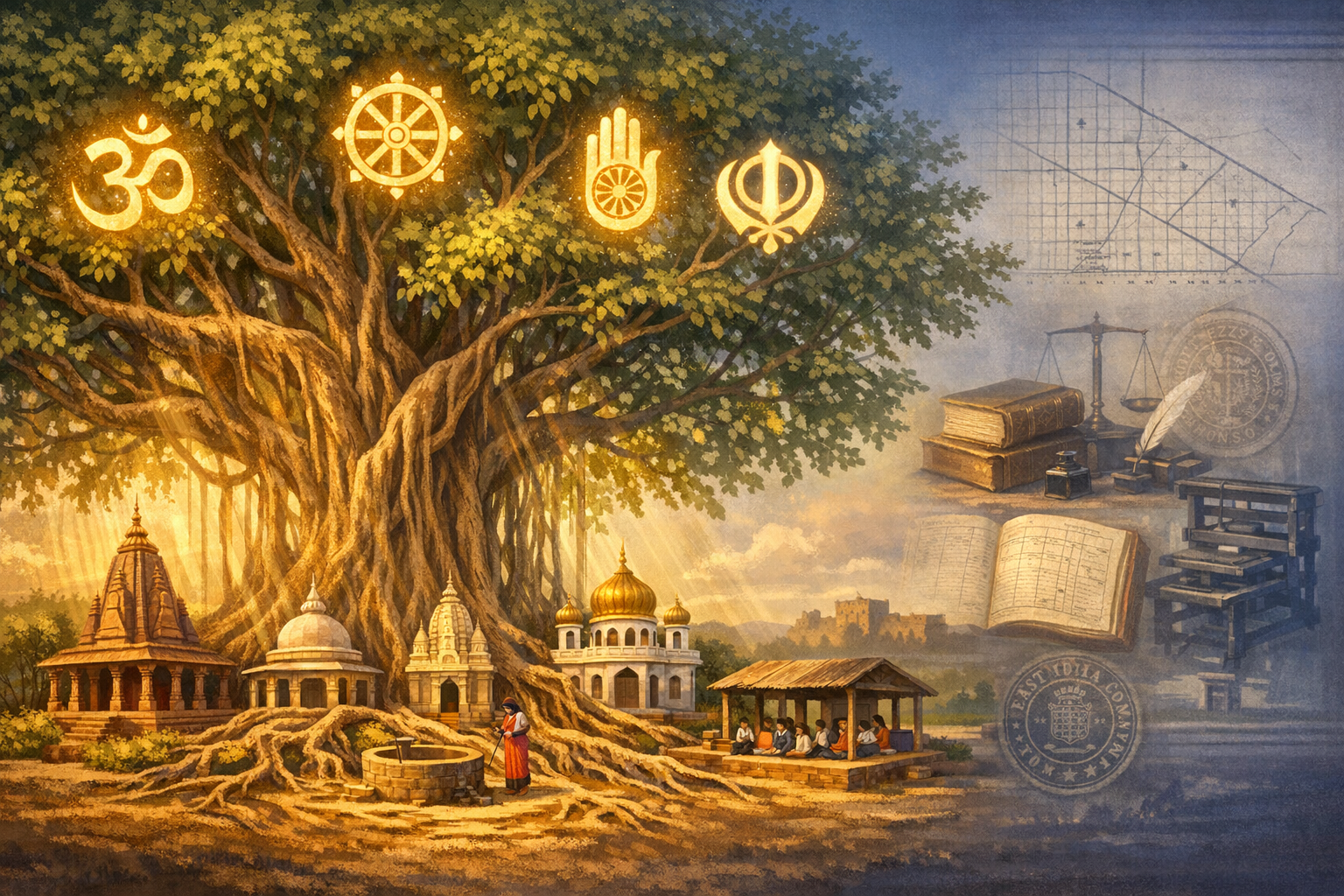
Across the long nineteenth century, the most consequential struggle in the subcontinent was not only fought on battlefields but also in classrooms, courts, land offices, and the realm of ideas. This was the war they could not win: a sustained imperial attempt to standardize, rank, and reorder a plural civilization that, at its ethical core, drew strength from the complementary traditions of Hinduism, Buddhism, Jainism, and Sikhism. Part 1 traces the contours of this civilizational encounter up to, and including, the 1857 War of Independence, with attention to the hybrid nature of powermilitary, legal, economic, educational, and narrativedeployed by the British East India Company and, later, the Crown.
Calling it a war is not rhetorical excess. Empire’s project sought to recast society through new laws and land settlements, novel forms of schooling, and a powerful “knowledge regime” that codified and classified. The response was not a mirror image of coercion, but a quiet and resilient recommitment to dharmaethical duty and social responsibilityexpressed in seva (service), ahimsa (non-violence), pluralist worship (Ishta), and many-sided reasoning (Anekantavada). These were not abstractions; they were lived practices binding households, guilds, temples, mathas, viharas, sanghas, and gurdwaras in networks of mutual care.
The British East India Company’s ascendancy (c. 1757–1857) reconfigured authority at every tier. Revenue settlementsPermanent Settlement in Bengal, Ryotwari in parts of the south and west, and Mahalwari in the northaltered agrarian relationships, diminished customary rights, and privileged extractive certainty over local reciprocity. Village assemblies and temple- and monastery-linked trusts that once mediated social welfare and dispute resolution were increasingly displaced by a centralized fiscal state. Economic historians debate the scale and timing of “deindustrialization,” but there is agreement that the structures of trade and taxation were reoriented to imperial priorities.
Law and procedure followed. From late eighteenth-century experiments under Warren Hastings, colonial courts first sought to apply “personal law” via pandits and maulvis, but this soon yielded to codification. The move from a layered jurisprudencewhere Dharmashastra, local customs, guild rules, and royal edicts coexistedto uniform codes was not merely administrative. It compressed normative diversity into standardized categories, redrawing the boundary between the moral and the legal, and progressively situating conscience under statute. The later Indian Penal Code (1860) would crystallize this trend, but its intellectual genealogy preceded 1857.
Education became a strategic theater. The 1813 Charter Act opened the door to missionary activity; Thomas Babbington Macaulay’s 1835 Minute, endorsed by Governor-General William Bentinck, privileged English-medium instruction over Sanskrit and Persian; and the 1854 Wood’s Despatch advanced an imperial system of graded schooling. The intention was not only utilitarian training for administration but also the cultivation of a new intellectual orientation. Pathshalas, gurukulas, maktabs, and madrasas continued, yet their public standing and endowments were increasingly overshadowed by the state-backed model, reshaping elite formation and the channels through which knowledge flowed.
Alongside institutional reform, a powerful discursive frame congealed. Missionary polemics, the rise of racialist philology, and census-based enumeration normalized a set of claims about “Hinduism,” “caste,” and “religion” that had limited precedent in indigenous self-understandings. The Aryan Invasion Theory (in its nineteenth-century form) and the reification of caste as a rigid, pan-Indian grid introduced taxonomies that often obscured regional, sectarian, and occupational fluidities. Not every colonial administrator subscribed to these views, and some scholars later revised them; nevertheless, the categories proved administratively convenient and intellectually durable.
Economically, the extractive logic of Company rule rechanneled surpluses through revenue demands, monopolies, and new commercial circuits. Artisanal sectors faced volatile competition and policy shocks; agrarian actors absorbed price and climate risks with fewer customary buffers. The precise magnitude of the “drain” remains debated, but the direction of causality is clear: the political economy was recalibrated to serve a broader imperial system, creating new vulnerabilities in subsistence and social insurance.
Against this background, the 1857 War of Independence erupted as a multi-causal convulsion. Immediate military grievancesmost famously the cartridge controversyintersected with deeper resentments: annexations under the Doctrine of Lapse, disruption of aristocratic and religious endowments, and anxieties over accelerated cultural change. Leadership emerged from displaced rulers, sepoy ranks, and local notables; participation ranged from intense commitment to wary neutrality. The uprising was regionally uneven, yet its symbolic power as an assertion of dignity and autonomy remains central to Indian history.
It is essential, however, to avoid flattening the 1857 landscape into a simple binary. Some regions stayed quiet, others fragmented along local lines, and many communities faced tragic reprisals. Historical analysis by scholars across traditionsIndian and European, nationalist and revisionistconverges on the view that the rebellion was at once a military mutiny, a political revolution, and a cultural assertion. It revealed both the possibilities and the limits of coordination in a vast, diverse society facing a highly organized imperial power.
What makes this a war they could not win lies less in the tactical outcomes of 1857 and more in a deeper civilizational grammar that proved resistant to centralizing ideologies. Four dharmic traditionsHinduism, Buddhism, Jainism, and Sikhismshared a set of ethical intuitions that supported pluralism without collapsing into relativism. The Hindu idea of Ishta legitimized diverse spiritual paths and deities while affirming a unitary, ultimate reality. Jain Anekantavada taught many-sidedness, training the mind to hold complex truths without erasure. Buddhist compassion (karuna) and the sangha’s communal ethic prioritized suffering’s alleviation over sectarian supremacy. Sikh miri-piri integrated spiritual sovereignty with temporal responsibility, anchoring seva and courage in a disciplined community (panth).
These were not merely philosophical ornaments; they were social technologies. Temples, mathas, akharas, viharas, sanghas, and gurdwaras functioned as welfare nodes, dispute-resolution venues, and cultural schools. Langar institutionalized equal dignity in shared meals; village and town festivals synchronized calendars across caste and sect; manuscript copying and, later, vernacular print sustained the circulation of epics, puranas, gurbani, and shastras. Even when formal sovereignty was compromised, social sovereignty endured in the everyday: rites of passage, neighborhood solidarity, guild obligations, and seasonal vows that reinforced mutual dependence.
Families across the subcontinent still recount how elders navigated this period with a resilient ethics of care: pooling grain during scarcity, organizing community kitchens, funding a pupil’s schooling, or repairing a local shrine. These lived practices were not grand gestures but accumulative acts, shielding communities from the full force of policy shocks. For many, dignity flowed from duty fulfilledtoward family, neighbor, and stranger alikerather than from titles or state recognition.
The educational and intellectual countercurrent also gained strength. While the new schools produced clerks and lawyers, vernacular presses and voluntary associations produced readers and debaters. Periodicals, pamphlets, and itinerant discourses reasserted dharmic ideas in modern idioms: the compatibility of reason and reverence, the social centrality of self-restraint and generosity, and the political salience of truth-telling. This ferment would, in later decades, enable organized reformArya Samaj, Singh Sabha initiatives, and broader cultural revivalwithout collapsing the plural ground that sustained inter-tradition respect.
Historiography remains appropriately cautious. R.C. Majumdar, Jadunath Sarkar, G.B. Malleson, and others have produced differing emphases on causation, leadership, and consequence. Yet a common thread emerges across schools: attempts to impose a singular civilizational narrative repeatedly met with a protean pluralism embedded in everyday institutions and ideas. Categories the colonial state tried to freezereligion, caste, communitywere experienced locally as negotiated, seasonal, profession-linked, and festival-mediated.
After 1857, Crown rule recalibrated strategy: more attention to “community” representation, expanded but still instrumental education, and tighter surveillance. But the center of gravity continued to shift outside officialdominto cooperative societies, sabhas, samajs, akharas, satsangs, gurudwara committees, and reading rooms. The idiom of Indian history began to change as well, making room for a unified ethic across dharmic traditions without sacrificing doctrinal uniqueness. That idiom emphasized responsibility over resentment, self-cultivation over spectacle, and the long work of cultural preservation over short bursts of political theater.
In retrospect, the most decisive “front” of the nineteenth century was cognitive and ethical. Empire’s cultural offensive could reorganize institutions but struggled to rewire conscience in a civilization trained to see many sides, honor multiple paths, and subject power to moral scrutiny. Ahimsa set limits on what could be justified in the name of expediency; seva ensured that the weak were not abandoned; Ishta normalized difference as devotion rather than deviance; and Anekantavada disciplined discourse to humility. Together, they made society less governable by singular narratives and more governable by shared norms.
This is why the war they could not win remains a useful lens. It reframes 1857 not as an isolated eruption but as a dramatic episode in a longer struggle over law, land, learning, livelihood, and meaning. It foregrounds the unity-in-diversity at the heart of India’s dharmic traditions, a unity that does not erase difference but elevates it to a principle of coexistence. Part 2 will follow the arc into the late nineteenth and early twentieth centuries, tracing how vernacular publics, reform movements, and inter-tradition solidarity reshaped political imaginationpreparing the ground for independence and an enduring, plural civilizational confidence.
Inspired by this post on SikhNet – News.