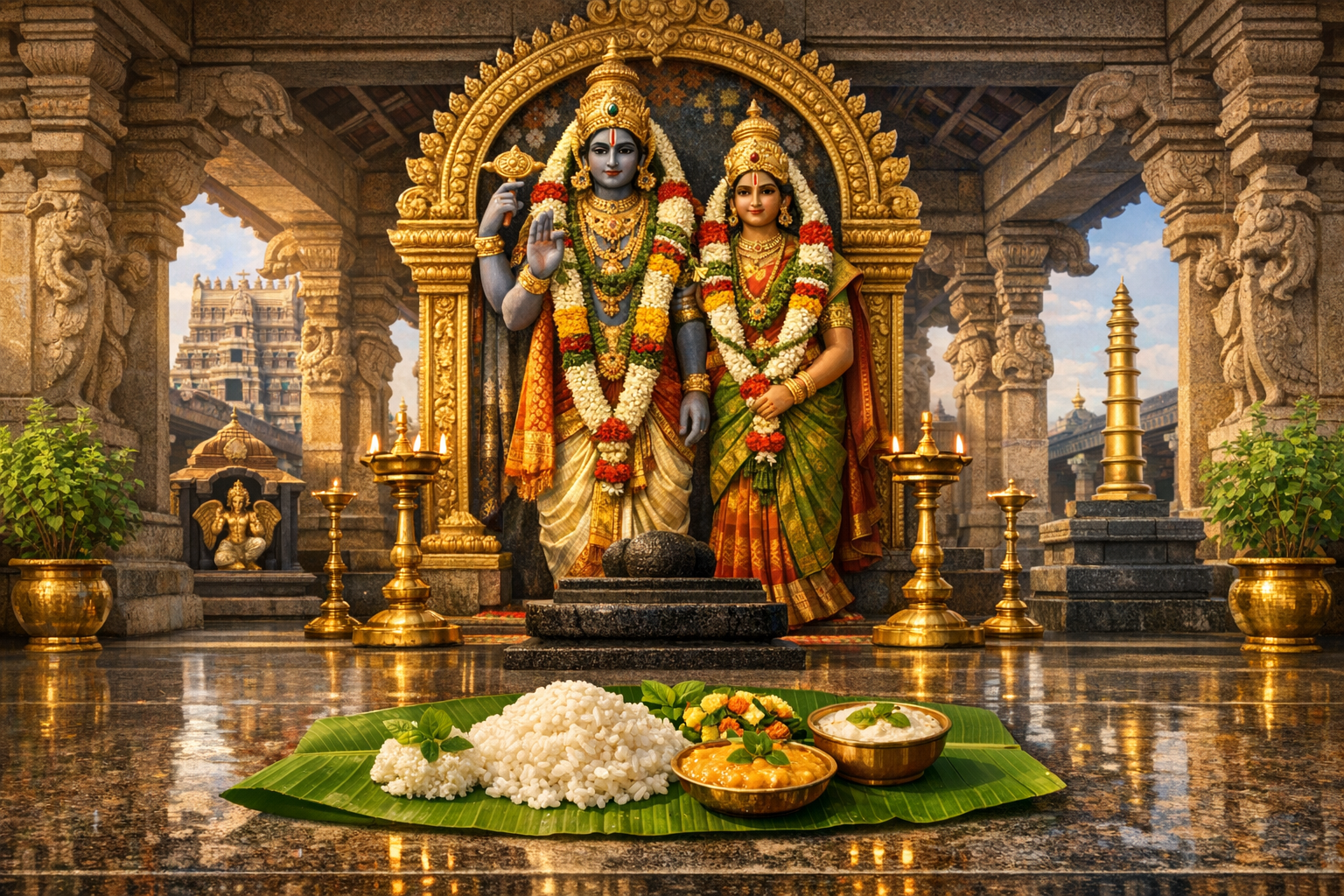
Oppiliappan Temple at Thiruvinnagar near Kumbakonam stands among the revered 108 Divya Desams, enshrining Vishnu as Oppiliappan and celebrating the sacred marriage to Bhumi Devi. The temple’s living traditionoffering all naivedyam without saltembodies a profound theological vow and a distinctive Vaishnava practice that continues to shape devotional life, ritual aesthetics, and ethical reflection.
Etymologically, Oppiliappan is parsed in two interwoven ways in Tamil devotional memory. As oppu illā appan, it proclaims the Lord “without equal,” emphasizing transcendence and supreme compassion. As uppu illā appan, it alludes to the Lord “who accepts food without salt,” distilling into one practice the tenderness and unconditional grace that characterize this shrine’s sthala-purāṇa.
The sacred narrative situates Bhumi Devi within Vaishnava cosmology as Lakshmi’s manifestation as Earth, consonant with the Purāṇic arc in which Vishnu, the sustainer, unites with the life-bearing ground of all beings. In this reading, the marriage of Vishnu and Bhumi Devi becomes more than a mythic episode: it expresses the perennial intimacy between divine sustenance and the planet that nourishes and shelters all creatures.
Thiruvinnagar’s sthala-purāṇa, preserved in oral traditions and temple liturgy, recounts how the sage Markandeya’s penance invoked Vishnu’s presence and grace. One cherished strand narrates that the sage found an infant girl near a tulasi grove, raised her with meticulous devotion, and named her Bhumi Devi. When the time of marriage approached, an ascetic suitorVishnu self-disclosedsought her hand. Markandeya hesitated, citing her youth and remarking that she was unaccustomed to cooking with salt. Vishnu’s response, that He would accept only saltless offerings henceforth, transformed hesitation into revelation, sealing the divine union at Thiruvinnagar.
This vow continues to structure daily worship. All naivedyam prepared for Oppiliappan is without salt, a norm observed in ritual kitchens and shared prasadam. Devotees often note how the flavor profilesubtle, clean, and mindfulbecomes a spiritual pedagogy in itself, training the palate toward sattva (clarity and balance) and focusing attention on gratitude over gustatory intensity.
Doctrinally, the saltless offering may be read as a sign of unconditional anugraha (grace): the Lord meets devotees where they are, removing conditions and hierarchies of worthiness. In an allied ethical register, it affirms the humility of annadānafood as servicerecalling shared dharmic sensibilities that honor simple sustenance and hospitality as sacred acts.
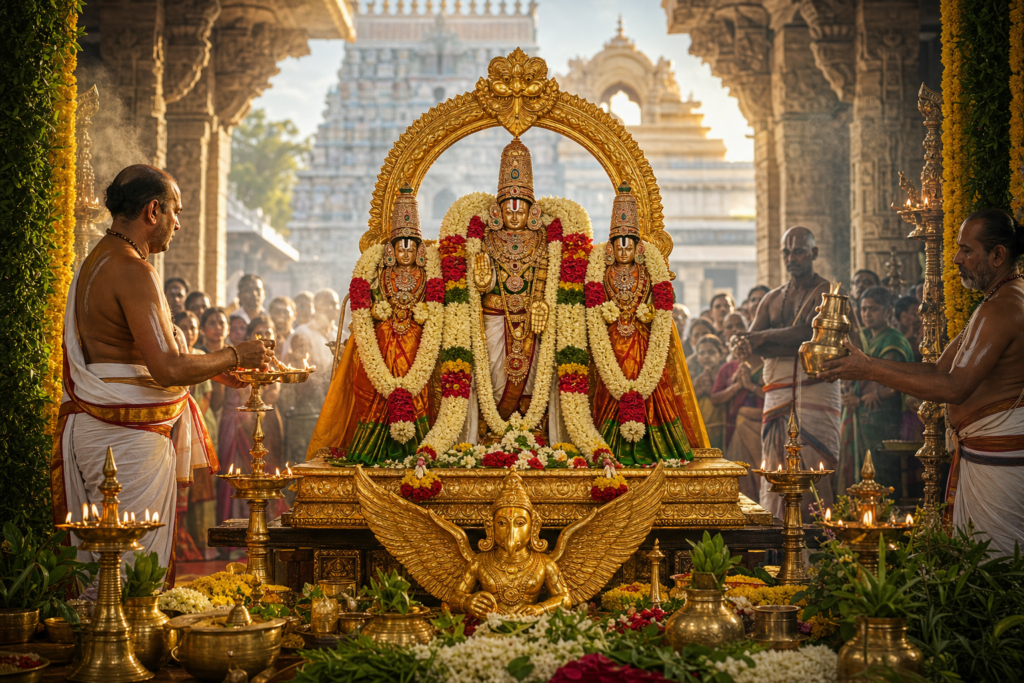
Daily worship (nitya-ārādhanā) at Thiruvinnagar follows the Vaishnava Agamascommonly Vaikhānasa or Pañcarātracomprising sequences of alankāra (adornment), naivedyam (here, without salt), and dīpa-ārādhanā (lamp offering). The standard arc of services spans dawn to late nightUshatkālam, Kālasandhi, Uchikālam, Sāyarakṣai, and Ardha-jamamwith Divya Prabandham recitations enlivening the ritual soundscape. Tulasi worship and garlands remain integral to the temple’s devotional idiom.
Iconographically, the mūlavar (main icon) presents Vishnu in a serene standing posture, with shankha (conch) and chakra (discus) denoting protection and order, while Bhumi Devi stands in close attendance, signifying the immediacy of Earth’s grace. A shrine for Garuḍa, a dhvaja-stambha (flagstaff), and a bali-pīṭha (sacrificial plinth) align the processional and liturgical axes, balancing metaphysical symbolism with embodied ritual movement.
The temple’s form exemplifies Dravidian architecture of the Kaveri delta: a tiered gopuram marking sacred ingress, concentric prakarams (enclosures) guiding circumambulation, and a sequence of mandapas mediating the devotee’s approach to the garbhagṛha (sanctum). While precise construction phases reflect multiple periods, stylistic features and epigraphic patterns across the region suggest strong Chola foundations with later Nayaka-era enhancements, consistent with the broader development of Kumbakonam’s temple network.
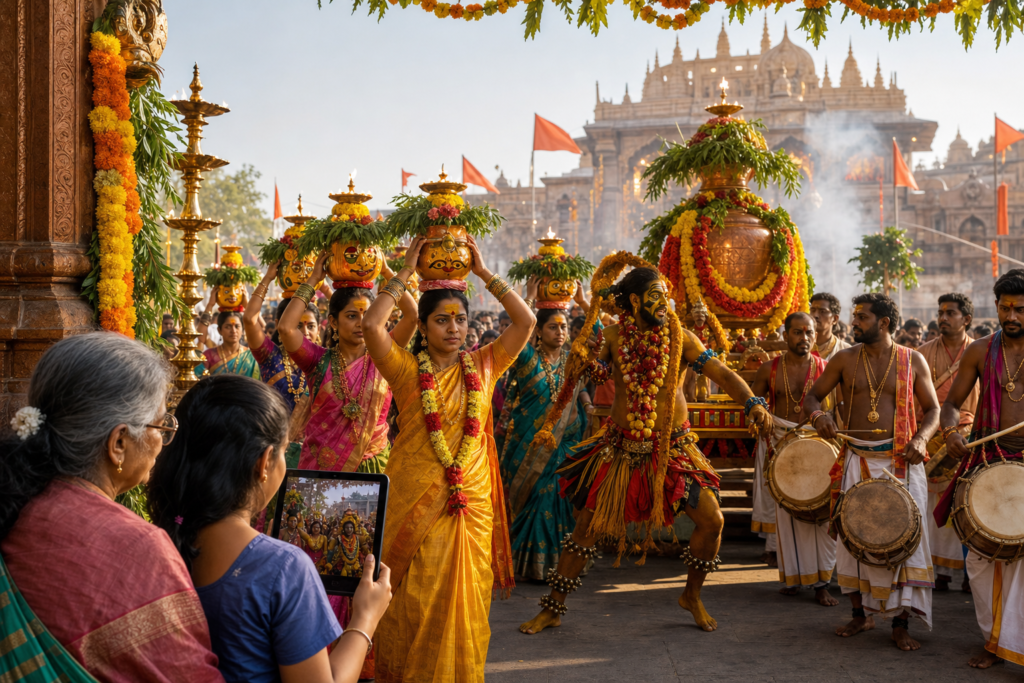
Festivals at Oppiliappan Temple articulate theology through pageantry and collective devotion. Vaikuntha Ekadashi is observed with special solemnity; the month of Purattasiparticularly on Śravaṇa (Tiruvonam) nakṣatraattracts heightened worship; and the divine wedding (Thirukalyāṇam) is celebrated with customary grandeur. Brahmotsavam, Pavitrotsavam, and deepam-centric observances further integrate ritual cycles with communal participation and sacred aesthetics.
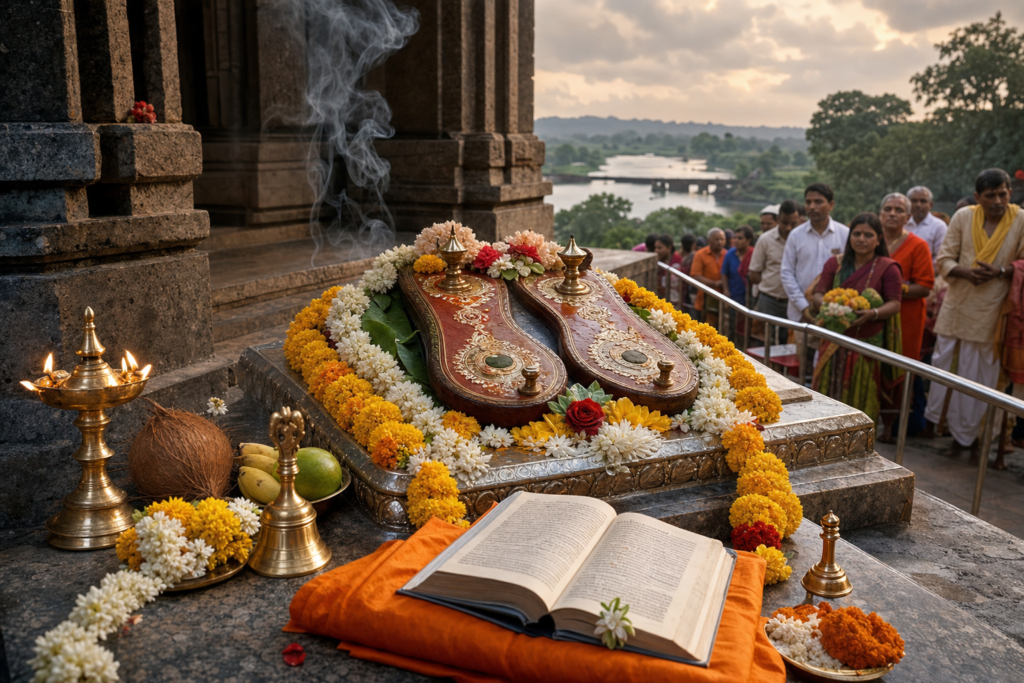
Hymnologically, Thiruvinnagar is lauded in the Nālāyira Divya Prabandham, where the Āḻvārs’ verses offer mangalāśāsanam (benediction) upon Oppiliappan. In the shared exegetical tradition, the site is read alongside Purāṇic narrativesVarāha’s rescue of Bhumi and Lakshmi’s boundless compassioncreating a textured theological tapestry in which Earth, fortune, and preservation coinhere around Vishnu’s grace.
The marriage of Vishnu and Bhumi Devi at Thiruvinnagar may be fruitfully interpreted through the lens of dharmic pluralism. Hinduism honors Bhumi as mother in the Prithvi Sukta (Atharva Veda 12.1), Vaishnava liturgy reveres her as Bhudevi, and allied traditions sustain parallel motifs: in Buddhism, the “Earth Witness” moment during the Buddha’s enlightenment signals the planet as a witness to truth; in Jainism, ahiṃsā extends compassionate regard even to prithvi-kāya jīvas (earth-bodied life forms), fostering ecological restraint; and in Sikhism, the inclusive practice of langar mirrors annadāna’s ethos of dignity in shared meals. These convergences illuminate a common civilizational ethic: Earth is sacred, nourishment is service, and social harmony is a spiritual imperative.
Within this framework, the temple’s saltless vow acquires ecological and ethical resonance. Reducing lavana (salt)a potent taste in Ayurvedasymbolically tempers excess, aligning diet with sattva and disciplining desire. The practice cultivates attentiveness to the essentials of nourishment and to the planet that makes nourishment possible, echoing Bhumi Devi’s presence as both theological principle and environmental reminder.
Visitors frequently recount a gentle transformation in sensibility while partaking of Oppiliappan’s prasadam. What appears at first to be a culinary limitation becomes a contemplative aid; the mind notices aroma, texture, and the quiet sweetness of grains and vegetables. In the shared silence of the mandapa, such subtlety evokes humility and gratituderelatable experiences that bind devotees across regions and life stages.
Ritual etiquette at Thiruvinnagar is shaped by this ethos. Devotees customarily avoid presenting salted offerings; tulasi, flowers, and fruits are preferred. Many pilgrims observe vrata on Śravaṇa nakṣatra, read Āḻvār hymns linked to the shrine, and join group recitations that reinforce community devotion. The temple’s cadence thus educates through participation, offering a model of embodied theology accessible to households and monastic communities alike.
Regionally, Oppiliappan Temple belongs to the dense sacred geography surrounding Kumbakonam, where major Vaishnava and Shaiva shrines interrelate through pilgrimage circuits, riverine symbolism, and seasonal fairs. This spatial network enhances the experiential depth of Thiruvinnagar, situating Oppiliappan’s compassion amid a constellation of temples that collectively narrate the Dharmic imagination of the Kaveri delta.
Scholars and practitioners alike read Thiruvinnagar as a locus where narrative, ritual, and architecture converge. The Dravidian gopuram articulates ascent into the sacred; mandapas choreograph communal devotion; and the garbhagṛha holds the still center of darśan. The temple’s agamic routines and hymnological associations create a “living archive” through which visitors encounter both the historic Oppiliappan Koil and its ever-renewing present.
As a theological sign, Vishnu’s marriage to Bhumi Devi at Oppiliappan Temple proclaims that protection (rakṣaṇa) and provision (poshana) are inseparable. In affirming Earth’s dignity within the ambit of divine love, the temple offers a civilizational lesson of enduring relevance: devotion matures into stewardship, and grace flowers as responsibility toward each other and the planet we share.
In sum, Oppiliappan Temple in Thiruvinnagar preserves a uniquely compassionate liturgysaltless naivedyamrooted in a luminous marriage narrative and framed by the Dravidian artistry of the Kaveri heartland. It remains a place where pilgrims experience Vishnu’s boundless grace through Bhumi Devi’s gentle presence, and where Hindu, Buddhist, Jain, and Sikh sensibilities toward Earth, food, and fellowship can meet in mutual recognition.
Inspired by this post on Hindu Blog.