
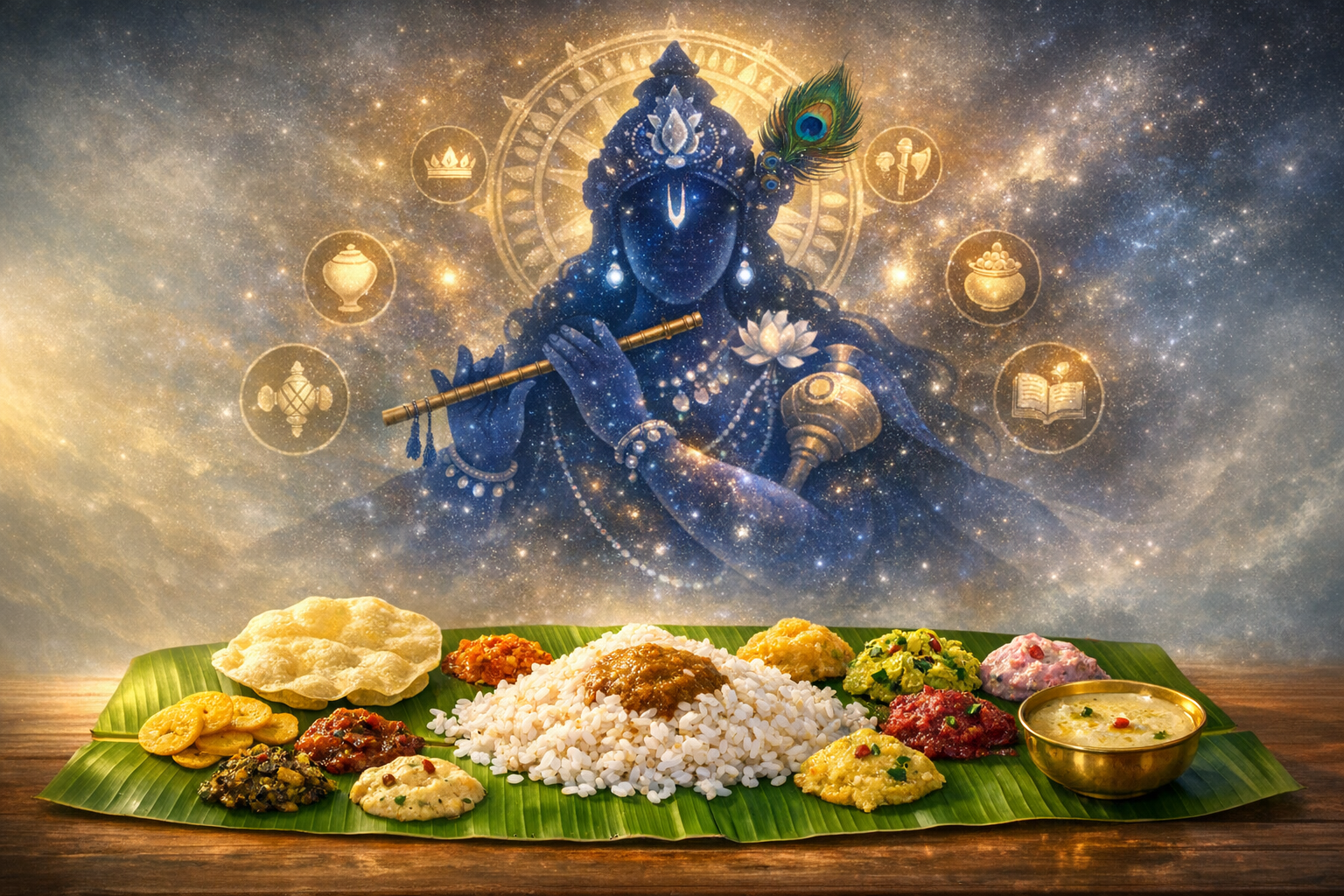
In Kerala, a traditional Sadhya arrives on a banana leaf as a constellation of more than twenty dishes—rice, sambar, avial, payasam, pickles, pappadam, thoran, and pachadi—each complementing the other in texture, taste, and nutrition. To eat only the payasam and then claim to have known the Sadhya would be to miss the very point of the meal’s design: wholeness achieved through a carefully harmonized diversity. The same principle illuminates how Krishna is to be understood in Hindu philosophy: the complete Sri Krishna cannot be grasped through a single attribute, pastime, or mood; the fuller vision emerges only when the many dimensions are perceived together.
Religious understanding often falters through reductionism—the tendency to fixate on one facet and universalize it. In the study of Hindu traditions, such partialism becomes a methodological error, overlooking how scriptural sources, ritual practices, and lived devotion interlock to present a unified theological whole. Approaching Krishna through only one rasa (devotional flavor), one lila (divine play), or one title (such as Govinda or Parthasarathi) is akin to sampling just one dish of the Sadhya; it yields taste, not totality. A sound hermeneutic must, therefore, attend to the breadth of Vaishnava theology and the depth of lived bhakti.
Within Hindu philosophy, the term Bhagavān signifies the one who possesses the six complete opulences (ṣaḍ-aiśvarya): aiśvarya (sovereignty), vīrya (energy or valor), yaśas (fame), śrī (prosperity), jñāna (knowledge), and vairāgya (detachment). Sri Krishna is described in the Bhagavata Purana and allied Vaishnava traditions as the purna-avatara, the fullest personal manifestation of the Divine. This definition underscores a key principle: completeness is not a mere aggregate of parts but the integral presence of all divine qualities in perfect balance. Any approach that absolutizes a single quality risks obscuring the integrated character that Bhagavān connotes.
The Bhagavad Gita advances this integral vision in two complementary chapters often studied together for this reason. Chapter 10 (Vibhuti-Yoga) catalogs the divine manifestations across the cosmos—Krishna as the essence in the greatest of beings, qualities, and phenomena—encouraging seekers to perceive divinity in the world’s manifold excellences. Chapter 11 (Vishvarupa-Darshana) then reveals the Vishvarupa, the all-encompassing cosmic form, dissolving partial viewpoints into a direct encounter with totality. The text thereby offers an epistemic progression: discern the many to intuit the One; then behold how the One holds the many within itself.
Scriptural narrative further sustains this layered completeness. The Bhagavata Purana presents Krishna as both the intimate cowherd of Vraja (mādhurya, sweetness) and the sovereign Lord of Dwaraka (aiśvarya, majesty), and as the charioteer-counselor at Kurukshetra who anchors dharma during crisis. Each role, when viewed in isolation, yields a partial devotion; only when Gopāla, Vāsudeva, Dwarkādheesh, and Parthasārathi are contemplated together does the theological portrait approach wholeness. The lila-spectrum—from playful flute melodies in Vṛndāvana to statecraft and ethical counsel in the Mahabharata—invites a comprehensive spiritual pedagogy.
Classical Vaishnava theology, particularly in the Pāñcharātra tradition, articulates a structured account of divine manifestations through the vyūhas—Vāsudeva, Saṅkarṣaṇa, Pradyumna, and Aniruddha—offering an ontological map for how transcendence interfaces with creation, cognition, and governance. This schema does not fragment the Divine; it clarifies modes of functional expression. Read alongside the Bhagavad Gita and the Bhagavata Purana, the vyūha doctrine reinforces that completeness entails both unity and multiplicity without contradiction.
Different Vedantic sampradāyas also emphasize complementary angles: Advaita highlights the non-dual substratum (Brahman), Viśiṣṭādvaita presents a qualified non-dualism where the Divine is the inner controller of diverse attributes, and Dvaita underscores the distinction between the Supreme and the individual self. Gaudiya Vaishnavism’s acintya-bhedābheda (inconceivable oneness and difference) gathers these insights into a paradox-friendly synthesis. Engaging these darśanas together curbs sectarian narrowing and trains perception toward the whole.
Bhakti itself is polymorphous yet coherent. The tradition identifies primary devotional rasas—śānta (reverence), dāsya (service), sakhya (friendship), vātsalya (parental love), and mādhurya (conjugal sweetness)—that together form a spectrum of relationship to the Divine. Favoring a single rasa can foster depth, yet awareness of the larger spectrum prevents sentimental absolutism. In practice, seekers often mature by first stabilizing in one relationship-model and then gently expanding empathy to appreciate others, mirroring how a balanced Sadhya complements sweet, sour, salty, bitter, pungent, and astringent tastes.
The nava-vidha-bhakti (ninefold devotion)—śravaṇa (listening), kīrtana (chanting), smaraṇa (remembrance), pāda-sevana (service to the Divine presence), arcana (worship), vandana (prostration/praise), dāsya (servitude), sakhya (friendship), and ātma-nivedana (self-surrender)—offers a practical “menu” that resists single-technique fixation. A life of devotion that regularly rotates through these modalities strengthens comprehension, experience, and ethical integration. As with the Sadhya, variety is not distraction; it is design.
The cultural metaphor of Sadhya is especially apt because it encodes an epistemology of completeness into daily life. Served on a banana leaf, the meal directs attention to placement, sequence, and proportion; each component influences the whole. Similarly, a well-ordered spiritual life honors the seasonality of festivals (Janmashtami, Govardhan Puja, Gita Jayanti), the alternation of study (svādhyāya) and song (kīrtana), the rhythm of meditation and service (seva), and the integration of ethical vows with contemplative insight. Completeness is cultivated through cadence.
From a methodological standpoint, three classical means—śāstra-pramāṇa (scriptural testimony), yukti (reasoning), and anubhava (direct experience)—should converge. Śāstra prunes errors of subjectivity; yukti guards against misinterpretation; anubhava tests vitality in lived practice. If any one is over-emphasized, imbalance ensues: pure intellectualism may become arid, unmoored experience can drift, and unexamined citation risks dogmatism. Their triangulation yields a stable, whole vision of Krishna and of dharma.
Inter-dharmic reflections strengthen this orientation toward wholeness. Jainism’s anekāntavāda (many-sidedness) cautions against absolutizing partial truths, encouraging humility before complexity. Buddhism’s upāya (skillful means) and the doctrine of two truths (conventional and ultimate) legitimize layered approaches to reality, echoing the Gita’s graded revelations. Sikh wisdom begins with Ik Onkar, emphasizing a singular reality that pervades multiplicity. Such resonances do not collapse distinct paths; rather, they affirm a shared civilizational ethic: unity in spiritual diversity.
Ishta-devatā (chosen form of the Divine) is often misunderstood as permission for narrow vision; the tradition intends the opposite. Ishta is a pedagogical gateway—a personalized entry through which the seeker grows into appreciation of the Infinite’s plenitude. Respect for another’s Ishta is not mere tolerance; it is recognition that the Divine’s completeness surpasses any single conceptual frame. Thus, honoring different devotional doors strengthens, not weakens, one’s own fidelity to Krishna’s wholeness.
Common pitfalls in devotional life map cleanly onto the Sadhya metaphor. Sentimental reductionism clings only to mādhurya without revering dharma-anchoring counsel; moral reductionism fixates on instruction without tasting the sweetness that makes virtue livable; historical reductionism treats Krishna as a figure of the past while neglecting the ever-present Paramatma; and aesthetic reductionism prefers music and poetry but sidelines disciplined practice. The corrective is not less devotion but a more symphonic devotion.
Practical integration can follow a simple weekly cadence. Dedicate study periods to Bhagavad Gita chapters 10 and 11 to rehearse the logic of completeness; add selections from the Bhagavata Purana that move between Vraja-lila and statecraft in Dwaraka. Balance kīrtana with quiet japa, communal seva with solitary contemplation, temple arcana with scriptural reflection. Across the month, align practices with festival observances so that personal rhythm harmonizes with cultural-historical memory.
Community life offers further completeness: satsanga (good company) introduces perspectives one might not reach alone, and inter-tradition dialogues among Hindus, Buddhists, Jains, and Sikhs nurture mutual learning without erasing distinct commitments. Shared service projects ground lofty insights in tangible compassion. In this way, spiritual diversity ceases to be a challenge and becomes a resource for clarity.
Ethically, a whole vision of Krishna yields a whole vision of duty. Parthasarathi’s counsel in the Mahabharata insists that right action (karma-yoga) be tethered to insight (jnana) and devotion (bhakti). The synthesis prevents activism from becoming restless, contemplation from becoming escapist, and ritual from becoming mechanical. Dharma, like a well-prepared Sadhya, is nutritious only when its elements are proportionate.
Pedagogically, the Sadhya can even guide how learning unfolds. Beginners may start with a “sweet dish”—a beloved bhajan or a favorite image of Krishna—while mentors gradually introduce savory, subtle, and even austere “flavors”: philosophy, ethics, and disciplined practice. Over time, palate and perception expand together, and the seeker discovers that the earlier sweetness is now richer because it is supported by understanding.
This integrative posture also strengthens resilience. Life’s alternating seasons—festivity and fasting, victory and vulnerability—mirror devotional rasas. When a seeker has cultivated multiple relationships to the Divine and multiple practices of engagement, no single life-event can exhaust spiritual resources. Completeness equips one to remain steady.
The Kerala Sadhya ends not with payasam alone but with the satisfaction that every dish found its place and purpose. So too with the pursuit of Krishna: fulfillment arrives when Gopāla’s intimacy, Krishna’s counsel, Vishvarupa’s awe, and Bhagavān’s six opulences are held together in the heart. Partial visions delight; complete vision transforms.
A final implication follows for the broader dharmic family: unity is not uniformity. Hindus, Buddhists, Jains, and Sikhs can honor their distinct revelations while cultivating the shared discipline of resisting reductionism. The civilizational ethos—Vasudhaiva Kutumbakam—invites a world where completeness in understanding fosters completeness in compassion.
Do not stop at one dish. Knowing Krishna in his complete form is the Sadhya of a life well-lived.
Inspired by this post on Hindu Blog.











Leave a Reply
You must be logged in to post a comment.