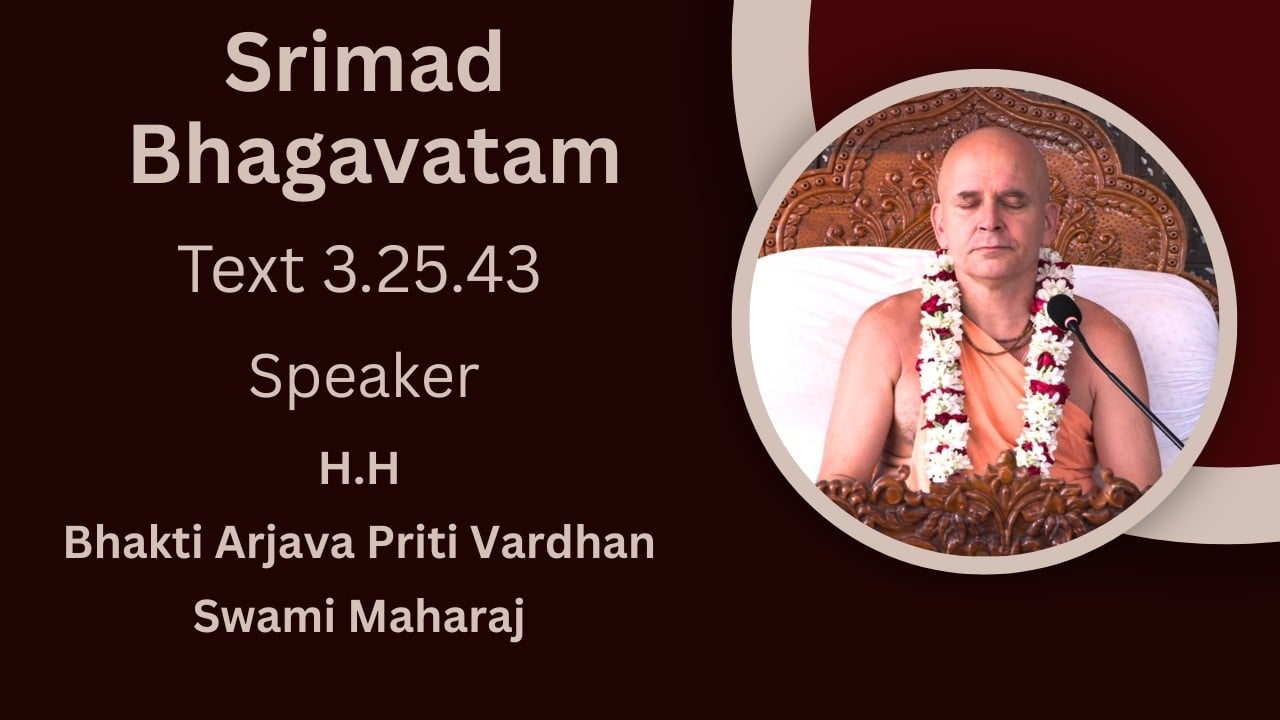
Śrīmad-Bhāgavatam Canto 3, Chapter 25 culminates in a set of verses that crystallize the theistic synthesis known as bhakti‑sāṅkhya—Kapila Muni’s revelation that spiritual science attains completion only when discriminative analysis is joined to loving devotion. In a lucid discourse on ŚB 3.25.43 for Mayapur TV – English, H.H. Bhakti Arjava Priti Vardhan Swami Maharaj situates the text in its narrative arc—Kapila addressing Devahūti—and emphasizes how association with realized practitioners, sustained hearing of divine narrations, and steady service collectively reconfigure consciousness toward direct realization of the Supreme.
Within the Bhāgavatam’s architecture, Chapter 25 operates as a doctrinal keystone. It surveys the qualities of genuine sādhus, explains the catalytic force of sādhu‑saṅga, describes the progression from faith to mature love, and then shows how such devotion confers experiential knowledge that transcends mere speculation. ŚB 3.25.43, near the chapter’s close, consolidates these themes by underscoring bhakti as the direct and sufficient means for God-realization, provided the heart is clarified through association and disciplined practice.
Historically and philosophically, Kapila’s bhakti‑sāṅkhya is distinct from later non-theistic Sāṅkhya systems. While classical Sāṅkhya offers a rigorous taxonomy of puruṣa and prakṛti and their evolutes, Kapila unambiguously affirms the supremacy of the personal Absolute and the indispensability of devotion. This theistic Sāṅkhya accepts analytic clarity (viveka) and ontological mapping of the guṇas, yet it insists that analysis alone cannot deliver the intimacy of pareśānubhava—the living experience of the Supreme Person—without bhakti.
The chapter’s middle movement, echoed throughout the discourse, highlights sādhu‑saṅga as the first operative cause in transformation. The Bhāgavatam profiles sādhus as forbearant, compassionate, friendly toward all beings, and fixed in truth; their speech becomes a “rasāyana” for the heart and ear. In this company, hearing about the Lord rapidly aligns a practitioner with the apavarga‑vartman—the path of emancipation—where śraddhā ripens into rati and then into steadfast bhakti. The progression is not sentimental; it is a reproducible psychology of spiritual change described with precision.
Epistemologically, the chapter advances a triad of pramāṇa: śabda (scriptural testimony), yukti (reason), and anubhava (realized insight). It privileges śabda as the unfailing guide yet holds that the proof of śabda is verified in purified anubhava, made possible by bhakti‑yoga. The discourse underscores that, in the Bhāgavatam, devotion is not merely an emotion but an ontic method that grants access to realities beyond the bandwidth of unaided sense and inference.
Read in this frame, ŚB 3.25.43 affirms a mature synthesis: when consciousness is softened and clarified by association and service, the Supreme becomes knowable through bhakti alone, and the residual adhesions of rajas and tamas lose their purchase. The verse belongs to a concluding cluster that sets bhakti above the oscillations of karma and the abstractions of mere jñāna, not by dismissing ethics or knowledge, but by completing them within a personalist telos.
Gauḍīya Vaiṣṇava commentators give the chapter a finely graded hermeneutic. Śrīdhara Svāmī preserves the logical spine of theistic Sāṅkhya; Jīva Gosvāmī shows in the Bhakti‑sandarbha how sādhu‑saṅga transduces śraddhā into abiding taste; and Viśvanātha Cakravartī Ṭhākura details how service purifies citta so that the presence of Bhagavān is apprehended as self‑evident. Their readings converge on a unified claim: bhakti is both means and end, method and realization.
From a practice perspective, ŚB 3.25 animates the classic arc that Gauḍīya teachers often describe—śraddhā → sādhu‑saṅga → bhajana‑kriyā → anartha‑nivṛtti → niṣṭhā → ruci → āsakti → bhāva → prema. Śravaṇa and kīrtana stabilize attention; smaraṇa and arcana refine interiority; sevā sublimates agency; and association keeps the discipline honest and affectively warm. Over time, ceto‑darpaṇa‑mārjanaṁ—the cleansing of the mirror of the mind—becomes palpable as restlessness recedes and clarity grows durable.
The chapter’s psychology is remarkably contemporary. By mapping the guṇas as drivers of cognition and behavior, Kapila anticipates an integrative science of mind. Rajas disperses and inflames; tamas occludes and drags; sattva clarifies and steadies. Bhakti‑yoga does not merely repress rajas and tamas; it reorients their energies under sattva and then carries the practitioner beyond even sattva’s ceiling into direct devotion. Listeners routinely report that, with regular kīrtana and śravaṇa, anxiety attenuates, reactivity softens, and attention deepens—outcomes that align with the text’s predictive model.
Ethical formation is integral, not optional. The qualities Kapila extols—titikṣā, karuṇā, and friendliness toward all beings—translate into ahiṁsā, truth-telling, restraint, and generosity in daily life. The discourse clarifies that this virtue‑ethic is not peripheral to realization; it is the very ecology in which realization becomes stable and communicable, creating communities that heal rather than harm.
In a broader dharmic frame, the chapter’s stress on sādhu‑saṅga resonates across traditions. Buddhism’s saṅgha, Jainism’s satsaṅga and vows of ahiṁsā and aparigraha, and Sikhism’s sangat and nām‑kīrtan all value communal practice, ethical refinement, and remembrance of the Divine. Read this way, ŚB 3.25.43 serves unity rather than exclusivism: it models how rigorous analysis and heartfelt devotion can coexist with empathy and respect for complementary paths within the dhārmika family.
The medium of delivery matters for contemporary seekers. Mayapur TV – English extends the reach of such scriptural expositions, enabling diaspora communities to embed śravaṇa into daily schedules and to sustain sādhu‑saṅga across distance. Observers frequently note that regular participation in these sessions anchors family routines, supports youth in value‑formation, and provides elders with structured opportunities for study and contemplation.
Pedagogically, H.H. Bhakti Arjava Priti Vardhan Swami Maharaj’s treatment of ŚB 3.25.43 balances fidelity to Sanskrit nuance with accessible explanation. Listeners encounter an academically careful account of bhakti‑sāṅkhya that neither dilutes doctrine nor lapses into sectarianism. The approach demonstrates how a text can be both historically situated and presently actionable, with clear outlines for disciplined practice.
Applied in everyday life, the chapter invites three simple commitments that scale with one’s capacity: keep company with those who ennoble; hear and speak narrations that heal the heart; and convert insight into service. As these become habits, the cumulative effect mirrors the chapter’s promise—faith consolidates into taste, taste into love, and love into a stable, unforced awareness of the Divine that is at once personal and universally compassionate.
Taken together, ŚB 3.25.43 and its surrounding verses present a complete science of spiritual transformation—analytically sharp, ethically demanding, and emotionally intelligent. For Hinduism’s Bhakti Tradition and for kindred streams in Buddhism, Jainism, and Sikhism, the message is clear: communal practice and loving remembrance are not merely consolations; they are robust technologies of liberation that dignify human life and harmonize plural paths within a shared dharmic horizon.
Inspired by this post on Dandavats.