Selecting the best days for Hanuman Puja through Nakshatras and Tithis is a time-tested practice rooted in the Panchanga and the discipline of Muhurta Shastra. When approached with clarity, this framework supports devotion with rhythm, intention, and astrological precision, while remaining inclusive of regional customs and family traditions within the broader dharmic heritage.
In Panchanga-based timing, five limbs are considered: Vara (weekday), Tithi (lunar day), Nakshatra (lunar constellation), Yoga, and Karana. For Hanuman Puja, the most accessible and impactful combination is built around the weekday, Tithi, and Nakshatra, complemented by simple filters such as Chandrabala (Moon’s strength for the native), Tarabala (star-based strength), and avoidance of daily inauspicious segments like Rahu Kalam and Yamaganda.
Weekday selection is foundational. Tuesday (Mangalvar) and Saturday (Shanivar) are traditionally preferred for Hanuman Puja. Tuesday aligns with Mars and the cultivation of courage, discipline, and resolute action, qualities celebrated in Shri Hanuman’s character. Saturday links devotion to relief from Shani-related hardships; for many households, a lamp lit for Hanuman on Saturday evening symbolizes protection, steadiness, and inner resilience.
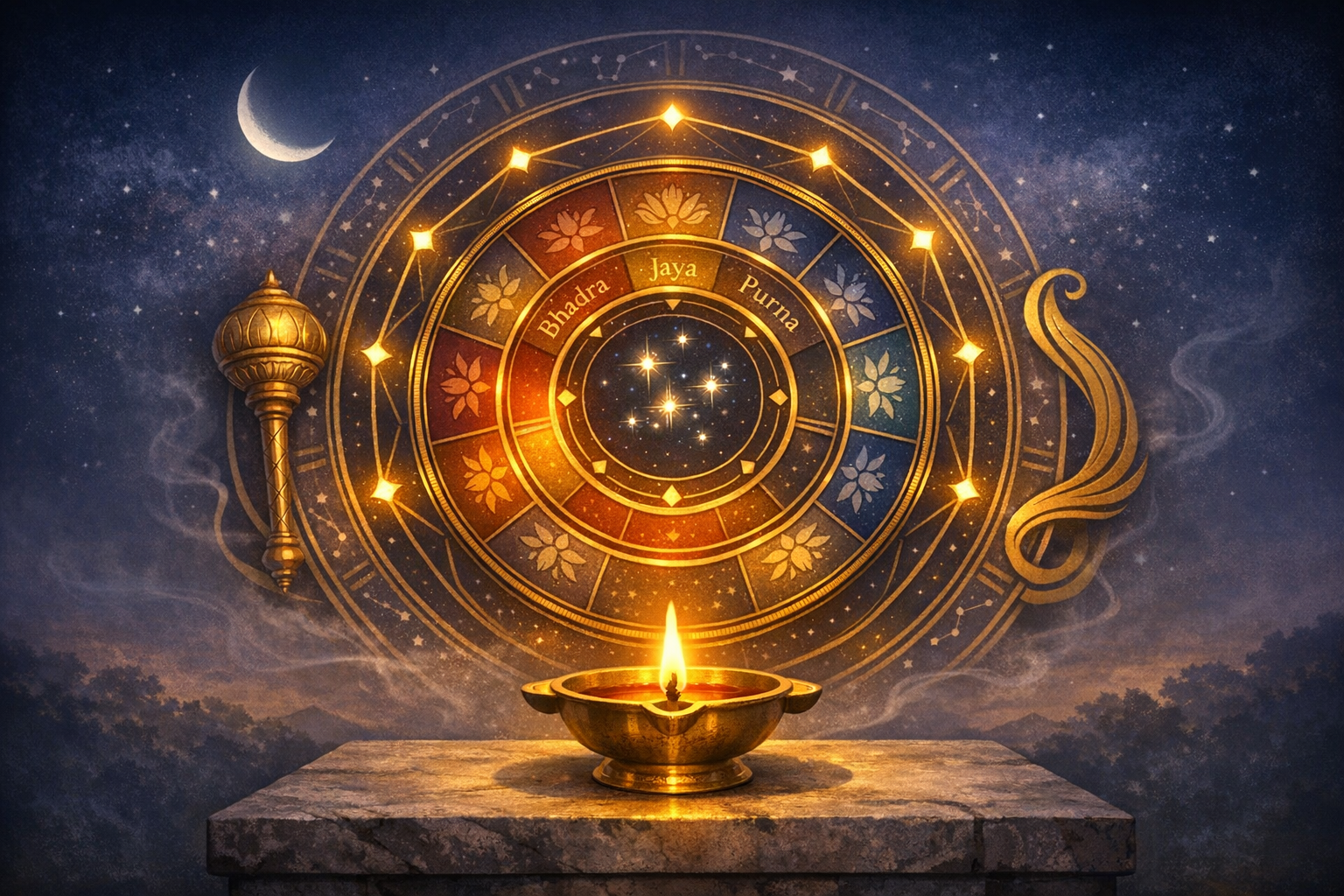
Tithi selection benefits from the classical Nanda–Bhadra–Jaya–Rikta–Purna cycle, which repeats every five Tithis. For devotional works such as Hanuman Puja, practitioners typically favor Bhadra (Tithi numbers 2, 7, 12), Jaya (3, 8, 13), and Purna (5, 10, 15), with Purnima often reserved for collective worship and scriptural recitation. Rikta Tithis (4, 9, 14) are traditionally avoided for starting new undertakings, yet experienced practitioners may use them for remedial or protective observances under qualified guidance. The overarching principle remains simple: devotion is never invalidated by the calendar, yet the calendar can amplify devotion.
Nakshatra selection refines the window further by anchoring the Puja to the Moon’s position. Pushya is widely recognized across muhurta texts as auspicious for most sacred activities, and many almanacs specifically note that in Chaitra Month, Pushya Nakshatra is highly meritorious for Hanuman Puja. Beyond this, regional Panchangas often preserve month-specific pairings of Nakshatras for Hanuman; because such lists differ by tradition, it is prudent to follow the almanac or priestly guidance used in one’s community.
Tarabala adds personalization without complexity. Count from one’s Janma Nakshatra (birth star) to the day’s Nakshatra, cycling through a ninefold sequence: Janma, Sampat, Vipat, Kshema, Pratyak, Sadhana, Naidhana, Mitra, Ati-Mitra. Favorable Taras for devotional acts include Sampat, Kshema, Sadhana, Mitra, and Ati-Mitra, while Vipat, Pratyak, and Naidhana are generally avoided. This quick check ensures the selected Nakshatra is supportive relative to one’s natal star.
Chandrabala evaluates the Moon’s sign-based strength relative to one’s Janma Rashi. Positions 1, 3, 6, 7, 10, and 11 from the Janma Rashi are considered favorable for most spiritual practices. If a chosen Tuesday or Saturday lacks Chandrabala, many devotees still proceed, giving precedence to regularity of worship, though where feasible they select a date that satisfies both Chandrabala and Tarabala.
Practical assembly of a muhurta works like this. Start by marking Tuesdays and Saturdays in the chosen month. Within those, select a Tithi from the Bhadra–Jaya–Purna grouping, or a festival date pertinent to Hanuman. Then, prioritize days when the Moon occupies an auspicious NakshatraPushya is universally safeand, where possible, ensure favorable Tarabala and Chandrabala. Finally, schedule the Puja outside Rahu Kalam and Yamaganda; if a single window must be chosen by all, Abhijit Muhurta around midday is a time-honored fallback.
Monthly planning benefits from a simple rhythm. In each month, earmark Tuesdays and Saturdays for steady sadhanaHanuman Chalisa, Sundara Kanda parayan, or Panchopachara Pujathen elevate one of those days when the month’s designated Nakshatra (as listed in the local Panchang) occurs. For those who observe an anushthana, completing a vrata for 11, 21, or 41 consecutive Tuesdays is a common and effective discipline.
Special observances further enrich the calendar. Hanuman Jayanti is widely kept on Chaitra Purnima in many regions, while certain southern traditions align Hanuman Jayanti with a different lunar phase or with Moola Nakshatra in Margazhi. Each of these observances is auspicious in its own right. The shared essence is remembrance of Hanuman’s unwavering bhakti to Sri Rama and the cultivation of strength, clarity, and service.
Yogas and Karanas can be considered for added refinement. Devotees often favor Siddha or Amrita Siddhi Yogas and avoid Vyatipata and Vaidhriti when possible. For those not trained in advanced muhurta calculations, observing Puja during Brahma Muhurta before sunrise or during Abhijit Muhurta provides a dignified, accessible alternative that aligns with classical guidance.
Saturday evenings during Pradosh Kala hold a distinct place in household practice, with Hanuman worship often combined with prayers for relief from Shani-related obstacles. Some practitioners also find value in selecting Mangal Hora on Tuesdays to emphasize courage and right action, especially when undertaking new disciplines such as a vow of regular Hanuman Chalisa recitation.
Experientially, consistent Tuesday or Saturday worship fosters a stabilizing cadence in daily life. Many devotees recount a palpable steadiness and protection as they progress through a vrata, while families describe the shared lighting of a lamp for Hanuman as a weekly anchor that connects generations through a living, participatory tradition.
These timing practices reflect an ecumenical Panchanga discipline shared in spirit across dharmic pathways. While Hanuman Puja is a distinctly Hindu observance, the underlying respect for auspicious time, lunar rhythms, and ethical intention resonates with communities in Buddhism, Jainism, and Sikhism that also honor calendrical cycles, disciplined practice, and compassionate service.
A clear, community-aligned plan serves most households best. Identify the local Panchang in use, note Tuesday and Saturday preferences, confirm the month’s highlighted Nakshatra for Hanuman where prescribed, and harmonize these with Tarabala, Chandrabala, and practical constraints of family life. When regional or lineage instructions differ, trust the living tradition that has nourished the community; such diversity is a strength, not a conflict.
Equally important is the reminder, affirmed by teachers across traditions, that inner disposition is sovereign. When life’s pressures disrupt the perfect muhurta, sincere remembrance and devoted action remain fully efficacious. Calendrical refinement amplifies devotion; it does not replace it.
In summary, the best days for Hanuman Puja emerge at the intersection of practice and principle: Tuesday and Saturday as reliable pillars, Bhadra–Jaya–Purna Tithis as supportive currents, Pushya Nakshatra as a universally auspicious anchorespecially in Chaitraand personalization through Tarabala and Chandrabala. Within this blueprint, every home can build a schedule that is precise, sustainable, and spiritually nourishing.
Inspired by this post on Hindu Pad.