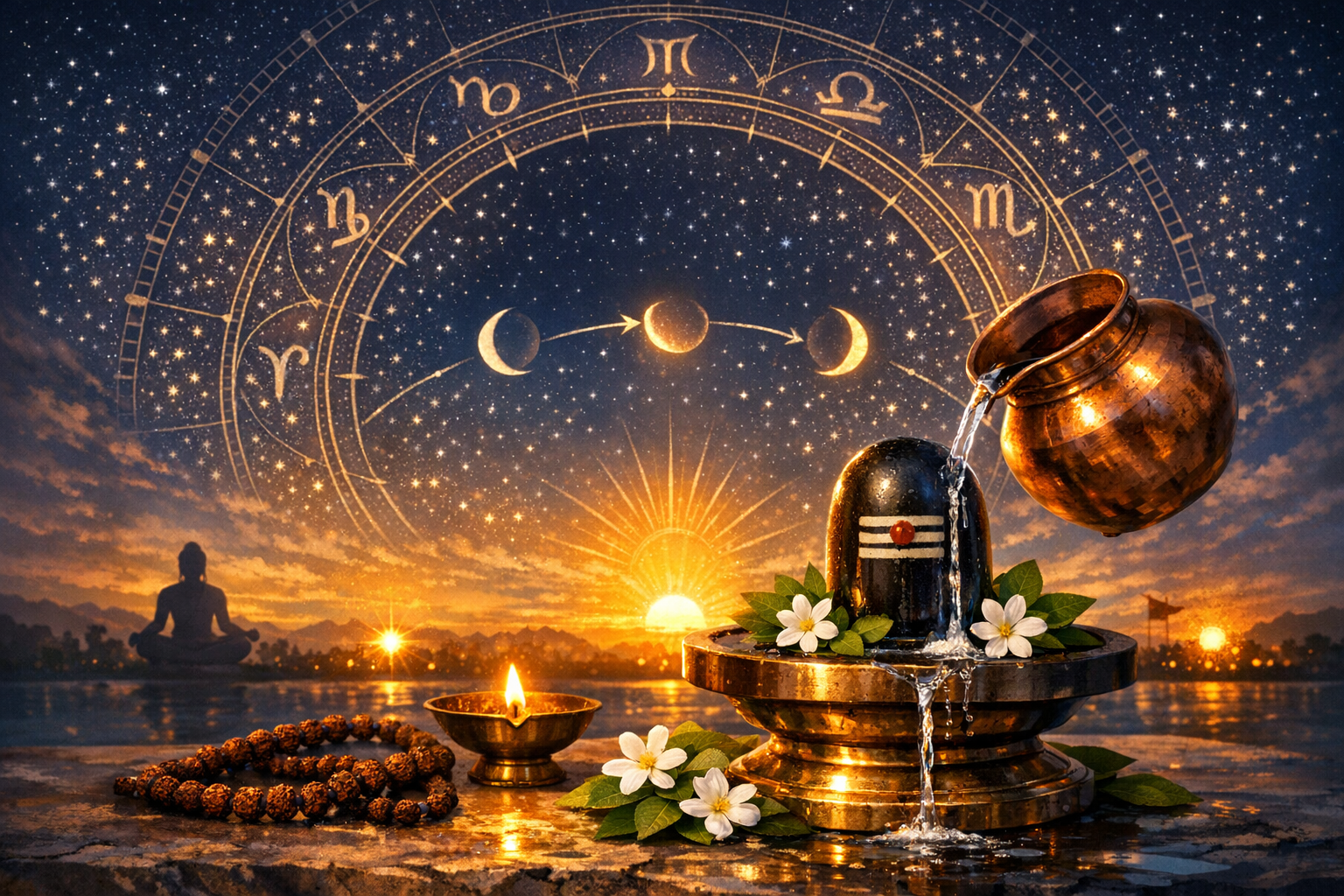
On Monday, May 18, 2026, the Hindu Panchang marks Shukla Paksha Dwitiyathe second lunar day of the waxing phasein most regions. Shukla Paksha Dwitiya prevails until approximately 8:46 PM (IST), after which Shukla Paksha Tritiya begins for the remainder of the night and continues into the next civil day. Minor regional and methodological variations can occur, but this Dwitiya-to-Tritiya transition time provides a reliable working reference for planners and observers across India.
This point in the fortnight carries a distinct rhythm. The waxing half of the month (Shukla Paksha) is traditionally associated with expansion, clarity, and initiative. Dwitiya is favored for setting gentle beginnings and strengthening relationships, while Tritiya lends momentum to sustained effort and skill-building. Falling on a Monday (Somavara), the day also harmonizes naturally with Shiva-upasana; many households observe somvara-vrata or offer simple abhishekam and bilva leaves to Lord Shiva to invite composure and focus for the week ahead.
Technically, a tithi is defined by the angular separation between the Moon and the Sun as observed from Earth. Each tithi spans 12° of this geocentric elongation. Dwitiya corresponds to the interval when the Moon–Sun separation lies between 12° and 24°, and Tritiya covers 24° to 36°. The tithi changes the moment this separation crosses the next 12° threshold. Mathematically, if λMoon and λSun are the ecliptic longitudes, the operative expression is floor(((λMoon − λSun) mod 360)/12) + 1, with the boundary crossing determining the precise end of one tithi and the start of the next.
A complete Panchang records five limbs: Tithi (lunar day), Vara (weekday), Nakshatra (lunar mansion), Yoga (sum-based lunar-solar contact), and Karana (half-tithi segment). These collectively inform muhurta selection and ritual sequencing. On May 18, 2026, the governing tithi dynamics are as stated above; the weekday is Somavara; and the Nakshatra, Rashi, Yoga, and Karana are determined by the Moon’s and Sun’s instantaneous longitudes for a given location and time. Because these parameters are time- and place-sensitive, consulting a regional Panchang calibrated for the nearest latitude–longitude is best practice for precision.
Nakshatra and Rashi on this date merit special attention. The Moon’s Nakshatra defines the qualitative flavor of the day’s mindstream, while the Moon’s Rashi frames the broader emotional and relational tone. Both are sensitive to the observer’s location and the exact clock time at which the query is made. Without a reference city, providing a single universal Nakshatra–Rashi label risks misleading readers; therefore, a location-specific Panchang or an accredited astronomical ephemeris should be used to verify the operative Nakshatra and the Moon’s Rashi for any intended activity window on May 18, 2026.
Shubh Muhurta principles help translate these celestial measures into practical choices. Abhijit Muhurtacentered on local solar noonis widely used for urgent undertakings when other options are constrained. Brahma Muhurtaroughly the last 96 minutes before local sunriseis esteemed for meditation, japa, and study. Vijay Muhurtaapproximately two hours before local sunsetsupports confident action and presentations. Godhuli Velaaround sunsetinvites reflective closures, devotional singing, and family harmony. Each of these relies on locally adjusted sunrise and sunset; using true sunrise/sunset times for the observer’s coordinates refines accuracy.
Rahu Kalam, Yamaganda, and Gulika are cautionary windows derived by dividing the daylight duration from local sunrise to local sunset into eight equal segments. On Mondays, the canonical pattern places Rahu Kalam in the 2nd segment of the day, Yamaganda in the 4th, and Gulika in the 6th. To compute real-time windows, measure the day length in minutes, divide by eight, and map these segments forward from sunrise. When important beginnings cannot be shifted, many practitioners balance risk by aligning actions with Abhijit or Vijay Muhurta and completing any inauspicious overlaps with a brief prayer or dana.
Choghadiya, used widely in western India, complements these calculations by labeling successive day and night segments as Amrit, Shubh, Laabh (auspicious to very auspicious), Chal (generally neutral), and Rog, Kaal, Udveg (to be avoided for new starts). The day and night are each divided into eight segments whose durations depend on the local day or night length. For May 18, 2026, selecting Amrit, Shubh, or Laabh segmentscomputed from the regional sunrise or sunsetprovides a pragmatic way to schedule travel, business outreach, or small ceremonies when a fuller muhurta analysis is not feasible.
The Dwitiya–Tritiya sequence offers a balanced arc for practice. Dwitiya’s gentler current supports reconnecting with mentors, organizing study material, and initiating light training. As Tritiya begins after 8:46 PM (IST), the night hours and the following morning can be dedicated to structured sadhana or skill work. In homes where Lakshmi or Gauri worship is customary on Tritiya, recitation of Shri Sukta or the Lakshmi Ashtottara Sata Namavali is considered auspicious, particularly when aligned with an Amrit or Shubh Choghadiya.
Across dharmic traditions, the shared intuition to harmonize inner life with lunar rhythms fosters unity more than difference. Hindu Panchang usage, Buddhist Uposatha observances keyed to lunar phases, Jain tithi-based vratas, and Sikh families’ cultural engagement with lunar festivals in the broader Indic milieu all reflect a common civilizational habit: time is not merely counted, it is sanctified. Attending to Shukla Dwitiya and Tritiya on May 18, 2026, thus participates in a pan-dharmic ethos of mindful calendrics that honors diversity while cultivating shared reverence.
Methodological notes matter. Regional calendars may follow Amanta or Purnimanta month reckoning; computational traditions vary between Drik (observational/astronomical) and Vakyam (rule-based) approaches; and local horizon effects slightly shift sunrise, moonrise, and muhurta boundaries. When planning samskaras or significant vows, practitioners typically defer to the family purohit or a trusted Panchang that is explicitly configured for their city. For everyday alignmentdevotion, reading, exercise, focused workthe Dwitiya-to-Tritiya timeline and the general muhurta framework above provide more than sufficient guidance.
Practically applied, this Panchang entry encourages a calm, Shiva-centered Monday, measured beginnings under Shukla Paksha Dwitiya, and purposeful follow-through as Shukla Paksha Tritiya starts after 8:46 PM (IST). With thoughtful attention to local sunrise, one can refine Abhijit, Brahma Muhurta, and Choghadiya segments, avoid Monday’s Rahu Kalam, and schedule sensitive tasks into the most supportive windows. In doing so, individuals align action with a time-tested Indic science of time that elevates routine days into meaningful, integrated practice.
Inspired by this post on Hindu Blog.