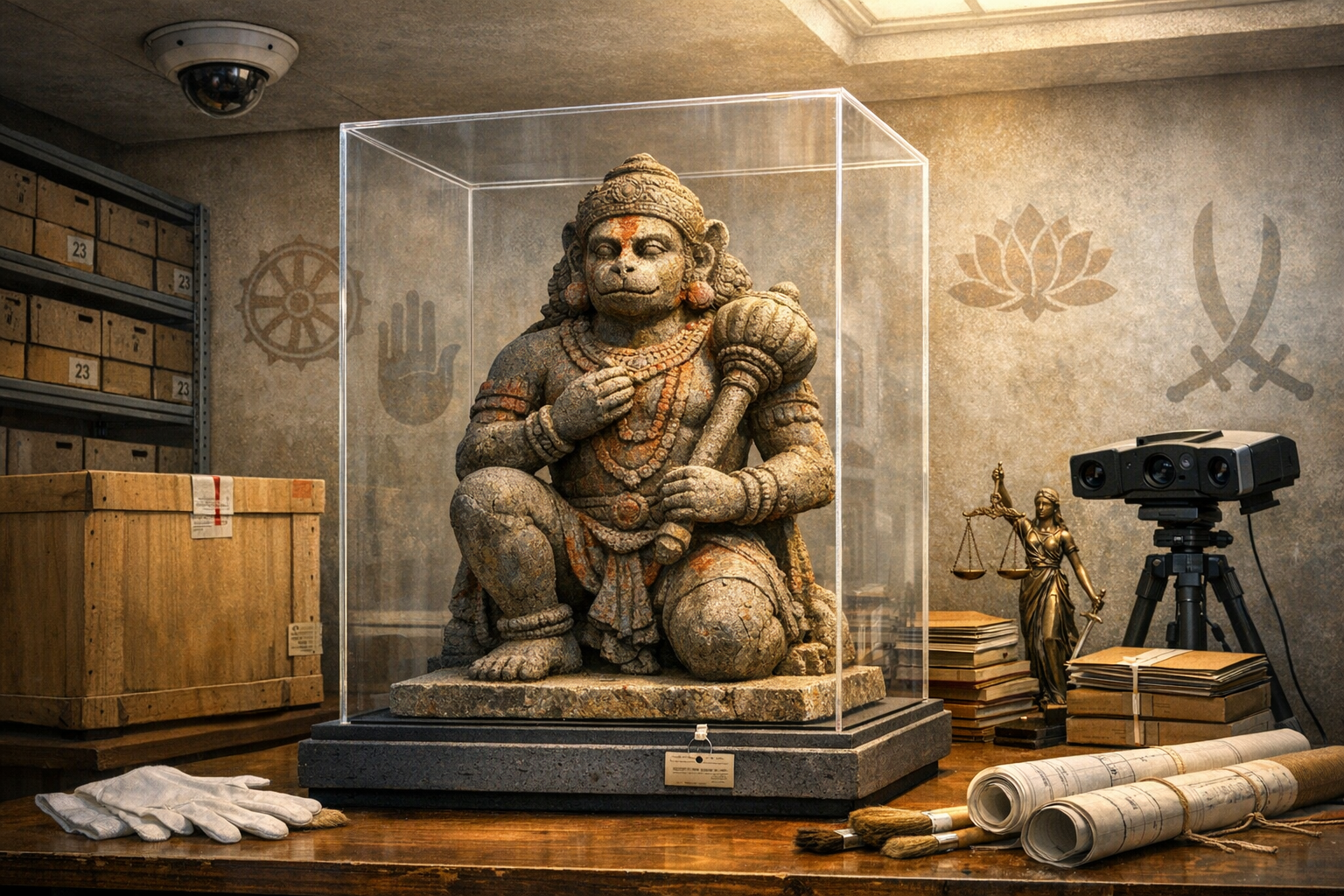
A colonial-era Hanuman idol reportedly held in Pune police custody has ignited a careful and necessary conversation at the intersection of heritage law, cultural memory, and community devotion. The call for its public installation reflects a wider aspiration to heal historical disruptions from British rule while honoring India’s robust legal and conservation frameworks. The issue is not merely administrative; it sits within a living tradition in which sacred objects embody community identity, continuity, and the inclusive spirit shared across dharmic pathsHinduism, Buddhism, Jainism, and Sikhism.
Many Pune residents intuitively perceive such an idol as more than carved stone. For countless families, the image of Hanuman evokes courage, service, and moral rectitude; it is a focal point for personal vows, community service, and civic solidarity. The continued police custody of a historically significant idol, first taken during British colonial rule, understandably generates a sense of incompleteness. Yet, those sentiments must be woven into a responsible process that secures lawful release, ensures expert conservation, and guarantees a safe and dignified reinstallation that welcomes all.
Placing the matter in historical perspective clarifies why deliberation is essential. Under British Colonial Rule, authorities frequently exercised broad powers over public assembly and religious expression, often seizing objects associated with congregational life when they feared disorder or wished to consolidate control. Across the subcontinent, not only Hindu icons but also Buddhist and Jain sculptures and Sikh heritage objects occasionally fell into bureaucratic custody or museum storage. Reversing such displacements in independent India has generally proceeded through courts, heritage institutions, and local governments to achieve outcomes that respect both faith and law.
Any contemporary action must begin with clarity on the applicable legal frameworks. For movable antiquitiesobjects generally at least one hundred years oldthe Antiquities and Art Treasures Act, 1972 (AATA 1972) and its rules govern registration, transfer, and export. The Archaeological Survey of India (ASI) is the central authority for registration and technical oversight of antiquities, while State Departments of Archaeology may share responsibilities for documentation, storage, and conservation. If the Hanuman idol qualifies as an antiquity under AATA 1972, its status should be verified against registries, and any proposed transfer or installation must comply with statutory procedures.
A second pillar of the applicable law concerns property in police possession. The Criminal Procedure Code (CrPC) provides the mechanism for lawful custody and release of seized property, especially Sections 451 and 457. Jurisprudence following Sunderbhai Ambalal Desai v. State of Gujarat (2002) encourages timely, judicious release of seized items to appropriate custodians to prevent deterioration, subject to safeguards ensuring future production before a court if required. While that precedent is often cited in the context of perishable or utilitarian goods, the underlying logicminimizing harm to property while preserving evidentiary valuealso supports conservation-first decisions for cultural objects.
Indian courts have long recognized the juristic personality of deities installed and worshipped in a temple, enabling them to hold and protect property through trusts or shebaits. In cases involving displaced or uninstalled murtis, courts and administrators typically look to provenance, community ties, and conservation needs to determine appropriate custodianship. In practice, that often leads to one of three outcomes: supervised return to a historically connected shrine or trust, allocation to a public museum when worship reinstallation is not feasible, or creation of a joint stewardship arrangement that balances ritual life and conservation imperatives.
For the Hanuman idol in Pune police custody, a responsible roadmap would proceed through distinct phases. First, documentary clarification should be conducted: chain-of-custody records from colonial-era seizure to present-day malkhana inventories; archival correspondence, if any; and expert assessments establishing age, material, iconographic features, and condition. Second, legal due diligence under AATA 1972 and CrPC provisions should determine the competent forum (usually a Magistrate) and the requisite applications for interim custody or permanent transfer, with ASI and the State Archaeology Department providing technical inputs. Third, an inclusive consultation should bring together the concerned temple trust(s), municipal authorities, conservation professionals, and community representatives from Hindu, Buddhist, Jain, and Sikh organizations to align on a stewardship model that protects the idol and invites broad public participation.
Conservation science must lead the proposed reinstallation. Prior to any movement, a condition assessment should document surface integrity, fractures, prior repairs, salt efflorescence, biological growth, and structural risks. The installation site should be prepared with a stable, vibration-dampening plinth; compatible materials (e.g., lime-based mortars rather than Portland cement where relevant); and environmental controls limiting temperature and humidity fluctuations. Where feasible, glazing or microclimate enclosures that do not impede darshan can reduce airborne pollutants and biological growth. These measures are standard in contemporary temple conservation and are compatible with respectful ritual practice when designed collaboratively.
Security and documentation are equally crucial. A comprehensive plan should include CCTV coverage with failover storage, controlled access during closed hours, and a visitor flow design that prevents crowd crush. The idol ought to be documented with high-resolution photography and 3D scanning to create a “digital twin” for condition monitoring, forensic reference, and educational use. RFID or discreet micro-tagging, where conservation-appropriate, strengthens deterrence and recovery prospects. Periodic condition reportingideally every six to twelve monthsshould be institutionalized, with ASI or State Archaeology oversight, to ensure preventive conservation remains the norm rather than emergency intervention.
Because public installation of religious structures in India is sensitive, compliance with civic and judicial directions is essential. Supreme Court–guided norms since 2009 urge States and local bodies to regulate unauthorized religious structures in public spaces. To avoid any ambiguity, the installation venue should conform fully to municipal regulations and land-use approvals, with clear responsibilities assigned to the managing trust for safety, crowd management, hygiene, and neighborhood harmony. This alignment builds public confidence and shields the community from future disputes.
The interpretive and educational dimension should be consciously pluralistic, reflecting the blog’s objective of unity among dharmic traditions. Interpretive signage and digital content can highlight Hanuman’s virtuesseva, steadfastness, and humilityin a manner that resonates across Hindu, Buddhist, Jain, and Sikh ethical vocabularies. Schools and community groups can be invited to curated heritage walks that explain how British rule affected sacred art, how India’s legal system balances faith and conservation, and why inclusive stewardship benefits everyone. Such programming turns the idol’s return into a living classroom for civics, history, and shared values.
In comparable cases nationwide, idols recovered from long custodial limbo have returned to ritual life under tightly crafted orders from Magistrates and High Courts, with structured reporting to police and archaeology departments. Where provenance is uncertain, courts have favored solutions that maximize public access, preserve the artifact, and minimize future disputessometimes through museum display, sometimes through supervised temple custody. The common thread is due process: transparent applications, expert affidavits, and enforceable conditions that convert a moral claim into a durable civic achievement.
A well-run process in Pune would therefore include a phased handover with bonded transport; an indemnity and insurance framework that covers transit and installation risks; and a memorandum of understanding (MoU) among the police, the temple trust or museum, ASI/State Archaeology, and the local administration. The MoU should codify conservation requirements, reporting timelines, dispute-resolution mechanisms, and protocols for temporary withdrawal (for major conservation work) without disrupting community life. These safeguards ensure that public trustin both heritage governance and religious managementremains high.
If the idol ultimately proceeds to a temple setting, ritual and conservation teams can jointly develop protocols that keep sacred practice compatible with material care. For example, abhishekam frequency and media can be calibrated to minimize chemical stress on stone surfaces; oil applications can be limited to zones proven to be safe; and routine cleaning can employ non-ionic surfactants or dry mechanical methods appropriate to the stone type, as advised by conservators. None of these adjustments diminishes devotion; rather, they secure the icon’s physical longevity and the continuity of darshan for generations.
The broader social benefits of a lawful, conservation-led return are substantial. It restores a felt sense of historical justice after the disruptions of British Colonial Rule. It exemplifies how modern India’s institutionscourts, police, archaeology departments, and temple trustscan collaborate in the public interest. It cultivates civic pride in Pune’s stewardship of Cultural Heritage, aligns with national efforts to dignify sacred art, and models a unifying ethic that invites participation from Hindu, Buddhist, Jain, and Sikh communities without hierarchy or exclusion.
Ultimately, the aspiration to see the Hanuman idol released from police custody and restored to public life is both understandable and attainable. With careful provenance work, due process under AATA 1972 and CrPC provisions, expert conservation planning, and an inclusive governance framework, the city can transform a contested legacy into a shared triumph. Such an outcome honors faith and law alike, affirms the dignity of India’s living traditions, and offers a practical template for resolving similar cases across the country in a spirit of unity and respect.
Inspired by this post on Hindu Jagruti Samiti.