Sant Ravidas (c. 1450–1520) stands among the foremost poet-saints of the North Indian Bhakti movement, revered across Varanasi, Punjab, Rajasthan, and the Gangetic plains. He articulated a compelling synthesis of nirguna bhakti (devotion to the formless Divine), social equality, and the dignity of labor. His voice continues to resonate with Hindus and Sikhs and aligns with the ethical currents of Buddhism and Jainism, making his legacy a living bridge within the broader dharmic family.
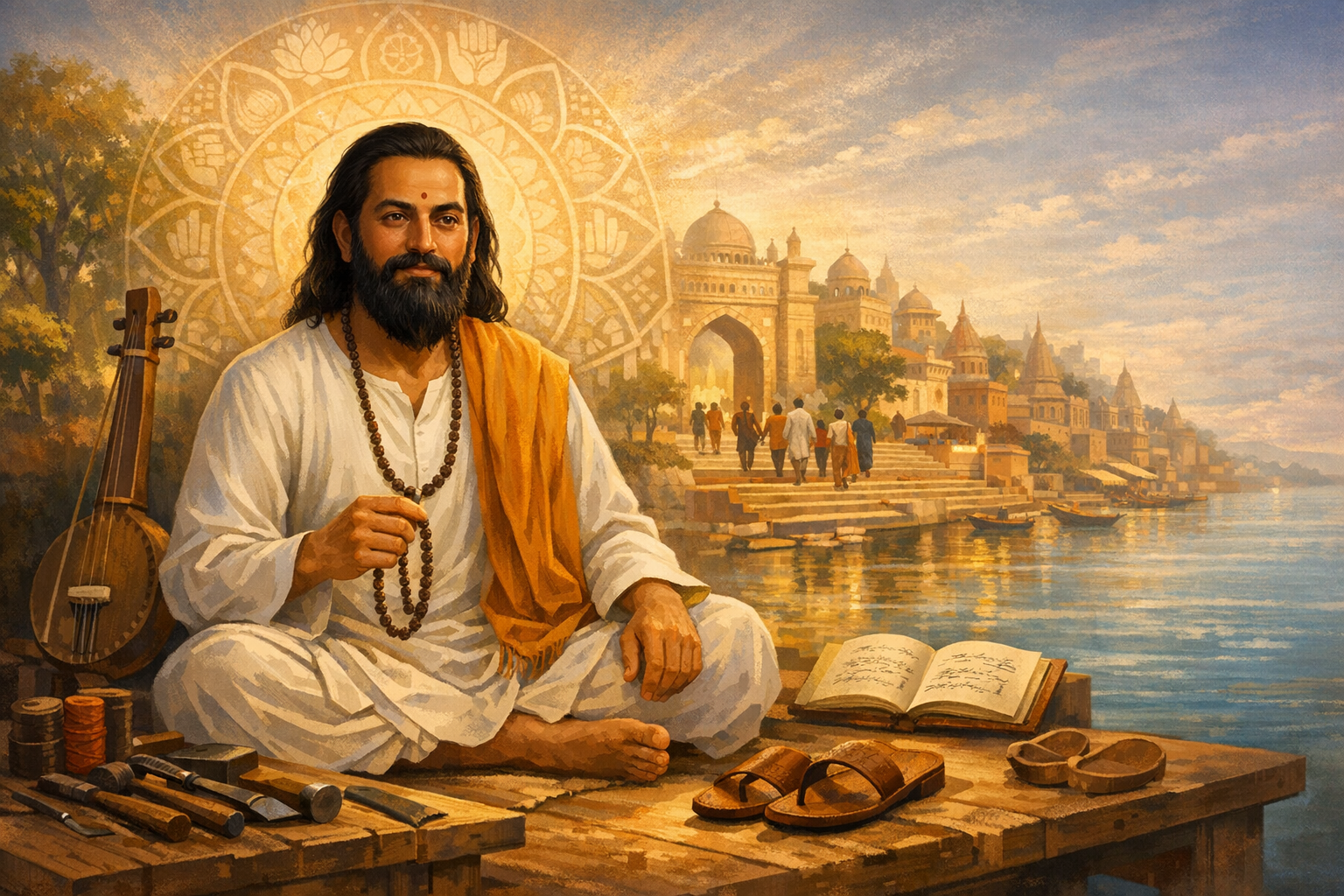
Born in Seer Govardhanpur near Varanasi, Uttar Pradesh, Ravidas came from a leather-working household that society of the time deemed “untouchable.” This social location gave his poetry a rare moral authority: he did not merely theorize about equality; he demonstrated it through his life, profession, and spiritual practice. By honoring his craft while pursuing intense devotion, he offered a powerful critique of notions of ritual purity and hierarchical status.
Traditions across North India widely hold that he was associated with the circle of Ramananda, and many accounts present Ravidas as one of Ramananda’s disciples. While the exact guru–shishya relationships among early Bhakti figures remain debated by scholars, the theological and poetic kinship among Ravidas, Kabir, and other sants is unmistakable: they privileged inner realization over outward ritual, and vernacular song over scholastic exclusivity.
Ravidas’s poetry is composed in accessible north Indian vernaculars—primarily Braj and related dialects—so that lay communities could partake in a direct devotional relationship with the Divine. His compositions, structured as padas and shabads, are musical, memorable, and designed for congregational singing. The language of affection (prem), remembrance of the Divine Name (naam), and the insistence on universal human dignity form the core of his oeuvre.
Theologically, Ravidas is a leading voice of nirguna bhakti. He speaks of a God beyond form and attribute yet intimately available through remembrance, love, and ethical living. In his songs, divine names such as Rama and Hari function not as sectarian markers but as portals to the same absolute Reality. In doing so, he preserved the openness typical of the Bhakti Tradition while avoiding doctrinal narrowness.
One of Ravidas’s most influential ideas is Begampura—the “city without sorrow”—an ethical and spiritual utopia where no one suffers deprivation, exclusion, or fear. Begampura is both a visionary critique of caste and status and a constructive program that imagines a society grounded in justice, friendship, and shared dignity. The concept remains a touchstone for social reformers and spiritual practitioners who seek to align inner devotion with outer justice.
Ravidas’s corpus achieved a canonical status when a selection of his hymns was included in the Guru Granth Sahib, the scripture central to Sikhism, compiled by Guru Arjan in 1604. Forty of his hymns are preserved there, set to multiple ragas and sung across gurdwaras worldwide. This inclusion made his voice an enduring spiritual resource for Sikhs while affirming the shared devotional currents uniting Hinduism and Sikhism.
The Sikh canon’s embrace of Ravidas offers a particularly compelling example of unity in religious diversity. It demonstrates that wisdom rooted in the Hindu sant tradition could be welcomed within another dharmic community’s scripture without erasing distinct identities. In practice, this has encouraged a culture of kirtan, seva (service), and egalitarian fellowship that closely mirrors Ravidas’s own message.
Hagiographical traditions also describe Ravidas’s influence on royal courts and devotees across caste lines; a celebrated motif portrays Mirabai regarding him as a spiritual guide. Whether taken historically or symbolically, this narrative highlights how his teachings crossed social and regional boundaries, affirming inner devotion over inherited status.
At the level of daily practice, Ravidas emphasized remembrance of the Divine Name, satsang (sacred company), ethical conduct, and humility. He critiqued rote ritualism and caste exclusivism not by denigrating tradition but by restoring its essence—direct God-realization open to all. His life as a cobbler becomes a living commentary on the dignity of labor; the workshop, no less than a temple, could be a sanctified space when pervaded by remembrance and service.
Historically, Ravidas’s life unfolded during the late Delhi Sultanate and the beginnings of the Mughal era, a period that saw widespread social churn and the rise of vernacular devotion. The Bhakti movement’s turn to people’s languages was not merely literary but democratizing: it brought sacred discourse out of elite enclaves and into the everyday lives of artisans, peasants, and urban guilds.
Ravidas’s critique of caste was uncompromising yet constructive. He attacked moral hierarchies that privileged birth over virtue and insisted that divine grace recognizes no such divisions. His songs repeatedly affirm that devotion, ethical action, and universal compassion—not lineage or learnedness—constitute the true measure of spiritual worth.
The linguistic texture of Ravidas’s poetry is rich with everyday imagery—shoes, tools, marketplaces—transformed into metaphors of spiritual labor. He made the shop a sadhana space, turning familiar objects into reminders of the ever-present Divine. This poetic strategy made devotion tangible and helped followers carry spiritual awareness into craft, family, and community life.
In textual history, early Bhakti anthologies such as the Bhaktamal (with later commentaries) situate Ravidas among the great sants of North India, a position reinforced by the enduring transmission of his songs across oral and written traditions. Subsequent collections—both within Hindu sampradayas and Sikh scripture—ensured that his voice remained central to the devotional canon.
Ravidas Jayanti, observed on Magh Purnima, celebrates his birth and teachings with kirtan, community gatherings, and acts of service. In Varanasi, the Shri Guru Ravidass Janam Asthan is a vibrant center of devotion, while in Punjab and the global diaspora, congregations commemorate his message through congregational singing and community kitchens, echoing the inclusive ethos he championed.
Modern Ravidass communities continue to hold his teachings at the heart of devotional life. While organizational expressions vary, the unifying thread remains clear: the affirmation of human equality, devotion without barriers, and the integration of spiritual realization with social responsibility. Framed within the wider dharmic ethos, these communities contribute to a living tapestry of shared values also cherished in Hinduism, Sikhism, Buddhism, and Jainism.
Read through a dharmic lens, Ravidas’s insistence on compassion, non-violence in conduct, and humility resonates with the Jain ideal of ahimsa and the Buddhist emphasis on universal suffering and liberation. Simultaneously, his presence within Sikh scripture underscores a practical unity-in-diversity: different streams flowing from and returning to common ethical and spiritual sources.
Begampura remains not just a poetic dream but a moral horizon for civic life. It encourages equitable institutions, inclusive education, and community service as spiritual responsibilities. In contemporary India and the diaspora, this vision has inspired initiatives in social uplift, inter-community dialogue, and shared service projects in which devotion and development reinforce one another.
From an intellectual standpoint, Ravidas’s contribution clarifies a key Bhakti insight: devotion is not escapism but a disciplined re-valuation of social life, grounded in direct experience of the Divine. He argued—through song and example—that freedom from sorrow is inseparable from the removal of injustice, and that spiritual maturity demands structural compassion.
The consolidation of his songs within the Guru Granth Sahib also invites attention to musicology and performance. His hymns are embedded in the raga architecture of the Sikh canon, enabling kirtan traditions to carry his message across languages and generations. This musical transmission ensures that Ravidas’s teachings are not only read but embodied, sung, and shared.
In literary terms, Ravidas’s diction marries theological depth with conversational clarity. The result is pedagogy through poetry—precise enough to sustain philosophical reflection, simple enough to guide daily conduct. Such clarity helps explain why his compositions remain central to both personal sadhana and communal worship.
Across centuries, narratives of Ravidas engaging with members of different communities—artisans and nobles, Hindus and Sikhs, men and women—evidence a pedagogy of inclusion. Rather than exalting renunciation alone, he sanctified participation in society, modeling how devotion can uplift families, professions, and cities.
In Varanasi, the sacral geography of ghats, temples, and congregational spaces still bears the imprint of Ravidas’s presence. Pilgrims, students, and householders recount the quiet power of listening to a Ravidas pada at dawn—a reminder that spiritual transformation often unfolds in ordinary settings when suffused with remembrance and love.
For the wider dharmic world, Ravidas offers a method as much as a message: center the Name, cultivate humility, serve without discrimination, and hold a communal aspiration like Begampura in view. This method invites synergy among Hindu, Sikh, Buddhist, and Jain communities, each contributing complementary practices to a shared ethical project.
In sum, Sant Ravidas is not simply a historical figure but a living interlocutor for the present. His nirguna devotion, his poetic enactment of equality, and his vision of a sorrowless city continue to animate conversations about faith, society, and human dignity. As long as communities seek to harmonize inner freedom with social justice, his songs will remain a guiding light.
Inspired by this post on Hindu Pad.