Across the vast landscape of Hindu thought and practice, the goat emerges as a compelling symbol that bridges ritual, mythology, ethics, and everyday life. It appears at the heart of yajna traditions, in the iconic narrative of Daksha Prajapati’s sacrifice and restoration, andthrough a closely related animal, the ram (mesha)in the iconography of Agni Dev. Understanding how goats and rams are represented across Vedic literature, Puranic narratives, and temple art not only clarifies long-standing confusions, but also reveals how dharmic traditions have progressively emphasized ahimsa (non-violence) while retaining deep reverence for sacred symbolism.
In Sanskrit sources, terminology is central. Aja often denotes a goat, while mesha refers to a ram. Both animals are intertwined with the ritual life of the Vedic household and the public shrauta sacrifice. Goats and sheep historically accompanied the fire ritual as “pashu,” ritually consecrated animals. Over centuries, these terms and images flowed into mythic retellings and temple arts, sometimes producing a popular shorthand in which “goat” and “ram” are treated interchangeably in devotional discourse, even though classical iconography tends to be specific.
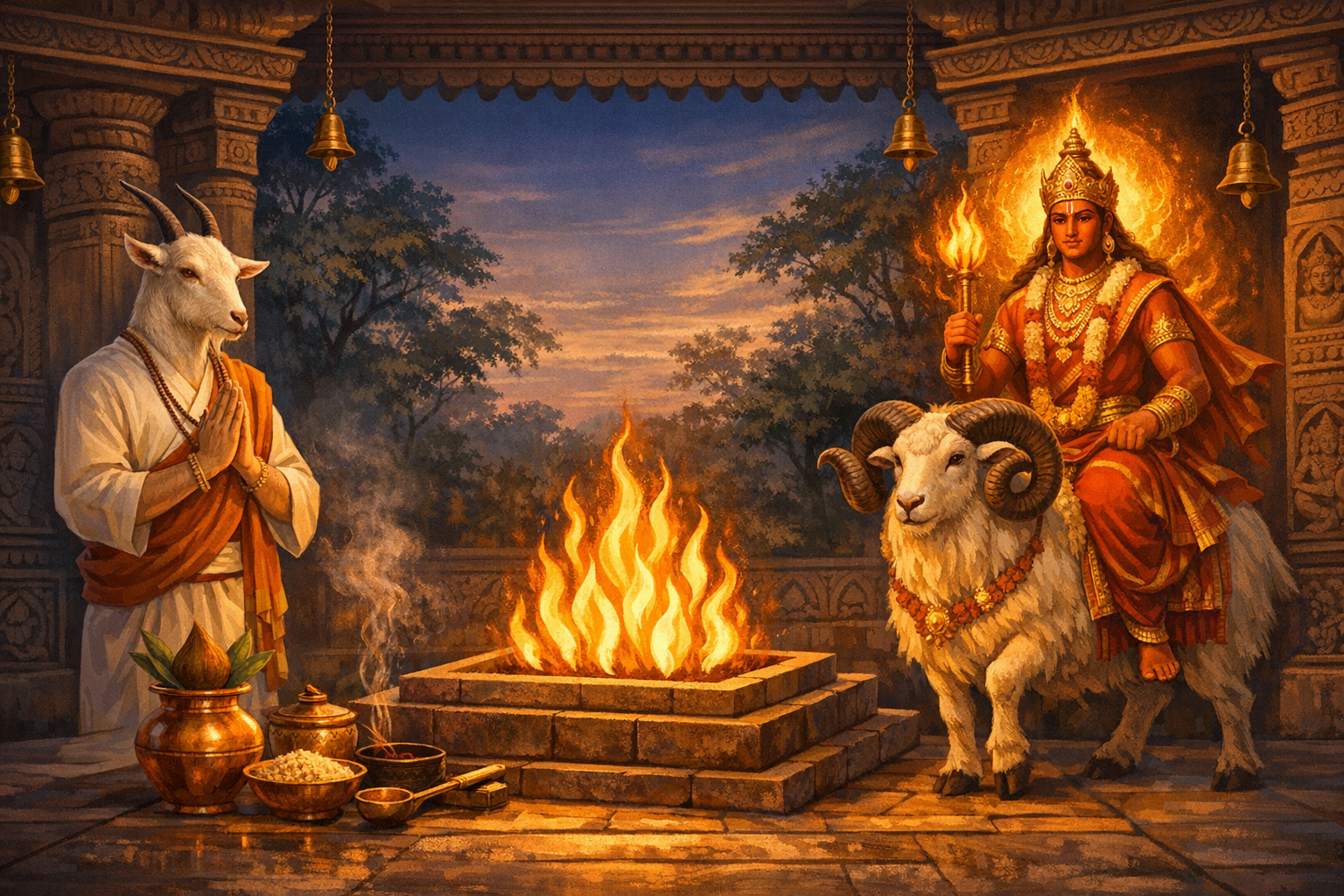
Agni Dev’s vahana provides a clear example of this fluidity. Classical iconographic texts and surviving sculptures typically depict Agni riding a ram (mesha), consistent with the fire deity’s association with vitality, warmth, and the swift energy of combustion. In many regional tellings and in casual descriptions, this ram is occasionally referred to as a “goat,” reflecting the broader Vedic linkage between sacrificial fires and caprids generally. From an art-historical perspective, however, the mesha is standard for Agni’s mount, while the goat’s ritual proximity to fire likely helped seed popular conflations.
The narrative of Daksha Prajapatipreserved in Purana literature and retold in numerous regional traditionscements the goat as a powerful moral and cosmological sign. In the well-known episode of Daksha’s yajna, the sacrifice proceeds in a spirit of pride and sectarian exclusion, culminating in a cosmic rupture. When Shiva’s emissaries shatter the rite, Daksha is ultimately restored to life with the head of a goat. This transformation is not a mere plot device; it is an ethical and theological statement. The goat’s head signifies humility after hubris, the restoration of cosmic order (rita) over ego, and a return to the operative unity of the devas through a renewed, more reverent ritual attitude.
From a textual viewpoint, Vedic Saṁhitās and Brāhmaṇas associate goats and sheep with specific sacrificial contexts. The shrauta corpus details the pashubandha (animal-offering segment) of certain soma and fire rites, where caprids play a role aligned to cosmic correspondences and the transmutation of offerings through Agni’s seven tongues. These texts form the ritual substratum from which later Purāṇic storytelling drew moral and symbolic lessons. As ritual frameworks diversified and localized, the goat became a potent emblem of consecration, surrender, and the boundary between life, sacrifice, and sanctity.
Equally significant is the ethical arc within the broader dharmic familyHinduism, Buddhism, Jainism, and Sikhismtoward minimizing harm. Even as Vedic ritualism recognized carefully prescribed animal offerings in limited contexts, later practice across regions and sects gravitated toward symbolic substitution. Under the influence of ahimsa-centric currentsespecially strong in Jain and Buddhist traditionsand a pervasive devotional ethos, many communities replaced historical animal offerings with grains, fruits, coconuts, or pumpkins (sometimes colloquially called “vegetarian bali”). This transition preserved the sanctity of yajna and bali while reflecting the dharmic ideal that compassion enhances, rather than diminishes, ritual efficacy.
In modern Hindu praxis, domestic fire rituals (homa, havan) emphasize offerings of clarified butter (ajya), grains, and fragrant woods. Households often note that Agni, the divine messenger who carries oblations to the devas, is honored without any injury to living beingsan approach squarely aligned with the instructions found in practical handbooks governing Havan Kund & Havan Ke Niyam. As a result, the goat’s historical role has been retained at the symbolic level: an emblem of dedication, of giving up the lower to reach the higher, and of the transformation that sacrificial fire is meant to bring about in the practitioner.
The Daksha cycle remains vital for understanding how Hinduism encodes ritual responsibility. The goat-headed restoration underscores that ritual power, without humility and inclusion, devolves into spiritual sterility. By receiving a goat’s head, Daksha regains life as a chastened, integrated participant within a cosmos governed by Shiva, Vishnu, and the devas, not by personal prestige. The figure of Veerabhadra, who emerges from Shiva’s wrath to correct the imbalance, is central to this theological drama; together, these motifs continue to inform temple iconography, processions, and narrative arts from classical sculpture to contemporary performance traditions.
Iconographically, Agni is portrayed with a radiant body, often red or golden, sometimes two-headed to signify his dual presence in heaven and on earth, and attended by flames that suggest his seven tongues. The mesha vahanasturdy and sure-footedconveys dynamism and sacrificial potency. Sculptures from early historic to medieval periods across the subcontinent consistently keep this pairing, while inscriptions and liturgical manuals detail how Agni’s presence is invoked in temple consecrations and domestic rites. In a number of regions, the presence of goats near shrines or village fires remains a familiar sight, blending the pastoral rhythms of rural life with ritual memory.
Linguistically, “aja” elegantly carries multiple resonances. Besides denoting a goat, it also appears in philosophical contexts to mean “unborn,” a reminder that Sanskrit diction is layered and context-sensitive. The daksha episode’s aja-śira (goat-head) is therefore doubly meaningful: it signals a literal replacement and hints at the restoration of a ritual mind aligned to primordial order, beyond personal pride. Such semantic depth is typical of Hindu scriptural expression, where narrative detail, philosophical reflection, and ritual code reinforce each other.
Astrologically, the prominence of the ram is visible in Mesha (Aries), an agni-tattva sign. While astrology and iconography are distinct streams, their symbolic reciprocity is noteworthy. Mesha Sankranti marks the solar ingress into Aries and is observed as a new-year threshold in several regionsVishu in Kerala, Vaishakha-oriented observances elsewhere, and cognate festival moments in Tamil and Odia cultural calendars. The ram thus threads calendric time, elemental doctrine, and divine mobility in a single image that communities intuitively grasp and commemorate.
In village life, goats retain practical and devotional significance. They represent resilience, nourishment, and livelihood within pastoral economies. Devotees frequently connect the gentle gaze of a temple-side goat with the living cosmos that Hinduism sacralizessarvam khalvidam brahma becomes more than an aphorism when daily rhythms, animals, and ritual fires collaborate to sustain community life. For many families, the presence of goats around shrines evokes gratitude, continuity, and an ethic of stewardship toward all beings.
Within the dharmic family, convergences are clear. Jainism’s unwavering ahimsa has inspired Hindu practice toward symbolic offerings. Buddhism’s emphasis on compassion and right action reshaped sacrificial norms in many regions, especially under historical patrons who curtailed animal slaughter around sacred hubs. Sikhism centers devotion, service (seva), and equality, and rejects propitiatory sacrifice as a path to grace. Together, these traditions affirm a shared civilizational ethos: rituals must serve awakening and welfare, never cruelty. This unity of intent allows diverse practices to coexist without coercion, expressing Vasudhaiva Kutumbakamthe world as one family.
From a hermeneutic standpoint, the goat in Hinduism operates at three levels. First, it is a historical ritual participant in the Vedic sacrificial ecosystem. Second, it is a mythic cipher, indexing humility, restored order, and the ethical governance of ritual power in the Daksha cycle. Third, it is a living emblem within agrarian and temple culture, linking spirituality with subsistence, and devotion with duty. These layers are not contradictory; instead, they document a tradition’s maturation from literal rite to symbolic depth and compassionate praxis.
Reading Vedic and Purāṇic materials alongside ethical developments shows why popular language sometimes calls Agni’s mount a “goat” while classical art insists on a “ram.” The conflation arises from the goat’s sacrificial proximity to fire and from the shared caprid family resemblance. Clarifying this strengthens rather than diminishes devotional connection: recognizing Agni’s mesha vahana honors the precision of iconography, while remembering the goat’s ritual history explains why communities instinctively associate it with the fire-god.
Finally, the Daksha Prajapati narrative invites reflection on ritual purpose. A rite that excludes, boasts, or wounds loses its spiritual center. A rite undertaken with humility, compassion, and lucidityqualities metaphorically awakened in Daksha through the goat-headrestores balance between devas, humans, and the natural world. When households gather around the homa flame today, offering grains and ghee with mantras, they participate in this living lineage: honoring Agni, remembering Daksha’s lesson, and upholding ahimsa as the beating heart of a dharmic civilization.
Inspired by this post on Hindu Pad.