The Mahabharata is more than a chronicle of a dynastic conflict; it is a living scripture and a vast dharmic ocean whose narrative architecture encodes meaning as surely as its verses teach ethics. Its division into eighteen Parvas (sections) is not a literary accident but a sacred design that frames the epic’s movement from origins to renunciation, from worldly order to transcendence.
The very term parvaliterally a jointsuggests a body whose parts connect and flex to sustain life. Read in this light, the Mahabharata’s parvas articulate a deliberate anatomy of dharma: limbs of story, bone of law, sinew of statecraft, and breath of spiritual practice, all cohering into a single organism of meaning.
The recurrence of the number eighteen is a structural signal across the epic tradition. Eighteen Parvas map the whole; the Kurukshetra War lasts eighteen days; the contending sides mustering eighteen akshauhinis of troops; and the Bhagavad Gita itself unfolds in eighteen chapters. This patterned repetition invites a hermeneutic that treats number as a key to the epic’s symbolic grammar.
Traditional interpreters often relate aṣṭādaśa (eighteen) to the synthesis of eightfold prakriti (earth, water, fire, air, space, mind, intellect, ego) and the ten indriyas (five cognitive and five active senses). The whole, then, gestures toward the integration of nature and facultiesurging a life in which ethical discernment (dharma) aligns the energies of body, mind, and society.
The eighteen Parvas are conventionally enumerated as: Adi, Sabha, Vana, Virata, Udyoga, Bhishma, Drona, Karna, Shalya, Sauptika, Stri, Shanti, Anushasana, Ashvamedhika, Ashramavasika, Mausala, Mahaprasthanika, and Svargarohana. Each bears a narrative function and a doctrinal charge, together producing a sustained meditation on duty, order, suffering, and liberation.
Across recensions, the distribution of material reveals intentional weighting. The epic places its longest deliberationsShanti and Anushasanaafter the war, emphasizing that the reckoning that follows violence requires the deepest philosophy. The placement itself is an argument: victory without wisdom is defeat of a subtler kind.
The foundational sequence (Adi, Sabha, Vana, Virata, Udyoga) establishes origins and ordeals. Genealogies, assemblies, exile, and disguised endurance culminate in Udyoga’s diplomatic labors. Here, Vidura-niti and the Sanatsujatiya articulate political ethics, leadership character, and the metaphysics that must inform statecraft.
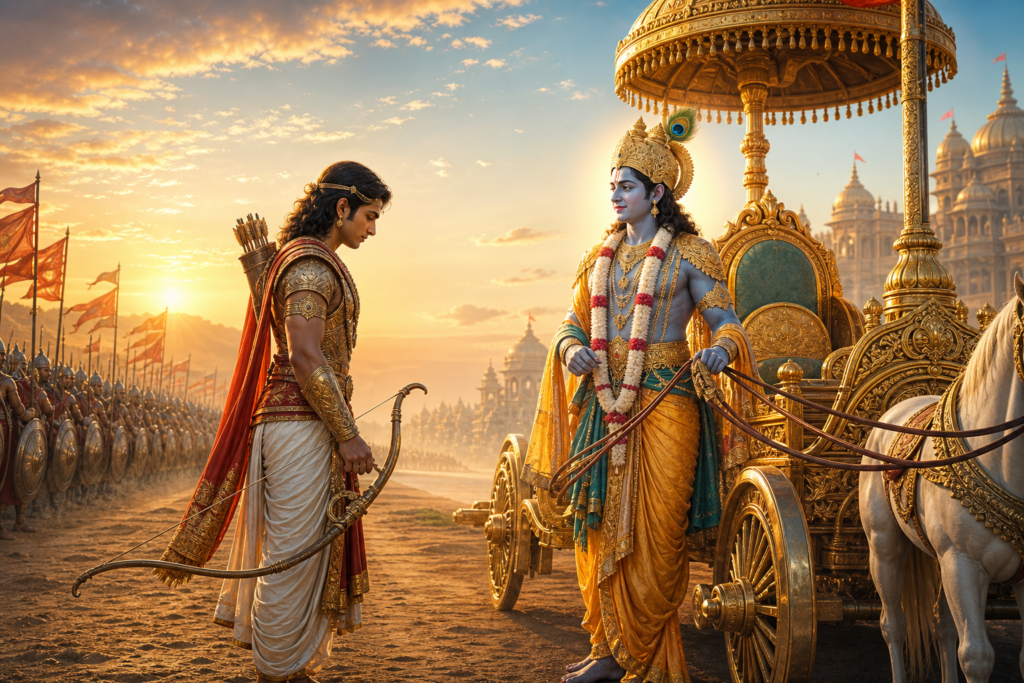
The war sequence (Bhishma, Drona, Karna, Shalya, Sauptika) presents the moral grammar of conflict. Bhishma Parva houses the Bhagavad Gita, offering a framework for action yoked to detachment. Drona and Karna Parvas explore loyalty and the tragic costs of oath-bound virtue; Shalya dramatizes persuasion and morale; Sauptika exposes the after-dark residues of rage.
The reckoning sequence (Stri, Shanti, Anushasana) turns to grief, governance, and grounded ethics. Stri Parva centers women’s sorrow as a moral summons to responsibility. Shanti Parva (Rajadharma, Apaddharma, Mokshadharma) and Anushasana Parva codify normsfrom taxation and judicial procedure to vows, gifts, ahimsa, and contemplative disciplinessetting a comprehensive syllabus for rulers and citizens alike.
The aftermath and transcendence sequence (Ashvamedhika, Ashramavasika, Mausala, Mahaprasthanika, Svargarohana) narrates ritual consolidation, the quieting of royal households, the dissolution of the Yadavas, the royal renunciation (mahaprasthana), and the final ascent. The movement from empire to pilgrimage stages an inner trajectory from possession to relinquishmentarthic grandeur resolving into moksha-seeking simplicity.
Viewed through the purusharthas, the architecture is pedagogic: artha and kama are constrained by dharma in the early and middle parvas, while the closing books orient the reader toward moksha. The epic’s compositional arc thus becomes a curriculum in integrated living.
Udyoga Parva merits special attention for contemporary readers of leadership and diplomacy. As negotiations fail, the text anatomizes causes of conflict: pride, partiality, and policy errors, alongside remedies such as truthfulness, restraint, and the prioritization of public welfare. These Udyoga Parva insights remain relevant for governance, negotiation, and conflict resolution today.
Bhishma Parva’s Bhagavad Gita, with its eighteen chapters, positions action (karma), devotion (bhakti), and knowledge (jnana) as mutually completing paths. It insists that right action arises from clear seeing (buddhi-yoga) and is sustained by inner steadiness, a formula that travels well from battlefield to boardroom to personal life.
Shanti and Anushasana Parvas provide the most comprehensive classical template for rajadharmaconstitutional restraint, fair taxation, justice delivery, protection of the vulnerable, and the ruler’s personal discipline. Their teachings on gifts (dana), non-injury (ahimsa), and truth (satya) are framed not as abstractions but as public policy ethics with measurable social consequences.
Stri Parva’s centering of lament is ethically programmatic: society must hear its most wounded voices if it is to prevent cyclical violence. In making grief audible, the epic instructs power to become accountable and compassion to become institutional.
Textual scholarship confirms that while episodes vary across the Northern and Southern recensions, the eighteen-parva scaffold is a civilizational constant. The Bhandarkar Oriental Research Institute’s Critical Edition consolidates this insight, underscoring that the epic’s sacred architecture is as integral to its meaning as any single dialogue within it.
The Mahabharata’s performative lifein parayana recitations, temple discourses, and household studyalso follows the parva divisions, allowing communities to engage narrative, law, and contemplation in seasonally and socially meaningful cycles.
Numerical symbolism further binds the epic to the wider dharmic world. Hindu traditions speak of aṣṭādaśa Mahapuranas and aṣṭādaśa Shakti Peethas; classical knowledge is often enumerated as aṣṭādaśa vidyāsthānas (the fourteen vidyas plus four upavedas). In Buddhism, the eighteen dhātus (sense bases, objects, and consciousnesses) map the field of experience, while East Asian lineages venerate Eighteen Arhats. Jain teachings enumerate eighteen pāpa-sthānas (sources of demerit), offering a precise ethics of restraint. These resonances do not collapse distinct philosophies; rather, they reveal a shared civilizational habit of using number as a contemplative tool.
Across these dharmic traditionsHinduism, Buddhism, Jainism, and Sikhismthe Mahabharata’s ethical and spiritual questions remain dialogically present. The epic’s idea of dharma-yuddha (righteous warfare under strict constraints), for example, engages ongoing reflections on just conduct, courage, and compassion that inform diverse Indic ideals, including the sant–sipahi (saint–soldier) synthesis of disciplined spirituality and responsible strength.
Read as a whole, the eighteen-parva architecture is both map and mirror: a map charting how societies guard order without losing their soul, and a mirror reflecting how individuals can align action with wisdom. By staging diplomacy, duty, sorrow, counsel, renunciation, and ascent in an exact sequence, the Mahabharata choreographs a pedagogy of becoming.
For modern practitioners and students, practical engagement can follow the structure itself. Begin with Adi through Udyoga to understand how private vice becomes public crisis; study Bhishma through Sauptika for the ethics and costs of conflict; dwell in Stri, Shanti, and Anushasana for law, policy, and personal discipline; and close with Ashvamedhika to Svargarohana to contemplate impermanence, pilgrimage, and release.
The epic’s unity of story and statute, symbol and statecraft, is precisely what makes the Mahabharata an enduring teacher. Its eighteen Parvas are not merely chapters; they are a sacred architecture designed to lead readers from fragmented living to integrated insightan architecture that continues to inspire a shared pursuit of wisdom across the dharmic family.
Inspired by this post on Hindu Blog.