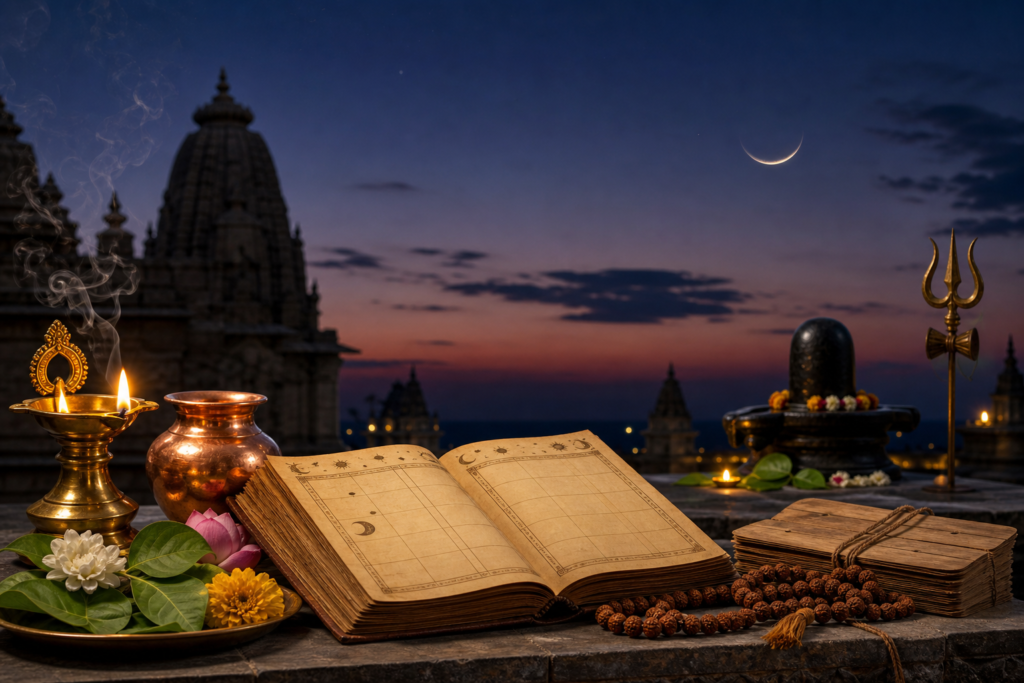
Saturday, May 2, 2026, in the Panchang – Hindu Calendar, begins with Krishna Paksha Pratipada tithi in most regions. This first lunar day of the waning fortnight continues until 11:03 PM on May 2. From that moment onward, it becomes Krishna Paksha Dwitiya tithi, carrying into the night and the following civil day. Minor variations by locality are possible due to longitude, latitude, and the computational tradition followed in regional almanacs.
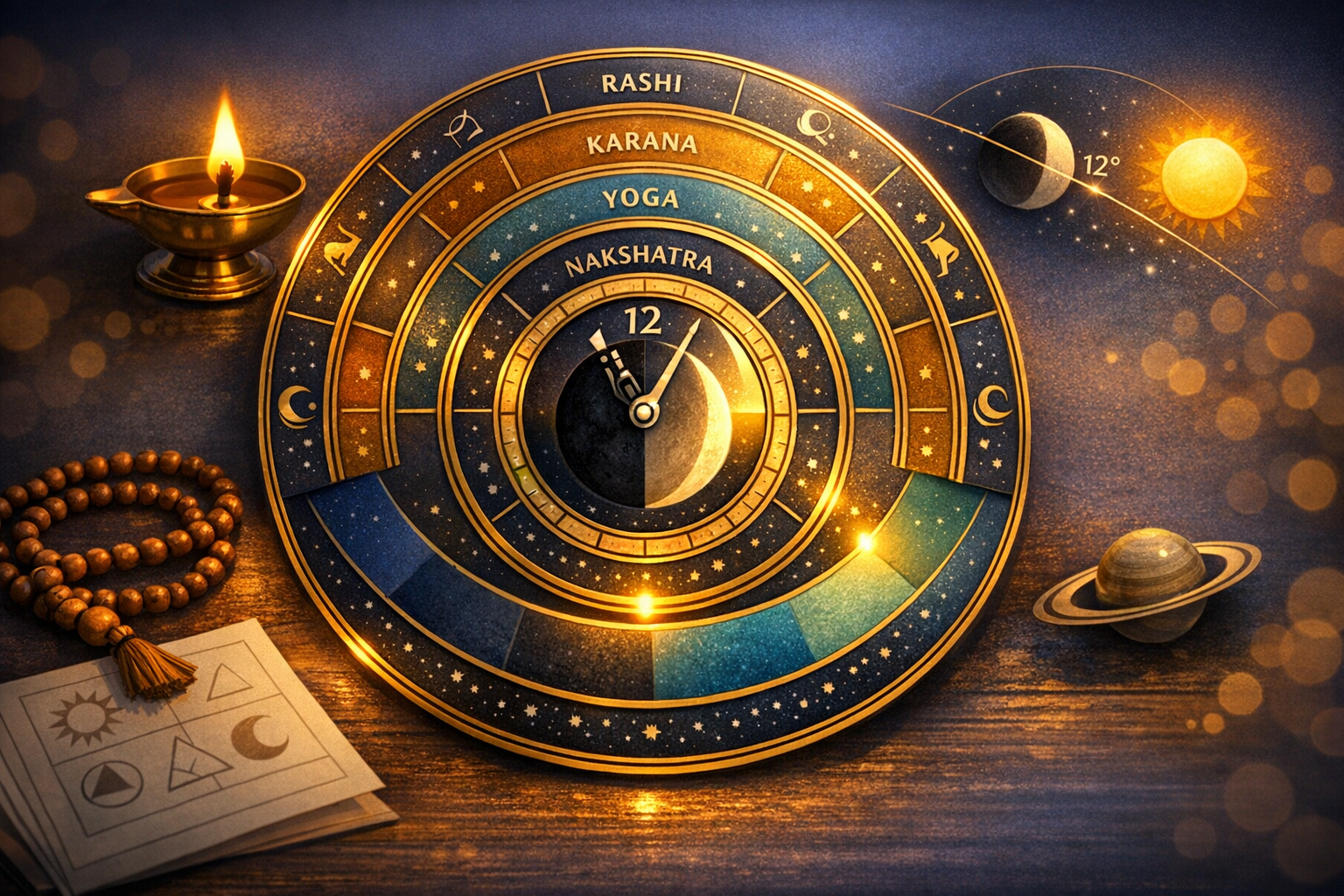
Understanding the tithi mathematically clarifies why such time stamps fall anywhere within the civil day. In Vedic calendrics, a tithi is defined by the angular separation between the Moon and the Sun along the ecliptic; each tithi spans 12 degrees of this separation. Pratipada corresponds to a separation of 0°–12°, while Dwitiya corresponds to 12°–24°. Because the Moon’s motion is not uniform and sunrise is not the astronomical reference point for tithi change, a tithi can begin or end at any clock time, often straddling two civil dates. The 11:03 PM transition on May 2 reflects the precise moment the Moon–Sun elongation crosses from the first to the second 12-degree arc in most regional computations.
Within the spiritual arc of the fortnight, Krishna Paksha is traditionally associated with inward-turning practices, refinement, and release. As the opening limb of this half-cycle, Pratipada favors setting a calm, principled sankalpa (intention), organizing devotional routines, and undertaking reflective study. With the onset of Dwitiya after 11:03 PM, the energy shifts toward steadiness and incremental progressuseful for continuing disciplines begun earlier in the day. Many households find it grounding to engage in simple, regular worship, silent mantra recitation, or contemplation during this waning phase to align action with clarity rather than impulse.
The weekday also contributes a meaningful layer in the Panchang. Saturday (Shaniwar) is thematically connected to patience, structure, service, and duty. This makes the day well-suited to completing pending responsibilities, honoring commitments, and upholding ethical boundaries. Practitioners often observe that dedicating time to seva (service), austerity in speech and consumption, and acts of charity fosters the Saturnine virtues of steadiness and responsibility across family and community life.
Planning auspicious undertakings typically involves considering both “do” and “do not” windows. The classic avoidance periods are Rahu Kalam, Yamaganda, and Gulika. These three are computed by dividing the daylight span from local sunrise to sunset into eight equal parts; which segment corresponds to each inauspicious period depends on the weekday. On Saturdays, Rahu Kalam falls in the 3rd division of the day, Yamaganda in the 6th, and Gulika in the 1st. To calculate: determine the length of daylight, divide by eight, then map each 1/8th segment sequentially from sunrise. Avoid launching new ventures, transactions, or travel in these windows when possible; routine activities and ongoing tasks, however, may continue without concern.
A commonly preferred positive window is the Abhijit Muhurat, centered on local midday (not clock noon unless it coincides with the Sun’s upper transit). When present on a given day and unobstructed by strong contrary factors, Abhijit is considered broadly auspicious for decisive actions. Because its exact span shifts slightly with season and latitude, verifying this with a reliable local Panchang or astronomy-based almanac is prudent for precision.
Beyond weekday and tithi, a full Panchang perspective considers the remaining three limbs: Nakshatra, Yoga, and Karana, together with the Moon’s Rashi (sign). Nakshatra reflects the lunar mansion occupied by the Moon and shapes the emotional and procedural tone of the day (for example, detail-orientation versus expansion). Yoga, derived from the sum of solar and lunar longitudes, speaks to the day’s integrative or frictional qualities. Karana is a half-tithi marker that refines the timing for starts and completionsuseful for scheduling sub-steps within a longer muhurat. The Moon’s Rashi modulates instinctive responses and interpersonal sensitivities. For May 2, 2026, these values vary with location and the ayanamsha (such as Lahiri or Raman); consulting a region-specific Panchang will provide exact Nakshatra, Yoga, Karana, and Rashi for the reader’s locale.
Regional calculation traditions can yield small, meaningful differences. Two reliable variants are drik (observation-oriented) Panchang, which uses precise astronomical algorithms and topocentric corrections, and traditional Panchang, which may privilege certain community-accepted rules (such as sunrise-bound observances) for vrata and festival determination. In practice, households and temples generally follow the trusted local almanac they have long used; consistency within a community preserves harmony and avoids confusion when coordinating family and societal rituals.
These lunar observances resonate across dharmic traditions. Hindu practitioners align daily worship and vrata with tithi; Buddhists observe Uposatha days for intensified ethics and meditation; Jains undertake fasts and samayik (meditative equanimity) with careful attention to lunar phases; Sikhs, while following the Nanakshahi calendar for core commemorations, also participate in many community observances in step with regional lunar customs. Emphasizing this shared cadence nurtures mutual respect and unity among Hinduism, Buddhism, Jainism, and Sikhisman ethos central to a harmonious dharmic society.
Practical guidance for this date follows from the above principles. For initiatives that benefit from the clean-slate quality of Pratipada, consider planning or preliminary steps before 11:03 PM. For actions seeking steadiness, continuity, and consolidation, the Dwitiya phase beginning after 11:03 PM is apt. Across the day, prioritize clarity over haste: schedule starts outside Rahu Kalam, Yamaganda, and Gulika; leverage Abhijit near local midday when suitable; and let Nakshatra, Yoga, Karana, and the Moon’s Rashi fine-tune the final window.
In summary, May 2, 2026, sees Krishna Paksha Pratipada tithi until 11:03 PM in most regions, followed by Krishna Paksha Dwitiya tithi. Saturday’s disciplined tenor supports methodical progress, service, and integrity. A balanced approachanchored in the five limbs of the Panchang, attentive to both auspicious and inauspicious intervals, and mindful of local calculation traditionshelps individuals and families plan their day with confidence, aligning spiritual intent with practical timing.
Inspired by this post on Hindu Blog.