Gautama Maharshi stands among the eminent Vedic sages whose name echoes across the textual and ritual landscape of South Asia. Revered in Hinduism as a seer of Rig Veda hymns, remembered in Buddhism through the shared clan name of the Buddha, and honored in Jainism via the illustrious Gautama Swami (Indrabhuti), the figure of Gautama becomes a bridge across Dharmic traditions. This multidimensional legacy makes Gautama not merely a historical or mythic persona but a living symbol of wisdom, discipline, and ethical inquiry that continues to inspire seekers today.
Within the Vedic corpus, Gautama (often styled as Gotama Rāhūgaṇa) is traditionally described as the son of Rahugana. Vedic genealogies associated with the Gautama lineage are reflected in the attributions of hymns to seers such as Vāmadeva Gautama and Nodhās Gautama. While the precise familial relations vary by source, traditional accounts frequently place Vāmadeva and Nodhās within Gautama’s lineage or circle of disciples, underscoring a robust intellectual heritage transmitted through the guru–shishya paramparā.
Contributions linked to the Gautama lineage in the Rig Veda (Ṛgveda) include hymns addressed to deities such as Agni, Indra, and the Aśvins. These compositions exhibit hallmark features of Vedic poetics—concise expression, layered metaphor, and mastery of chandas (metre), including Gāyatrī, Anuṣṭubh, and Triṣṭubh. The hymns demonstrate a deep engagement with cosmic order (ṛta), sacrificial knowledge (yajña-vidyā), and the subtle dynamics of speech (vāc), all of which shaped the subsequent evolution of Indian religious and philosophical thought.
Vāmadeva Gautama, credited with Mandala 4 of the Rig Veda, exemplifies the intellectual brilliance of this lineage. His hymns display sophisticated rhetorical play and theological depth, blending praise, philosophical reflection, and visionary insight. Nodhās Gautama’s attributions in Mandala 1 likewise speak to the lineage’s sustained literary presence and ritual authority during the early Vedic period.
Beyond the Rig Veda, the name Gautama is also preserved in the Dharmasutra literature. The Gautama Dharmasutra—often regarded by scholars as one of the earliest Dharmasutras—presents a concise sutra-style manual on social order, rites, and ethical discipline. It surveys āśrama-dharma (duties of life stages), varṇa norms, śrāddha (ancestral rites), prāyaścitta (expiations), and rājadharma (royal duties). Although historical dating and textual affiliations remain debated, many scholars situate the text within the Samaveda tradition and place its composition in the late first millennium BCE. Its stylistic economy and juridical precision mark a crucial step in the codification of dharma that would culminate in the later Dharmashastras.
Gautama’s name also resonates through the philosophical lineage of Nyāya. The Nyāya-sūtra is traditionally attributed to Akṣapāda Gautama, the systematizer of Indian logical and epistemological inquiry. While this Gautama is historically distinct from the Vedic seer, the shared name highlights how “Gautama” came to signal intellectual authority. The Nyāya school’s rigorous analysis of pramāṇas (means of valid knowledge)—pratyakṣa (perception), anumāna (inference), upamāna (comparison), and śabda (verbal testimony)—helped shape classical Indian philosophy and provided a durable framework for dialogical reasoning across Dharmic traditions.
In the epic and Purāṇic horizons, Gautama is integrally associated with Ahalya. The Valmiki Ramayana (Bāla Kāṇḍa) presents variations in which Ahalya undergoes a period of penance and is restored through the compassionate presence of Sri Rama. Later retellings sometimes narrate a petrifaction motif—Ahalya turning into stone and being redeemed by Rama’s touch. Across versions, the narrative, read with sensitivity and symbolic hermeneutics, foregrounds themes of austerity (tapas), error and expiation (prāyaścitta), and the redemptive power of grace, inviting an ethical reflection that resonates in Hindu, Buddhist, and Jain moral imaginations.
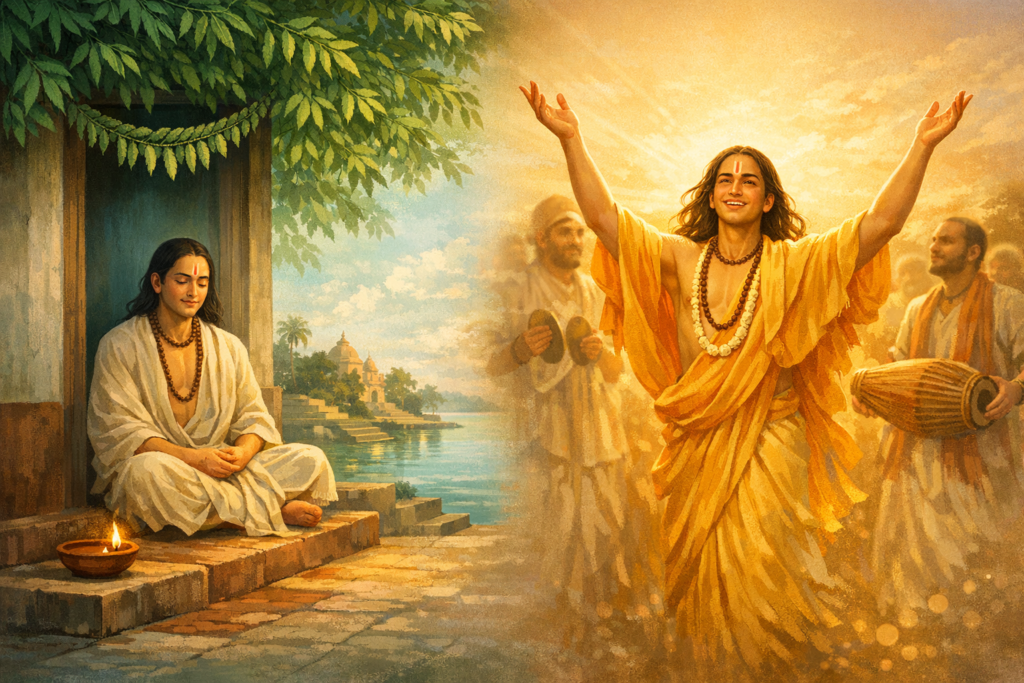
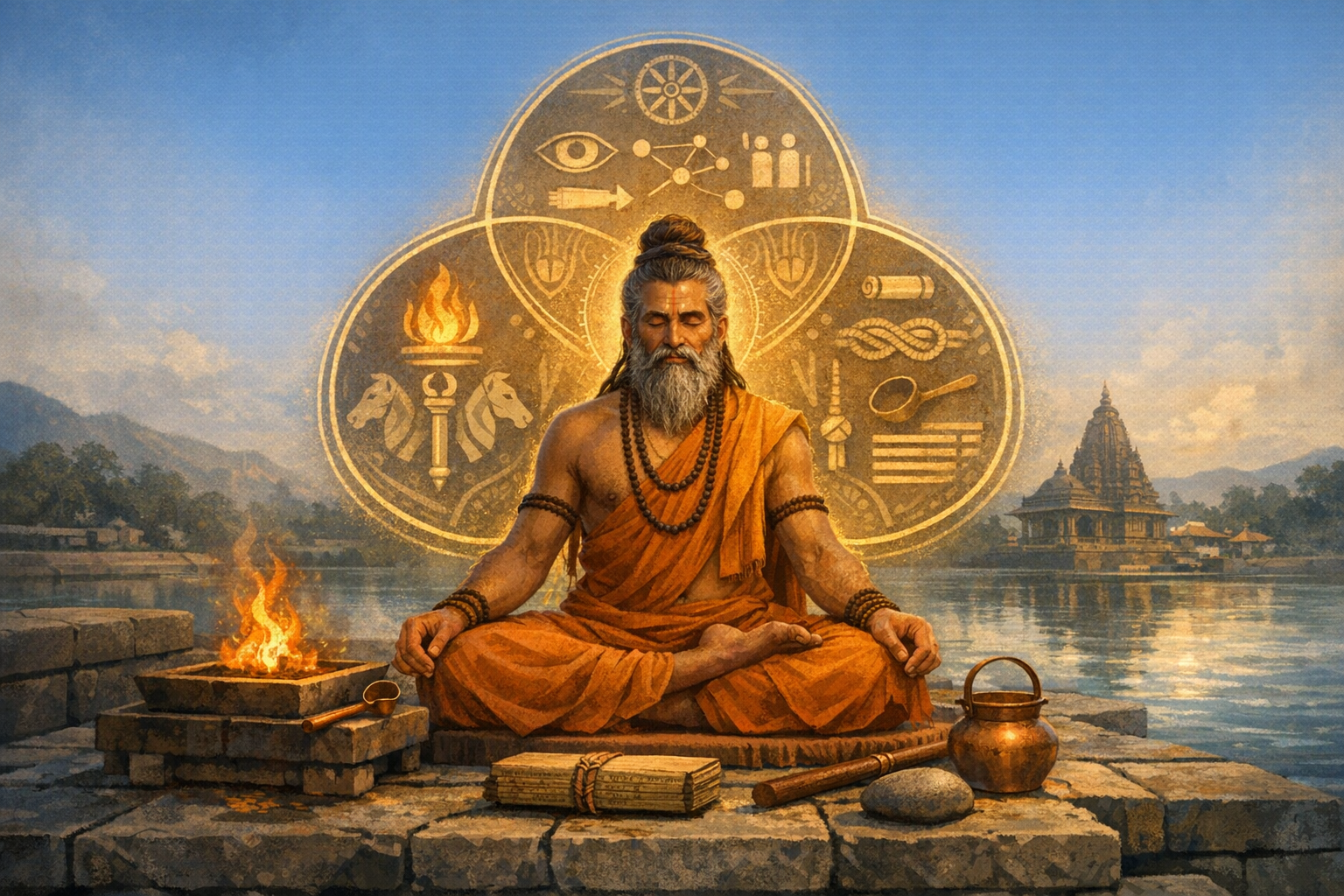
A second major strand in the living memory of Gautama appears in the sacred geography of the Godavari, often honored as Gautamī Ganga. Purāṇic accounts—prominently the Gautamī-māhātmya sections of the Skanda Purana—link Gautama’s tapas with the river’s earthly manifestation near Tryambakeśvara (Trimbakeshwar) by Nashik. This association has shaped a venerable pilgrimage tradition. Even today, visitors to Trimbakeshwar Temple encounter ritual practices and oral histories that keep the memory of Gautama’s ascetic discipline alive, reinforcing the river’s sacred identity as a channel of purification and renewal.
References to “Gautama” beyond Hinduism further deepen his cross-cultural significance within the Dharmic family. In Jain tradition, Gautama Swami (Indrabhuti) is revered as the chief disciple of Bhagavan Mahavira. While not the same historical figure as the Vedic seer, the shared name illustrates a broader onomastic and intellectual milieu in which values like ahiṃsā (non-violence), tapas (austerity), and śraddhā (faith) are recurrent and mutually intelligible across traditions.
In Buddhism, “Gautama” survives as the clan name associated with the Buddha (Siddhartha Gautama). Although the Buddha’s social and doctrinal setting is distinct, the shared name again underscores a deep cultural intertext, where questions of suffering, ethical conduct, meditation, and liberation travel across communities. This connective tissue across Hinduism, Buddhism, and Jainism offers a valuable platform today for inter-dharmic understanding, comparative philosophy, and compassionate dialogue—aspirations strongly aligned with the spirit of Sikhism’s emphasis on truth, service, and unity.
As with many ancient figures, textual layers are complex and at times overlapping. “Gautama” can denote a Vedic seer and lineage contributor to the Rig Veda, the authorial name behind the Gautama Dharmasutra, the logician Akṣapāda Gautama of the Nyāya-sūtra, and revered teachers in Jain and Buddhist contexts. Responsible historiography distinguishes these occurrences while appreciating the cultural continuity they collectively represent.
Philologically, Rig Vedic attributions to Gautama-related seers show how family lineages (gotras) anchored intellectual transmission. Hermeneutically, the Ahalya episode demonstrates how epic narrative invites multiple levels of reading—historical, symbolic, and ethical—without reducing the tradition to a single voice. Juridically, the Gautama Dharmasutra exhibits an early, methodical attempt to synthesize customs and norms into portable guidelines. Philosophically, Akṣapāda Gautama’s Nyāya foregrounds reasoning and debate as indispensable to the pursuit of truth.
For contemporary readers and pilgrims, Gautama’s legacy offers three practical insights. First, it encourages a humble appreciation of textual plurality: ancient India cultivated diverse schools that converged on shared moral concerns. Second, it commends disciplined inquiry—ritual, ethical, and philosophical—as the basis of personal and social flourishing. Third, it affirms unity within diversity: across Hinduism, Buddhism, Jainism, and Sikhism, one repeatedly encounters a commitment to dharma, compassion, and the transformative potential of knowledge.
In sacred sites such as Trimbakeshwar, the Godavari’s banks become a classroom where history, scripture, and lived devotion meet. Recitation of Sanskrit mantras, invocation of gotra names, and observance of ancestral rites continue to weave the memory of Gautama Maharshi into daily practice. Such continuity does not erase difference; rather, it renders difference dialogical, allowing each tradition to illuminate the others.
Seen in full, Gautama Maharshi is not a figure confined to a single text or denomination. He is a touchstone for Vedic revelation, a catalyst for normative reflection in the Dharmasutras, an emblem of rigorous reason in Nyāya, and a name that quietly binds the Dharmic family together. In honoring Gautama across these registers, communities affirm a shared inheritance—one that prizes truth, restraint, compassion, and intellectual courage.
That inheritance remains vital. Whether approached through the hymns of the Rig Veda, the measured counsel of the Gautama Dharmasutra, the logic of the Nyāya-sūtra, the moral drama of the Ramayana, or the cross-traditional echoes found in Buddhist and Jain lineages, Gautama’s legacy invites renewed study and renewed fellowship. It points toward a future in which the great rivers of the Dharmic traditions—like the Gautamī Ganga—flow together in mutual respect and shared purpose.
Inspired by this post on Hindu Pad.