जनेऊ क्यों पहनते हैं:– ब्राह्मणो ब्रह्मवर्चसी जायताम।। अर्थात:– ब्राह्मण ब्रह्म (ईश्वर) तेज से युक्त हो। ॐ यज्ञोपवीतं परमं पवित्रं, प्रजापतेयर्त्सहजं पुरस्तात्। आयुष्यमग्र्यं प्रतिमुञ्च शुभ्रं, यज्ञोपवीतं बलमस्तु तेजः॥ अर्थात:– जनेऊ को उपवीत, यज्ञसूत्र, व्रतबन्ध, बलबन्ध, मोनीबन्ध और ब्रह्मसूत्र भी कहते हैं। जनेऊ धारण करने की परम्परा बहुत ही प्राचीन है। वेदों में जनेऊ धारण करने की
Janeyu (Yagnopaveetham; yajñopavīta) designates one of the most enduring samskaras in the Hindu way of life. Framed by the aspiration ब्राह्मणो ब्रह्मवर्चसी जायताम and sanctified by the investiture mantra ॐ यज्ञोपवीतं परमं पवित्रं…, the sacred thread signals readiness for disciplined learning, ethical living, and daily remembrance of Brahman. Across regions it is known by names preserved in living usage—upavīta, yajñasūtra, vratabandha, balabandha, monībāndha, and colloquially even “brahmasūtra,” a cultural epithet distinct from the philosophical Brahma-sūtra.
Etymologically, upa + vīta means “a cord worn upon (the body)”; yajña + upavīta indicates “the thread aligned to sacrifice (yajña).” The core idea is orientation—placing the body, breath, and conduct in service of dharma. In North India it is often called janeu/janoi; in Tamil regions, poonal/poonool; in coastal and Deccan traditions, variants reflect local phonetics, yet the ritual grammar remains consistent within the Vedic tradition.
Scriptural foundations are found not as a single verse but as a corpus of injunctions and procedures. The Gṛhya Sūtras (such as Āpastamba, Baudhāyana, Gobhila, and Pāraskara) detail the upanayana samskara—the investiture through which the yajñopavīta is received. Dharmaśāstra texts (e.g., Manusmṛti 2.36–2.41 and parallel smṛtis) contextualize it as the doorway to Vedic study (vedārambha), daily observances (like sandhyā), and participation in rites (deva-kārya and pitṛ-kārya). Purāṇic and later liturgical manuals preserve the widely recited formula: ॐ यज्ञोपवीतं परमं पवित्रं…
Meaning and purpose align with the broader aims of samskara: inner refinement through outer discipline. The janeyu is a pedagogical device and a vow-marker, not a mere ornament. It reminds the wearer that knowledge carries responsibilities—truthfulness, self-restraint, reverence for teachers, and commitment to daily remembrance (smaraṇa) of the Divine through mantra, study, and service to society.
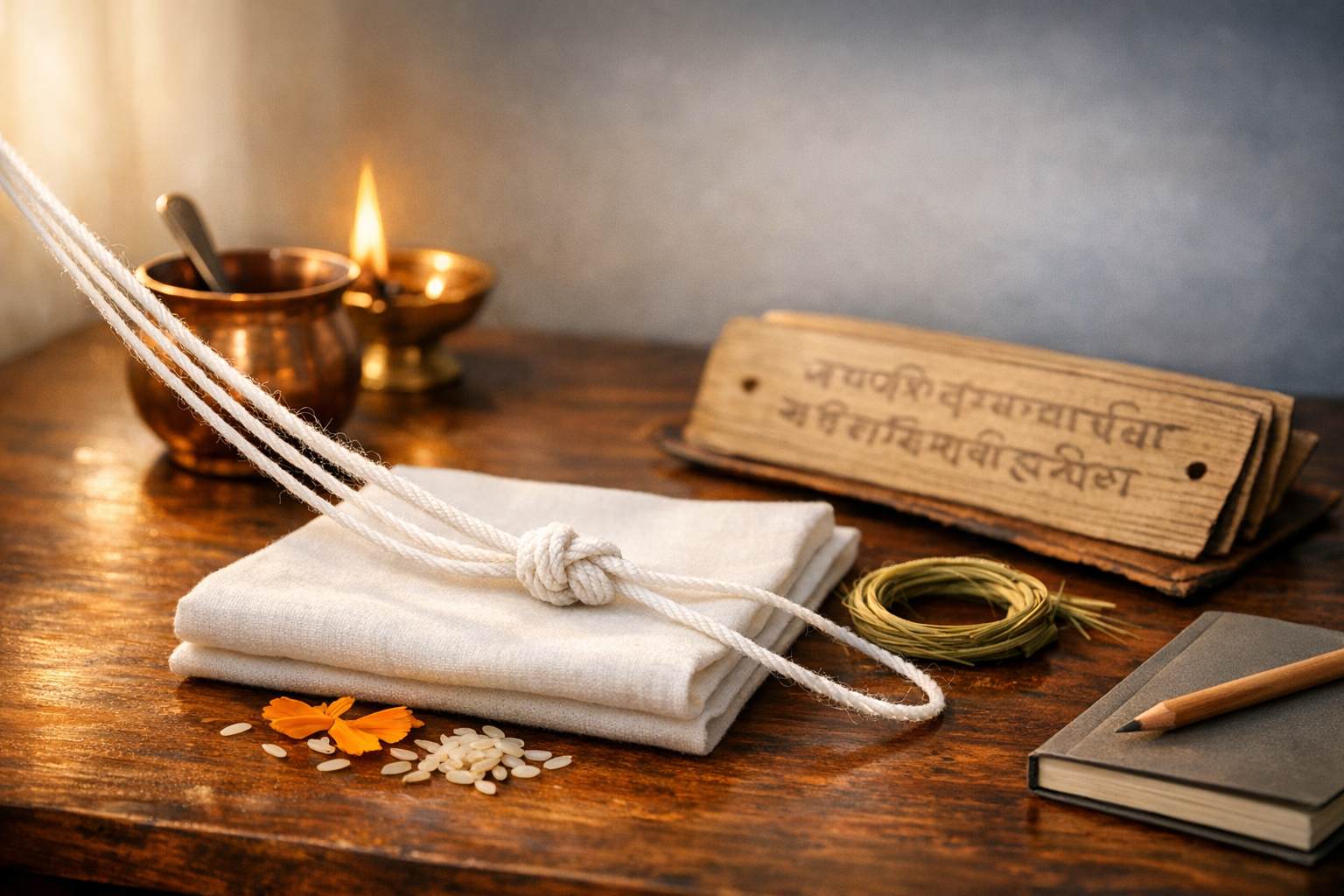
Construction follows clear ritual specifications. Traditionally, the thread is spun from cotton (karpāsa) for purity and simplicity; silk is used in some traditions for specific rites. Early sources mention mūrvā (a durable fiber; Sansevieria species) as ritually acceptable. The thread is usually composed of three primary strands, each itself made from multiple plies, joined by a central knot (brahma-granthi). The number three is richly symbolic in commentarial lore—representing ṛta-dharma-kāma, the triple Vedic canon (Ṛg–Yajus–Sāman), the three guṇas (sattva–rajas–tamas), and the triad of debts (ṛṣi–deva–pitṛ-ṛṇa) to be consciously repaid through study, worship, and service.
Wearing styles are functionally distinct and well-attested. Upavīti—draped over the left shoulder and under the right arm—is the standard posture for auspicious and deva-oriented rites (including daily sandhyāvandanam). Prācīnāvīti—over the right shoulder and under the left arm—is prescribed for pitṛ-kārya (ancestral rites). Nivīti—looped around the neck—is specified by certain Gṛhya Sūtras for select tasks. This grammar of orientation turns the thread into a living mnemonic: action is aligned by how the thread is worn.
Core liturgy at investiture includes sankalpa (intent), purification (ācāmana), girding with sacred grass (mekhalā), and the act of wearing the thread while reciting ॐ यज्ञोपवीतं परमं पवित्रं… The rite culminates in vedārambha, the beginning of study, anchored by Gayatrī-japa. Many regions add bhikṣā-caraṇa (ritual alms-seeking), imprinting humility and interdependence as non-negotiable virtues of the learner’s path.
Care and replacement are part of the discipline. The thread is kept clean, unknotted beyond the prescribed brahma-granthi, and replaced if frayed or soiled. Annual renewal is synchronized with Vedic upākarma (e.g., Avani Avittam for Yajurveda adherents), when students symbolically pause and recommence study, offering gratitude to the lineage of seers and teachers who preserved śruti and smṛti.
Age and eligibility have varied historically. Dharmaśāstra texts suggested early adolescence with differences by vocation; in practice, regional customs, community vocations, and pedagogical needs shaped timing. In modern Hindu society, many communities across India have embraced upanayana as an inclusive educational samskara, focusing on character formation rather than birth-based restriction. Where communities choose not to practice janeyu, allied samskaras emphasizing ethical vows and scriptural study serve the same goal of brahmacharya—disciplined learning oriented to the highest good.
Symbolism is layered but pragmatic. The tactile presence across the chest becomes a constant, gentle nudge to breathe with awareness, speak with integrity, and act with restraint. In daily sandhyā, the thread, the spoon (pātra), and water (ācamana) orchestrate posture, breath, and mantra for rhythm and regularity—habits that, over time, mature into lived spirituality.
Regional practice illustrates India’s plural unity. In Maharashtra and parts of North India, the mekhala (waist-girdle) of muñja grass gives the rite its popular name (munjā). In South India, the poonal bears the stamp of local recensions of the Yajurveda, with precise syllabic and ritual emphasis. Bengali, Gujarati, Odia, and Telugu manuals record nuanced variants while maintaining the shared grammar of Gṛhya Sūtra procedure. The continuity of form alongside regional accents exemplifies Sanatana Dharma’s capacity to preserve essence while embracing diversity.
Clarifications help dispel common misconceptions. The colloquial term “brahmasūtra” for the thread is not identical to the Brahma-sūtra attributed to Bādarāyaṇa, the canonical Vedānta text. Likewise, janeyu is not a magical charm; it is effective only insofar as it is yoked to study, meditation, and ethical action. Without sandhyā, svādhyāya (self-study), and sevā (service), the thread is an empty signifier.
Daily life integration is straightforward when approached as practice rather than display. Office attire, fieldwork, and study routines can easily accommodate the thread; the core commitments—truthful speech, mindful breath, and regular prayer—require intention, not ostentation. In diaspora settings, families often blend local school schedules with morning/evening sandhyā and weekend svādhyāya, demonstrating that the thread’s meaning is portable and perennial.
Scriptural memory and ethical resolve converge in the investiture mantras. The prayer for brahmavarcas (radiance born of knowledge) does not valorize status; it highlights responsibility—the luminous steadiness that comes from a life aligned to dharma. The phrase ब्रह्म (ईश्वर) तेज evokes an inner brightness that expresses as clarity, compassion, and courage.
From a comparative dharmic perspective, the janeyu aligns with a broader civilizational pattern: initiation marking a transition into disciplined learning and service. Buddhism’s upasampadā, Jainism’s dīkṣā, and Sikhism’s Amrit Sanchar differ in liturgy and theology yet share the ethical arc—vows, remembrance, and community accountability. Emphasizing this shared trajectory fosters unity among Hinduism, Buddhism, Jainism, and Sikhism while respecting each path’s integrity.
Health and ecology considerations are implicit in tradition. Cotton threads are biodegradable; the expectation of cleanliness cultivates bodily hygiene and ritual purity (śauca). Replacement when soiled avoids wasteful accumulation and keeps the symbol aligned with its intention—freshness in study and sincerity in conduct.
Pedagogy within upanayana is elegantly simple: a daily algorithm of alignment. Stand, breathe, recall the vow, chant with attention, act with kindness. The cord does not confer excellence; it conjures memory—the remembrance that excellence is a habit, built by small, steady practices sustained over time.
In community life, the sacred thread operates as a quiet covenant. It gently signals membership in a learning lineage, accountability to elders, and service to society. It need not create distance from others; rather, it should draw the wearer toward inclusive action—teaching, caregiving, and protecting the vulnerable—so that knowledge becomes a shared light.
Technically inclined readers will appreciate the ritual grammar that maps function to form. Upavīti for deva-kārya aligns the body’s left-right axis to the rite’s auspicious orientation; prācīnāvīti honors pitṛ-kārya by reversing the drape; nivīti suspends orientation when neither vector is liturgically appropriate. Material, number, knot, and orientation collectively encode intention—turning a simple thread into a language of dharma.
In contemporary practice, two commitments keep the janeyu meaningful: regular sandhyā (especially Gayatrī-japa with attentive breath) and svādhyāya (even a few daily ślokas or reflective reading). Where a household follows different dharmic paths, convergence on shared ethical vows—nonviolence, truthfulness, restraint, generosity, and remembrance—preserves unity without erasing differences. This is Vasudhaiva Kutumbakam as daily habit.
In sum, Janeyu (Yagnopaveetham) is a living samskara—part vow, part mnemonic, part discipline—anchored in the Vedic tradition and illuminated by Dharmaśāstra and Gṛhya Sūtra procedure. Its power lies not in the string but in the life it continuously re-orients: studied, mindful, serviceful, and open-hearted. Preserved with care, practiced with sincerity, and understood in the inclusive spirit of the broader dharmic family, it remains what the mantra proclaims—paramam pavitram, a supremely purifying aid to a life of knowledge and compassion.
Inspired by this post on Hindu Pad.