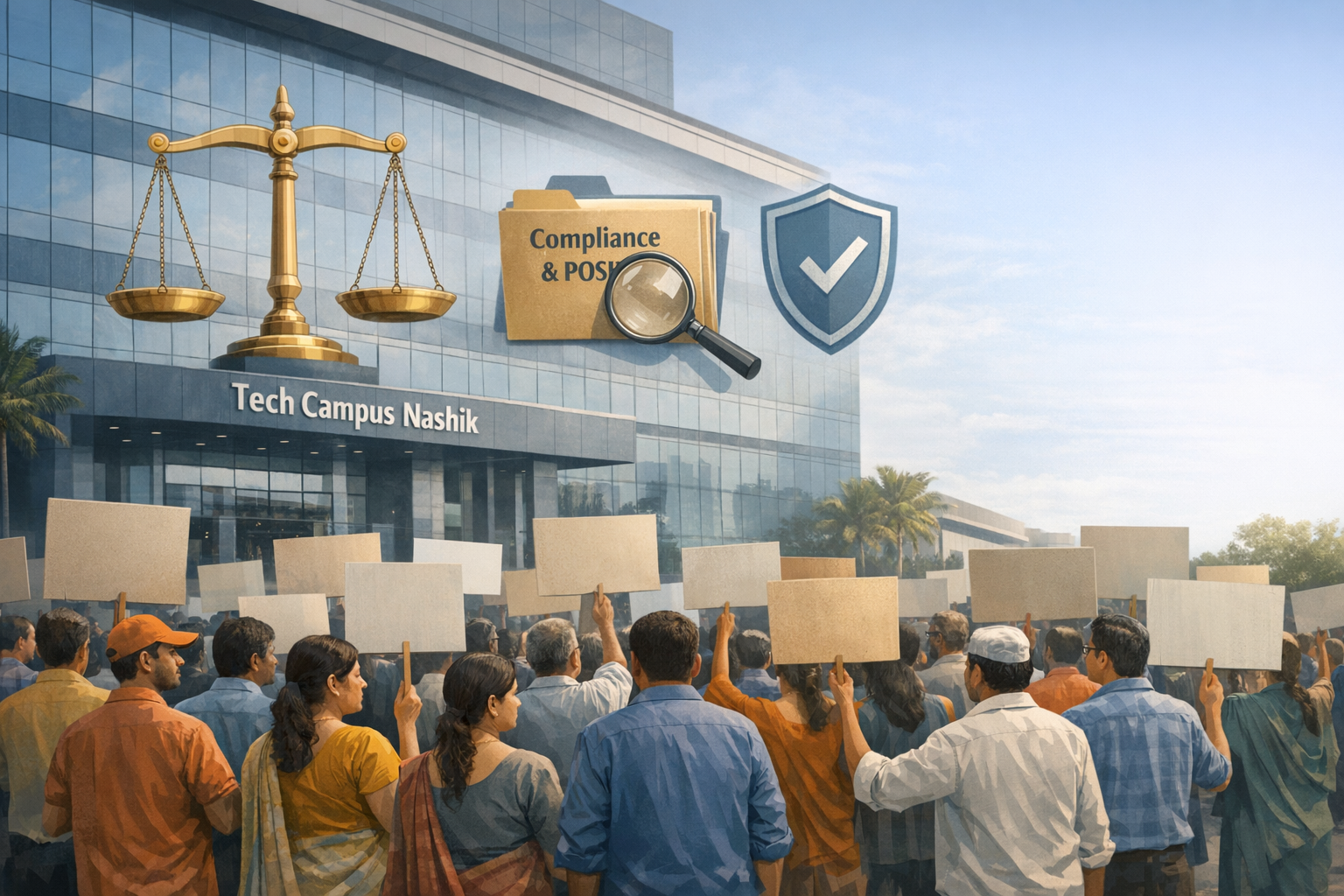
Reports from Nashik, Maharashtra indicate that a demonstration by Bajrang Dal took place outside the TCS office in April 2026, centering on allegations of coerced religious conversion and sexual harassment within a multinational corporate setting. The protest demanded decisive action; however, given the gravity of the claims and the potential for reputational and social harm, the most constructive path forward is an impartial, time-bound inquiry grounded in statutory due process and corporate compliance norms.
Public concern intensifies when workplace misconduct and communal anxieties intersect. Visuals and accounts circulating in local media referenced calls for strict accountability. Responsible coverage and civic engagement in such moments require precision in language, care for the dignity of those involved, and clear separation of unverified claims from established factsparticularly when allegations implicate both individual conduct and broader social tensions.
Two distinct issues are at play and must be evaluated through different legal and procedural lenses: (1) sexual harassment allegations in the workplace, and (2) alleged coerced religious conversion. Conflating these can undermine justice, dilute evidence standards, and complicate redress for potential survivors. The first is addressed primarily through the Prevention of Sexual Harassment (POSH) framework; the second, through constitutional protections, criminal law, and (where applicable) state legislation on unlawful conversion.
Under India’s POSH Act, 2013, an employer must constitute an Internal Committee (IC), maintain robust reporting channels, ensure confidentiality, and complete inquiries within prescribed timelines (generally 90 days for inquiry and an additional 60 days for implementation of recommendations). Employers are obligated to conduct awareness programs, ensure a safe work environment, and treat substantiated sexual harassment as misconduct under service rules. The statute also mandates non-retaliation, prohibits publication of identities or proceedings, and requires reasoned findings rooted in documentary and testimonial evidence.
From a governance standpoint, listed companies such as TCS also operate under the Companies Act, 2013 (including Section 177 on vigil mechanisms) and SEBI (LODR) Regulations, 2015, which reinforce whistleblower protections, escalation pathways, and board-level oversight. Effective mechanisms typically include accessible reporting portals, trained IC members, external subject-matter advisors where necessary, and clear disciplinary matrices aligned with employment law and internal codes of conduct.
Allegations of coerced religious conversion invoke India’s constitutional architecture. Article 25 guarantees freedom of conscience and the right to profess, practice, and propagate religion, subject to public order, morality, and health. Forced or fraudulent conversion, however, is not protected. Several Indian states have enacted anti-conversion statutes defining and penalizing conversion by force, fraud, or allurement. Maharashtra has not enacted a specific anti-conversion law to date; as a result, law enforcement relies on general penal provisions (for example, those addressing criminal intimidation, assault, wrongful confinement, or cheating) where evidence indicates coercion or deception.
When complaints plausibly suggest criminal elements alongside workplace violations, corporate processes and criminal investigations must proceed in parallel, each respecting jurisdictional boundaries. Police can register a First Information Report (FIR)and, where needed, a Zero FIRfollow evidentiary protocols, and avoid prejudgment. Corporate IC proceedings must remain independent, confidential, and free of external pressure, even while cooperating with lawful police requests.
Best-practice investigative sequencing includes: immediate safety measures for complainants; secure preservation of digital and physical evidence; formal complaints routed to the IC; prompt notices to respondents; interviews of witnesses; corroboration through access logs, communications, and CCTV where available; and reasoned findings issued within statutory timelines. Communication to stakeholders should be limited to need-to-know updates that protect confidentiality and avoid trial by media.
Safeguarding survivors requires trauma-informed protocolschoice of support person in interviews, flexibility in scheduling, and access to counseling. Many professionals recognize the anxiety associated with reportinga fear of retaliation, loss of career traction, or social stigma. Institutions that provide clear assurance against reprisals and emphasize confidentiality markedly improve reporting rates and the quality of evidence presented.
Due process equally protects the rights of the accused. Principles of natural justicenotice of allegations, reasonable opportunity to respond, and the ability to present witnesses and documentsare integral to credible outcomes. IC members must be trained to recognize implicit bias, avoid leading questions, and maintain meticulous records to withstand judicial scrutiny if challenged.
Public demonstrations fall under the constitutional right to peaceful assembly (Article 19(1)(b)), subject to reasonable restrictions. Community organizations, including Bajrang Dal, play a visible role in articulating social concerns; in turn, they also carry responsibility to avoid escalatory rhetoric, respect ongoing inquiries, and prioritize communal harmony. Terms such as “Corporate Jihad” are widely criticized for polarizing discourse and risk overshadowing the central task of evidence-based accountability.
In a plural society, dharmic values shared by Hinduism, Buddhism, Jainism, and Sikhismahimsa (non-violence), satya (truth), karuna (compassion), and daya (empathy)offer a principled compass. Applying these to corporate life means centering human dignity, ensuring fair process, and eschewing collective blame. Interfaith and intercultural awareness programs, coupled with robust anti-harassment and non-discrimination training, can defuse tensions before they harden into grievance cycles.
For employees seeking redress, multiple avenues exist. Complaints can be filed with the employer’s IC under the POSH Act; survivors may also use the Government of India’s SHe-Box portal for POSH-related grievances. Where criminal coercion or intimidation is alleged, police complaints can be filed at any station, including through a Zero FIR when jurisdiction is uncertain. State women’s helplines (such as 181 where operational) and the National Commission for Women provide supplementary support. Documentationtimestamps, messages, emails, access logsoften proves decisive.
Local business ecosystems feel the ripple effects of high-profile cases. The phrase “Nashik BPO allegations” has appeared in public discussions, highlighting how unresolved disputes can affect talent pipelines, employer branding, and community confidence. Transparent, timely investigations paired with survivor-centric safeguards and fair treatment of the accused are essential to restoring trust among employees, clients, and residents.
Responsible media and social media conduct is equally critical. Sharing unverified claims, doxxing parties, or circulating incendiary commentary undermines legal processes and deepens social divides. Precision in reportingdistinguishing allegation from substantiated factimproves public understanding and protects the integrity of both corporate and criminal inquiries.
A balanced resolution architecturerooted in law, guided by dharmic ethics, and attentive to the lived experiences of workerscan convert a moment of strain into an institutional learning opportunity. Impartial fact-finding, survivor safety, non-retaliation, and natural justice are not competing priorities; together, they form the only credible route to accountability and communal harmony in Nashik and beyond.
Inspired by this post on Struggle for Hindu Existence.