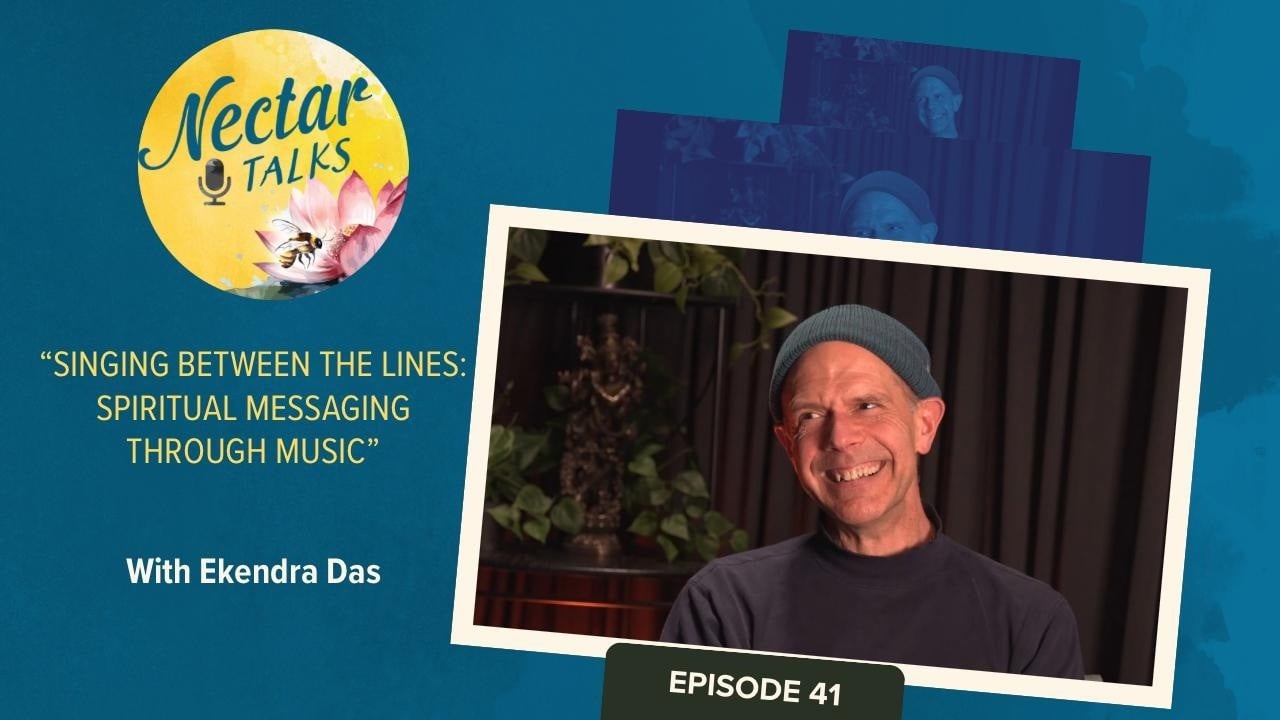
Ekendra Dasrevered in devotional circles as Ekendra Prabhuembodies how disciplined artistry matures into seva. His trajectory, from undertaking a range of “do the needful” services to aligning professional musicianship with spiritual purpose, demonstrates a pragmatic pathway many seekers follow: first serve in any capacity, then refine one’s offering until vocation and devotion converge. The resulting synthesis is not merely aesthetic; it is pedagogical, communal, and deeply dharmic in intent.
Like many devotees, he initially cycled through tasks that prioritized community needs over personal preference. Over time, professional skill and sadhana intersected, allowing music to function as both vocation and vehicle for Vaishnava outreach. That shift is consequential: when artistic rigor serves a sacred telos, it creates a communicative bridge that is accessible to newcomers while also resonant with seasoned practitioners in the Bhakti Tradition.
His embrace of the Straight Edge train added an ethical backbone familiar to dharmic disciplines. Straight Edge commitments to sobriety, non-violence, and self-restraint mirror the logic of vrata in Hinduism and find close kinship with the Buddhist pañcaśīla, Jain anuvratas, and Sikh rehat maryada. In this frame, music is not an escape but a practice of clarity; performance is anchored in yama–niyama-like guardrails that guard intent, cultivate sattva, and keep messaging aligned with principles rather than trends.
Participation in Krsna Conscious bands allowed contemporary formsamplified ensembles, guitar-driven harmonies, and dynamic stagecraftto carry timeless ideas. The sankirtana impulse adapts nimbly to context: from temple halls to campus auditoriums and community festivals, collectively sung bhajans and chanting sustain a move from individual receptivity to shared realization. Such ensembles demonstrate that stylistic modernity and scriptural fidelity are not adversaries; with careful curation, they are allies.
Equally notable is the use of theater and comedy as devotional tools. Drawing on the aesthetics codified in the Natyashastra and the Gaudiya Vaishnava taste for lila narratives, humor (hasya) becomes a responsible means to lower defenses, invite attention, and teach with gentleness. When jokes are conscientious rather than cynical, levity clarifies rather than compromises reverence, allowing complex conceptskarma, bhakti, and dharmato be received as living realities rather than abstractions.
“Singing between the lines” captures the layered nature of spiritual messaging in music. On the surface, there are memorable hooks and rhythmic motifs; beneath, there are metaphors, scriptural allusions, and value signaling. This dual coding speaks differently to multiple audiences: seekers hear resonant ethics, practitioners discern siddhanta, and casual listeners encounter an inviting mood that normalizes devotion without coercion. The praxis is simultaneously aesthetic and semiotic.
Technically, modality and meter do subtle doctrinal work. Raga choice frames bhava; tala scaffolds communal synchrony. In a kirtan idiom, call-and-response distributes agency, inviting listeners to become co-creators of the prayer. Mridanga accents, kartal shimmer, and voice-leading around the drone cultivate affective stability; when hybridized with guitar, bass, and drum kit, the sonic field widens without losing the devotional center. The result is a communicative ecology where arrangement decisions are also theological decisions.
Psychoacoustically, repetition helps encode mantras and core themes. Predictable cadences reduce cognitive load, increase entrainment, and facilitate group flow; synchronized singing is correlated in research literature with prosocial bonding and reduced stress markers. While such findings are general rather than sect-specific, they validate what practitioners report anecdotally: collective chanting calms the nervous system, steadies attention, and makes space for insight. The medium enacts the messagepresence, steadiness, and joy.
Language strategy matters. Interweaving Sanskrit mantras with vernacular lines allows transcreation rather than mere translation. A refrain such as the maha-mantra can anchor the piece, while verses in English (or regional languages) frame relevance: ethical conduct, compassion, and internal sovereignty. This code-switching respects the potency of sacred phonemes while keeping the narrative intelligible to diverse, often diasporic, audiences.
The Straight Edge discipline also communicates by example. Sobriety-centered performance reframes the concert as satsanga; it preserves clarity on and off stage, making the art credible. For adolescents exploring identity, this lived ethic demonstrates that intensity and purity can coexist. Parallels across dharmic traditions reinforce the point: Sikh kirtan’s sobriety and service ethos, Buddhist chanting’s mindfulness, and Jain stavans’ ahiṃsa orientation all position music as a means of ethical refinement and inner quietude.
Seen across the wider dharmic familyHindu, Buddhist, Jain, and Sikh traditionsmusic is a shared grammar of transcendence. Vaishnava kirtan, Shabad Kirtan, paritta and sutra chanting, and Jain stavan recitation employ melody, meter, and repetition to distill philosophy into lived experience. This unity in spiritual diversity is not an accident; it reflects a civilizational conviction that truth is better approached through disciplined practice than prescriptive dogma.
Humor and theater add a didactic horizon that many find relatable. Narrative skits, character dialogues, and situational irony illuminate how ego, desire, and distraction operate in ordinary life. When responsibly staged, comedy becomes a mirror that exposes folly while protecting dignity. Audiences often report that such performances “explain” bhakti without preaching, rendering abstract ideas concrete through recognizable situations.
For practitioners committed to accuracy, two curatorial filters help: fidelity to guru–śāstra–sādhu and contextual literacy. The first guards doctrinal integrity; the second ensures that references, aesthetics, and language match the social and generational landscape. In the hands of a professional musician like Ekendra Prabhu, those filters translate into choices about tempo, key centers, lyrical density, and stage pattereach calibrated to sustain devotion while remaining hospitable to newcomers.
Impact can be assessed with both qualitative and quantitative indicators. Qualitatively, look for post-event conversations that deepen, questions that gain specificity, and recurring participation in satsanga. Quantitatively, measure congregational singing time versus passive listening, retention of core refrains, and the diversity of the participating audience. When spiritual messaging succeeds, audiences tend to move from spectatorship to participation, and from participation to practice.
Several principles emerge from this journey. First, artistic integrity amplifies spiritual integrity; unpolished craft can obscure a clear message. Second, clarity beats cleverness; the more singable the refrain, the more portable the wisdom. Third, humor heals when it protects the sacred while revealing the superficial. Fourth, collaboration across dharmic traditions models the very pluralism being taughtinviting Sikh, Buddhist, and Jain voices into shared platforms exemplifies unity rather than merely declaring it.
Finally, the ethos of inclusivity is indispensable. Messaging that honors Ishta and respects multiple pathways strengthens the dharmic proposition that diverse temperaments rightly seek diverse practices. In this light, Ekendra Das’s integration of Krsna Conscious bands, Straight Edge discipline, and theater-comedy pedagogy functions as a case study in plural, ethical, and musically sophisticated communication. It shows how sound, story, and smile can work togethersoftening hearts, clarifying minds, and orienting lives toward compassionate action.
In sum, spiritual messaging through music is most effective when grounded in bhakti, guided by ethics, elevated by craft, and expanded through inter-traditional friendship. That is how singing between the lines becomes more than metaphor; it becomes a methodone that invites the wider dharmic family to breathe, listen, and respond as one.
Inspired by this post on Dandavats.