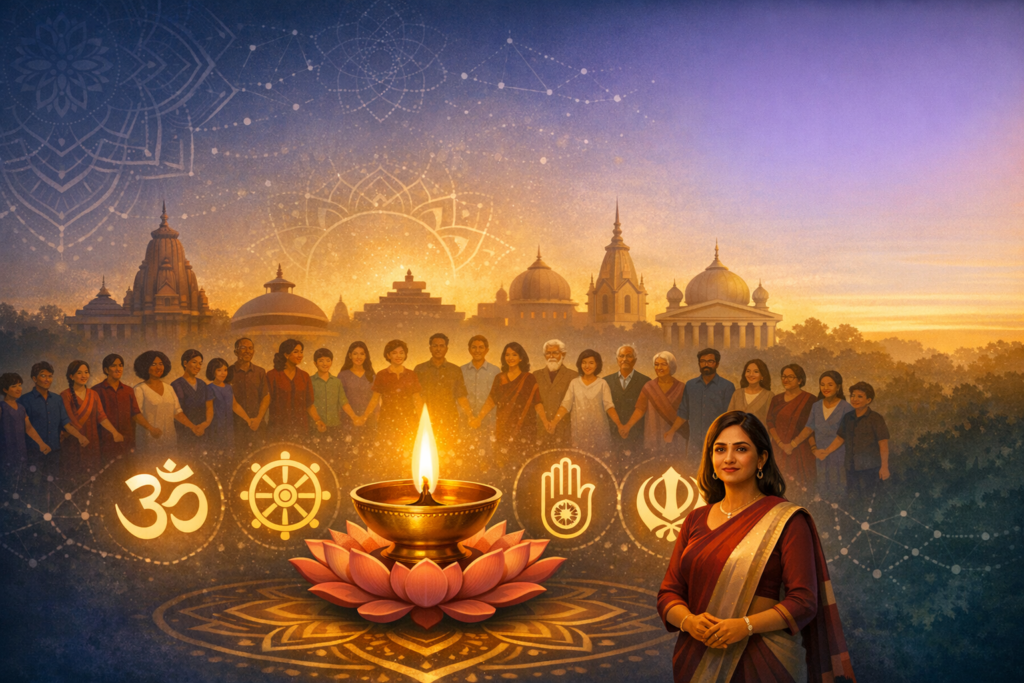
“Darkness from one side is light from the other side” functions as a concise hermeneutic for the Dharmic understanding of reality. Within Hindu philosophy and its sister traditions—Buddhism, Jainism, and Sikhism—truth is often approached through complementarity rather than binary opposition. The metaphor underscores a key insight: what appears as obscurity, error, or conflict from one vantage may disclose guidance, order, or harmony from another. Far from promoting relativism, this perspective invites disciplined inquiry, ethical clarity, and humility in judgment—qualities that sustain unity amid diversity across Dharmic traditions.
Indian philosophical discourse is replete with tools for interrogating perspective. The Upanishads, the Bhagavad Gita, and later Vedantic texts articulate layers of truth and modes of knowing (pramāṇa) that illuminate why appearances diverge. Nyāya prioritizes valid means of knowledge—pratyakṣa (perception), anumāna (inference), upamāna (comparison), and śabda (trustworthy testimony)—to correct error without dismissing lived experience. Samkhya and Yoga analyze the interplay of sattva, rajas, and tamas, mapping how mental states color what is perceived as “dark” or “luminous,” and prescribing practices to transform cognition and conduct.
Scriptural sources frame this complementarity with precision. The Isha Upanishad (verses 9–11) warns against one-sidedness—“Into blinding darkness enter those who are devoted to avidyā alone; into still greater darkness, as it were, those who delight in vidyā alone”—and then reconciles the terms by advising the integrated pursuit of both. The message is not a celebration of ignorance; rather, it is a sophisticated epistemic ethic: partial truths, taken as wholes, conceal reality, whereas balanced insight converts apparent contradictions into pathways toward wisdom.
The Bhagavad Gita extends this orientation from cognition to conduct. In 2.14, one finds the counsel to endure the “pairs of opposites” (dvandva)—heat and cold, pleasure and pain—without agitation. The teaching does not erase difference; it contextualizes difference, anchoring it in a broader vision of Dharma and equanimity (samatva). In 14.5–9, the Gita’s analysis of the gunas shows how tamas (inertia or obscuration) may seem like “darkness,” yet even this state can be transmuted into clarity (sattva) through right effort, discipline (abhyāsa), and discernment (viveka).
Advaita Vedanta refines this through the doctrine of adhyāsa (superimposition). The classic rope-snake illustration demonstrates how a dimly lit rope appears as a snake to the unprepared mind. The “darkness” is not merely the absence of light; it is a misalignment between perception and reality. Knowledge (jñāna) does not add a new object; it removes error, revealing what always already is. In this view, vyāvahārika-satya (conventional reality) and pāramārthika-satya (ultimate reality) do not compete but nest within one another; correct orientation converts confusion into insight.
Nyāya’s rigorous epistemology complements Vedanta by diagnosing why reasonable people disagree. Divergent conditions of observation, background assumptions, language, and authority produce distinct conclusions. Methodical cross-checking of pramāṇas converts apparent contradictions into a coherent picture. A disciplined process—stating the pūrva-pakṣa (the best version of the opposing view), examining counter-evidence, and arriving at a siddhānta (considered conclusion)—has long supported civil disagreement and philosophical progress across Dharmic sampradāyas.
Samkhya’s analytic model adds granularity. What looks like moral or spiritual “night” may be an indispensable phase of renewal. Tamas, when wisely harnessed, allows deep rest; rajas supplies energy to reorient action; sattva clarifies and harmonizes. Ethical and contemplative life becomes an art of transmutation: from rest to readiness to insight. The interplay shows why one tradition’s ascetic quietude can appear as “darkness” to an activist temperament, while the latter’s restless urgency can appear “rajasic” to contemplatives—yet both can be skillfully integrated within Dharma.
Yoga operationalizes this integration. Through pratyāhāra (withdrawal of the senses), dhāraṇā (concentration), and dhyāna (meditation), the mind recognizes its projections and stabilizes attention. Inner “darkness”—the unfamiliar silence that initially feels disorienting—becomes luminous awareness as habitual reactivity subsides. The much-quoted progression of śravaṇa–manana–nididhyāsana (listening, reflection, deep assimilation) turns perspectival friction into maturation.
Jain philosophy systematizes perspectival humility through Anekāntavāda (the doctrine of many-sidedness) and Syādvāda (the sevenfold conditional predication). A statement is assessed as true “in some respect” (syāt) relative to conditions; denial or affirmation is therefore qualified rather than absolute. The well-known parable of the blind men and the elephant in Indic lore dramatizes the principle: each grasp reveals a facet, not the whole. Anekāntavāda thus resists dogmatism without collapsing into nihilism; it demands careful articulation of scope, standpoint, and limitation—crucial norms for inter-traditional dialogue.
Buddhist Madhyamaka advances a similar sophistication with the “two truths”—saṃvṛti-satya (conventional) and paramārtha-satya (ultimate). Emptiness (śūnyatā) is not mere negation; it identifies the lack of independent, inherent essence in phenomena, thereby revealing dependent origination (pratītya-samutpāda). What appears substantial from one angle is revealed as relational from another. This insight transforms clinging and aversion. The result is not paralysis but compassionate clarity—wisdom that acts without reifying partial views.
Sikh thought, centered on Ik Onkar (the Oneness of the Divine), likewise reframes apparent oppositions. The Guru Granth Sahib continually urges humility before Truth and vigilance against haumai (egoic self-assertion) that hardens partial perspectives into absolutes. The Miri-Piri ideal integrates spiritual wisdom with responsible action, converting the “tension” between contemplation and civic duty into a creative synthesis. Here too, darkness becomes light when standpoint is purified by remembrance (simran), service (seva), and truthful living (sat).
Across these traditions, the Hindu concept of Ishta—the recognized freedom to approach the Divine according to one’s disposition—safeguards unity in religious diversity. Ishta does not trivialize truth into preference; it acknowledges psychological, cultural, and karmic diversity while directing practitioners to convergent ethical and contemplative ends. In a plural civilization, Ishta sustains social harmony without sacrificing philosophical rigor.
Dharmic literature also conveys this insight through potent symbols. In the Samudra Manthana (churning of the ocean), the emergence of halāhala poison precedes amṛta, the nectar of immortality. The episode encodes a civilizational axiom: apparent calamity, when faced with courage and wisdom, becomes the condition for deeper renewal. Similarly, Nataraja’s dance—encircled by the prabhāmaṇḍala (ring of flames)—shows creation and dissolution as rhythmic complements, with Apasmāra (ignorance) subdued underfoot. The form integrates ferocity and grace, darkness and light, into a single icon of cosmic intelligence.
Everyday analogies clarify the point without diluting it. Night, from one frame, obscures; from another, it restores circadian balance, enabling cognition to reset. Eclipses darken the sky yet serve astronomy and calendrics. Even in ethics, “apad-dharma” (norms appropriate to emergency) recognizes that right action adjusts to context without abandoning first principles. The Mahābhārata—especially through Vidura-nīti and the Gita’s counsel—documents the difficult art of keeping principle and prudence in creative tension.
Contemporary science supplies further resonance. Complementarity in quantum physics—wave and particle as mutually necessary descriptions—shows how model pluralism can track the one reality more faithfully than a single vantage point. As Niels Bohr and Werner Heisenberg argued, mutually exclusive frameworks may both be valid within their domains of applicability. Indian traditions long practiced an analogous pluralism of models—Vyavahāra and Paramārtha, Anekānta and Syādvāda, gunas and mokṣa—each illuminating aspects of an indivisible whole.
Practical guidance follows from these principles. First, articulate positions in their strongest form (pūrva-pakṣa) before critique. Second, disclose one’s standpoint and limits—what Jain philosophy encodes via conditional predication (syāt). Third, consult multiple pramāṇas rather than privileging a single channel of knowing. Fourth, alternate between analytic clarity (viveka) and contemplative stillness (dhyāna) so that insight is both rigorous and compassionate. Fifth, tether dialogue to shared ethical anchors—ahimsa, satya, and seva—ensuring that perspective-taking refines, rather than erodes, Dharma.
A caution is also integral: perspectival sophistication is not license for moral indifference. Dharmic traditions differentiate between layered truths and timeless values. The recognition that “darkness from one side is light from the other” disciplines cognition and speech, but it does not absolve harm or justify adharma. Rather, it equips communities to resolve disputes with fairness, to correct error without humiliation, and to preserve unity without sacrificing integrity.
In interfaith and intrafaith contexts, this approach nurtures a culture of expansive belonging summarized by the ideal Vasudhaiva Kutumbakam—“the world is one family.” Hinduism’s inclusiveness, Jainism’s Anekāntavāda, Buddhism’s two truths, and Sikhism’s emphasis on Ik Onkar each provide tested resources for transforming conflict into mutual illumination. With practice, what once looked like darkness becomes the condition for shared light: clearer understanding, steadier compassion, and resilient unity.
Thus the metaphor is more than poetic flourish; it is a method. By integrating scriptural insight, philosophical analysis, contemplative discipline, and ethical commitment, Dharmic traditions model how complex societies can hold difference without fracture. Perspective, diligently purified, turns shadows into teachers and plurality into strength.
Inspired by this post on Hindu Blog.