LingodbhavaShiva’s Infinite Pillar of Light: Iconography, Temple Rituals, and Timeless Wisdom
Lingodbhava, the manifestation of Lord Shiva as an infinite pillar of light (jyoti-stambha), encapsulates one of Hinduism’s most penetrating meditations on the limits of knowledge and the boundless nature of the Divine. As a theological idea, aniconic symbol, and temple icon, Lingodbhava unites narrative, philosophy, and architecture into a single vision of sacred infinity.
In the classical narrative, a dispute over supremacy arises between Brahma and Vishnu. To dissolve their contention, Shiva appears as an endless column of fire that pierces heaven and underworld. Vishnu assumes the form of Varaha to search downward for the base, while Brahma becomes a hamsa (swan) to fly upward in search of the summit. Neither end can be found; confronted with measureless light, finite search fails. A ketaki (screw pine, Pandanus) flower, blown down by the heat, is recruited by Brahma as false witness, prompting Shiva to pronounce a moral injunction against pride and perjurytraditionally remembered in the relative scarcity of Brahma temples and the avoidance of ketaki in Śiva-pūjā. The narrative does not diminish the dignity of creation or preservation; rather, it teaches epistemic humility before the Absolute.
Purāṇic literature such as the Linga Purana and Shiva Purana preserves the Lingodbhava episode, while the Skanda Purana’s Arunachala-mahātmya situates the jyoti-stambha in the sacred geography of Tiruvannamalai (Arunachala), revered as the Agni-linga among the pañca-bhūta sthalas. Earlier Vedic resonances are often noted in the Atharva Veda’s Skambha hymns, which praise a cosmic pillar upholding existence. Upanishadic declarations that Brahman surpasses words and thought form the philosophical horizon within which Lingodbhava is contemplated.
Etymologically, linga signifies a ‘mark’ or ‘sign,’ while udbhava denotes ‘emergence.’ Lingodbhava therefore names the emergence of the formless Absolute as a signan axis of light without top or bottomthrough which transcendence becomes perceptible without being enclosed by form.
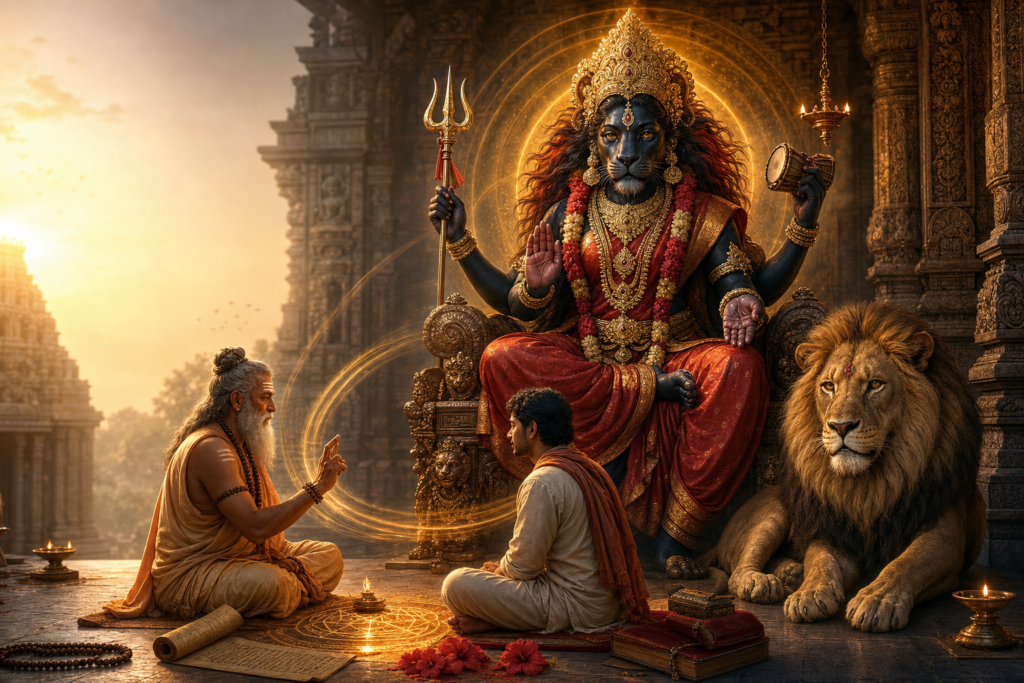
In temple iconography, Lingodbhava is rendered as Shiva emerging from a blazing linga, the shaft encircled by tongues of flame. Shiva is typically four-armed, the upper hands bearing the paraśu (axe) and mṛga (deer), with the lower hands in abhaya and varada mudras. To either side, Vishnu as Varaha burrows below and Brahma as a swan ascends above, visually narrating the failed search for the limits of the jyoti-stambha. The composition synthesizes narrative, doctrine, and sacred geometry in a single relief.
South Indian temple architecture, especially in Tamil Nadu and the Deccan, commonly situates the Lingodbhava panel on the rear (western) wall of the garbhagriha. Devotees encounter it during pradakshina, receiving darshan of the measureless axis of light that supports the sanctum’s resident linga. This spatial logicfacing the manifest icon in front while circumambulating to contemplate the unbounded source behindarticulates a subtle pedagogy in stone.
From the Pallava period through the Chola centuries, artisans refined the Lingodbhava motif in granite and later in bronze, with distinctive flames, poised animal vahanas, and elegantly proportioned figures. Kanchipuram and the Kaveri valley preserve exemplary treatments of the theme, whose aesthetics balance dynamism (flickering fire, ascending and descending quests) with stillness (Shiva’s vertical composure). Variations in regional schools across the Deccan attest to a living iconographic grammar encoded in the śilpa-śāstras and Āgamas.
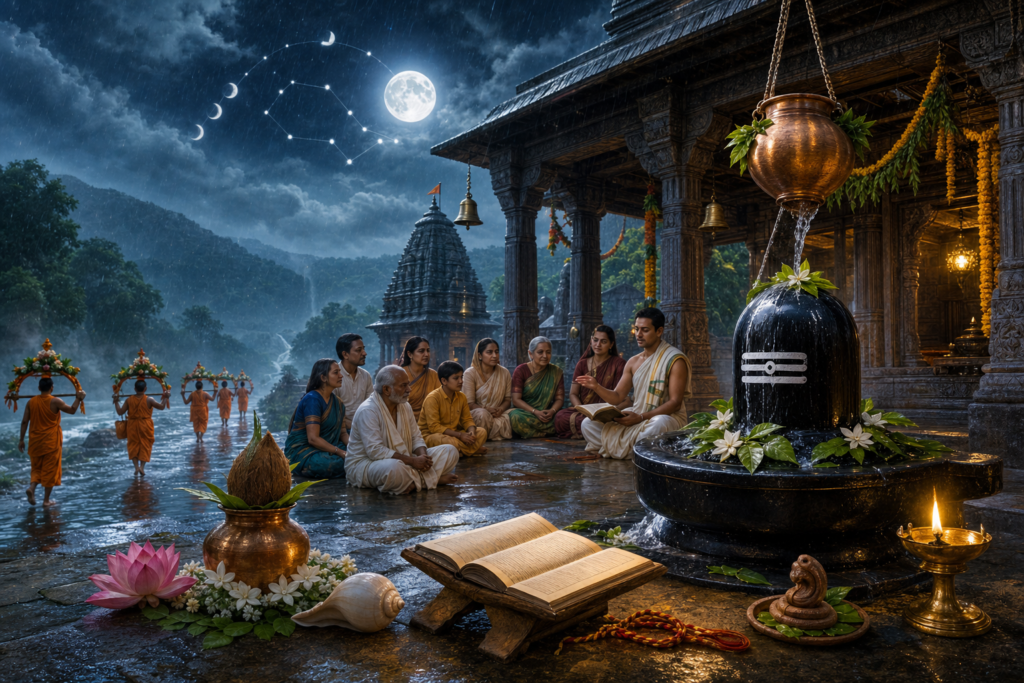
The living heart of Lingodbhava devotion beats each year at Tiruvannamalai during Karthigai Deepam, when a mahā-dīpam is kindled atop Arunachala to signify the primordial pillar of light. The entire town becomes a mandala of lamps as pilgrims circumambulate the mountain, honoring the mountain itself as linga. In many Saiva temples, Mahashivaratri observancesnightlong japa, bilva-archana, and abhishekaminvite contemplation of the same mystery: the presence that is immeasurable yet intimately near.
Philosophically, Lingodbhava has been read through multiple Darshanas. In Advaita Vedanta, the endless flame intimates nirguṇa Brahman that cannot be delimited by nāma-rūpa. In Śaiva Siddhānta and Kashmir Shaivism, it points to Paraśiva whose spontaneous śakti both conceals and reveals, allowing the seeker to awaken to the Self that pervades all. Bhakti exegesis emphasizes ethical humility and the primacy of surrender (śaraṇāgati) in approaching what transcends conceptual measure.
The episode functions as an epistemological parable about pramāṇa and its limits. Empirical ascent and descentsymbolized by flight and burrowingcannot locate the ground of Being because the Absolute is not an object among objects. The requirement is not a longer search but a different mode of knowing: interior stillness, discernment, and grace.
Seen within the wider dharmic family, Lingodbhava affirms insights cherished across traditions. Buddhism’s reflection on śūnyatā, Jainism’s anekāntavāda, and Sikhism’s Ik Onkar each signal the ineffable depth and unity that exceed any single vantage. The Hindu notion of Ishta further honors that seekers approach the One through diverse names and forms; Lingodbhava offers a shared horizon in which plurality is grounded in oneness.
Yogic literature frequently aligns spiritual ascent with a central axismeru-daṇḍa and suṣumṇā-nāḍīevoking a vertical pathway through which awareness is refined. While icon and subtle body are not collapsed into each other, Lingodbhava’s upright blaze provides a contemplative analogue for stabilizing attention, kindling inner luminosity, and integrating the gross and subtle.
Temple architecture amplifies these meanings. The soaring vimana above the sanctum, the dhvaja-stambha before it, and the garbhagriha’s dark interior together stage a cosmology: ground, axis, and zenith. Situated within this composition, the Lingodbhava relief performs a didactic roleorienting the pilgrim to the axis mundi that connects earth and sky, form and formlessness.
Pilgrims frequently describe a distinctive quietude before the rear sanctum panel, as if the visual grammar itself counsels humility. The still figure of Shiva emerging from fire, flanked by the earnest quests of Brahma and Vishnu, evokes both awe and reassurance: the universe is held by a presence neither distant nor domineering, but luminous and steady.
Modern discourse sometimes misreads the aniconic Shiva linga through narrow, phallic categories unfamiliar to the Indic hermeneutic. Lingodbhava corrects that lens by presenting the linga as an axis of lighta cosmological and metaphysical sign (liṅga) rather than a biological emblem. Within Hindu temple architecture and ritual practice, this sign names transcendence made approachable, not reducible.
In sum, Lingodbhava synthesizes scripture, symbolism, and stone into a single invitation: to recognize the Divine as infinite, to temper knowledge with humility, and to honor the many paths by which seekers approach the One. The pillar of light stands not as a contest of deities, but as a testament that creation, preservation, and dissolution are harmonized in the mystery that exceeds them all.
Lingodbhava names the emergence of the formless Absolute as a sign, shown as Shiva appearing through an endless axis of light. The article explains linga as a mark or sign and udbhava as emergence, not as a merely biological emblem.
What is the story of Brahma, Vishnu, and the infinite pillar of light?
In the classical narrative, Shiva appears as an endless column of fire to resolve a dispute between Brahma and Vishnu. Vishnu searches downward as Varaha and Brahma flies upward as a swan, but neither finds the end of the jyoti-stambha.
Where is Lingodbhava usually placed in South Indian temples?
The article notes that Lingodbhava panels are commonly placed on the rear western wall of the garbhagriha in South Indian temples, especially in Tamil Nadu and the Deccan. Devotees encounter the image during pradakshina around the sanctum.
How is Lingodbhava connected with Karthigai Deepam at Tiruvannamalai?
At Tiruvannamalai, Karthigai Deepam kindles a maha-dipam atop Arunachala to signify the primordial pillar of light. The mountain is honored as linga while pilgrims circumambulate it amid lamps.
What philosophical lesson does Lingodbhava teach?
Lingodbhava is presented as a lesson in epistemic humility before the Absolute. The failed upward and downward searches show that the Divine is not an object to be measured, but is approached through stillness, discernment, devotion, and grace.