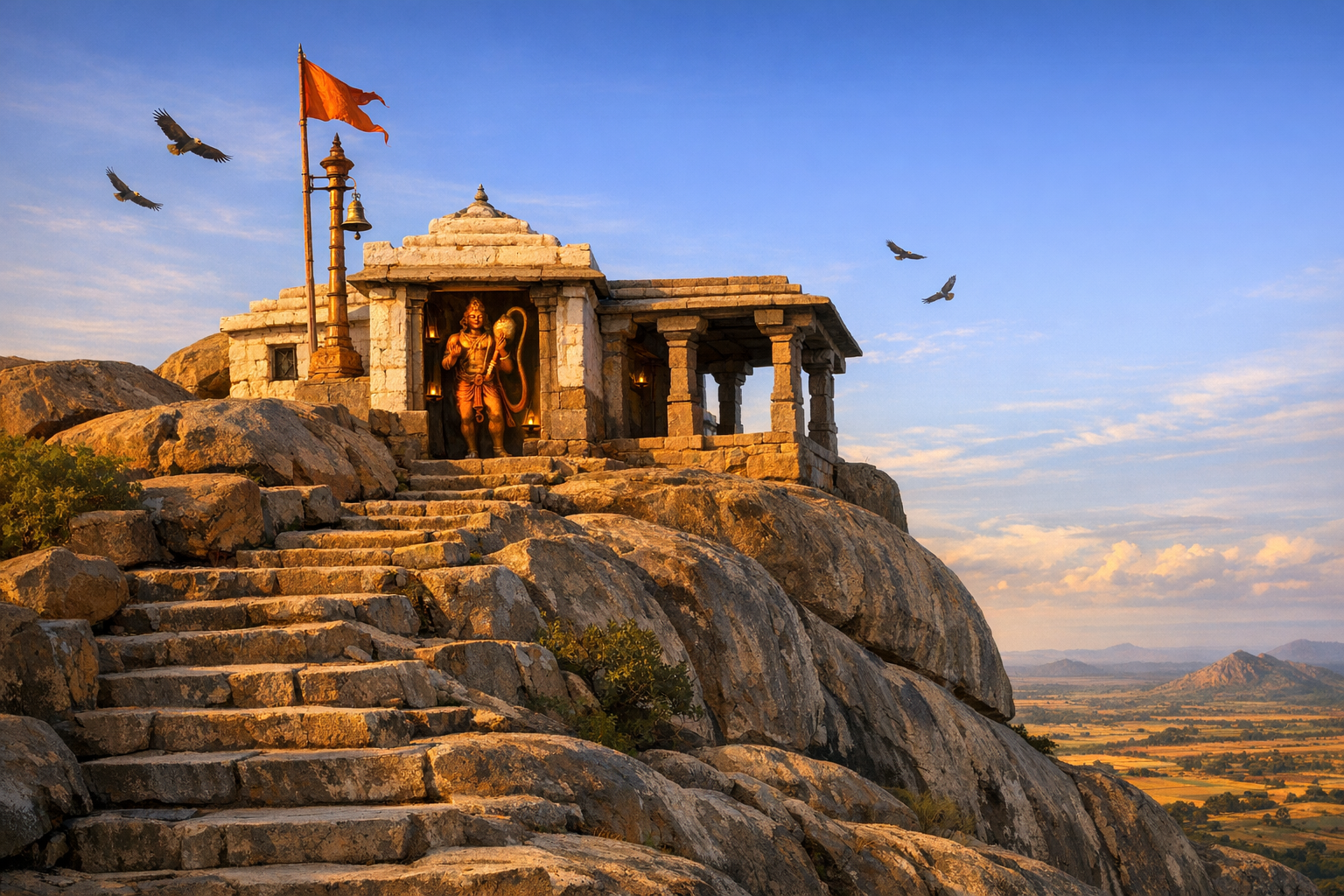
Sri Kshetra Haddinakallu Hanumantharaya Temple, locally celebrated as the Eagle Stone Hill Temple, crowns a rugged granite outcrop in Mandya district, Karnataka. This hilltop kshetra harmonizes natural grandeur with living devotion, drawing pilgrims, trekkers, heritage enthusiasts, and scholars to a space where geology, history, and sacred practice meet.
Known as Eagle Stone Hill for the raptors often seen circling its thermals, Haddinakallu serves as both a landmark and a locus of faith. The ascent offers expansive views of the southern Karnataka landscape, reinforcing a time-honored idea in the dharmic traditions that elevation can aid contemplation, tapas, and inner steadiness.
Local tradition holds that the shrine’s origins trace to the 8th century CE under the patronage of a regional ruler. Within the historical tapestry of the Deccan, this placement aligns with the early medieval phase in which temple-building accelerated across Karnataka, even as specific dynastic attributions at Haddinakallu remain a subject best approached with caution pending further epigraphic study. Oral histories, however, consistently point to a deep antiquity for the site and an unbroken continuity of worship.
As with many South Indian temples, Haddinakallu appears to have seen periodic renovation, repair, and embellishment over centuries. Such iterative care often reflects local stewardship and regional aesthetics layered upon an earlier core. The resulting palimpsest embodies the living nature of sacred architecture in Karnataka, where structures are conserved through ritual use as much as through stone and lime.
The hill itself is characteristic of the granite inselbergs that punctuate the Deccan plateau. These monoliths, formed through prolonged weathering and denudation, provide natural plinths for sanctuaries. The climb to Haddinakallu underscores the synergy between terrain and worship: the path slows the body, stills the breath, and prepares the mind for darshan.
Architecturally, hilltop shrines in this region frequently present a modest, function-driven plan centered on a compact garbhagriha accessed through a simple antarala and fronted by a small mandapa. Boundary elements are often minimal, with the rock itself shaping circulation and enclosure. While individual details at Haddinakallu warrant focused documentation, the overall impression is of a kshetra designed for elemental proximity to sky, stone, and wind rather than for monumental scale.
The presiding deity is revered as Hanumantharaya, a devotional epithet widely used in Karnataka for Lord Hanuman, Vayuputra and paragon of bhakti and seva. Regional Hanuman iconography commonly depicts the deity standing in samabhanga or a gentle tribhanga, holding a gada, with the right hand in abhaya, and the tail raised in alert vitality. Such visual cues encode theological meaning: courage, steadfastness, and service oriented toward dharma.
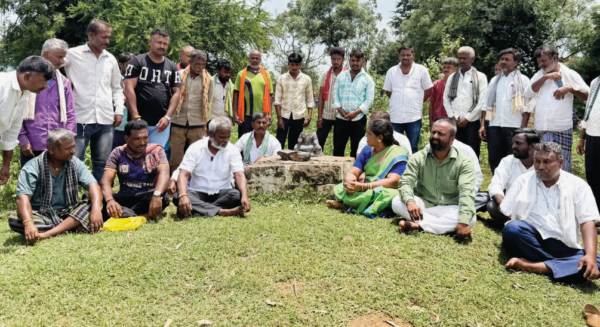
Daily worship typically includes abhisheka, alankara, and archana, along with recitations such as Hanuman Chalisa and passages from Sundara Kanda. Saturdays and Tuesdays often draw larger congregations, in line with regional customs. Offerings of flowers, coconuts, and fruits, along with the application of sindura and oil, reflect pan-Indian Hanuman traditions while retaining local flavor.
Hanuman Jayanti, observed on regionally varying calendrical dates in Karnataka, is the annual highlight. On this occasion, extended parayana, special alankaras, and communal distribution of prasada reinforce the shrine’s role as a social and spiritual anchor. Many families mark personal milestones with vows fulfilled through a climb, darshan, and humble seva at Haddinakallu.
The visitor experience is shaped by the ascent. Many report that the measured climb creates a reflective rhythm, punctuated by vistas and the soundscape of wind, birds, and temple bells. For some, the path itself becomes a vrata, a mindful undertaking culminating in an intimate encounter with Hanumantharaya, where gratitude and resolve are renewed.
From a research standpoint, Haddinakallu invites integrated study. Archaeological surface documentation, stylistic analysis, and a careful reading of local inscriptionsif and when recordedcould refine the chronological framework. Equally valuable are ethnographic perspectives on ritual life, oral narratives, and the intergenerational transmission of memory that sustains the kshetra’s sanctity.
The site also illuminates sacred geography. Hill shrines, river confluences, and forest hermitages form a network of tirthas that orient communities across Karnataka. Haddinakallu stands within this lattice, where the natural world is not a backdrop but a participant in worship, reinforcing ecological sensitivity as an intrinsic dimension of dharma.
In advancing unity among dharmic traditions, Haddinakallu offers resonances that extend beyond sectarian lines. The virtues associated with Hanumandevotion, courage, humility, and serviceare embraced across Hinduism, while the reverence for elevated places of contemplation echoes the meditative landscapes of Buddhism and Jainism. The ethic of seva, central to Sikh practice, likewise finds a shared horizon here. The kshetra thus models a plural, interrelated vision of sacred life.
Practical access typically involves a road approach from towns within Mandya district, with Bengaluru and Mysuru serving as major regional gateways. The final stretch entails a foot climb, which is best undertaken in comfortable footwear with water at hand. Local notices at the base, along with guidance from devotees and temple personnel, provide current information on visiting hours and ritual schedules.
Seasonally, post-monsoon months often present clear skies and pleasant temperatures for the ascent, while summer midday heat can be intense. Early morning and late afternoon visits are common for both comfort and contemplation. Visitors customarily observe modest attire, maintain silence near the sanctum, and follow customary practices such as circumambulation after receiving darshan.
Environmental stewardship remains vital. Disposing of offerings responsibly, minimizing plastic use, and avoiding any disturbance to the resident birdlifeespecially the eagles for which the hill is famedprotect the ecological integrity that is inseparable from the site’s spiritual ambiance.
The temple’s social footprint is equally notable. Pilgrimage sustains small vendors, guides, and local services around the base. Responsible travel that supports local livelihoods without straining fragile hill ecology aligns economic well-being with the ethics of dharma and care for place.
Haddinakallu can be appreciated in comparative perspective alongside other hilltop Hanuman shrines across Karnataka, including the celebrated Anjanadri landscapes. Such parallels suggest historical patterns in which hill shrines served as spiritual waypoints, communal gathering spaces, and even cultural markers of regional identity.
Dating and stylistic questions deserve scholarly nuance. While oral memory situates Haddinakallu’s origins in the 8th century CE, observable features may reflect later refurbishments or accretions, as is common in long-lived temples. A composite chronology is therefore plausible, where an early core remains enlivened by subsequent devotional and architectural cycles.
At the summit, the interplay of wind, bell-tone, and open sky encourages a meditative turn. Many visitors recount a subtle quietude after darshana sense that courage, clarity, and compassion, attributes inseparable from Hanuman’s iconography, can be carried off the hill and into daily life.
Haddinakallu Hanumantharaya Temple ultimately rewards attention on multiple levels. It offers a lived encounter with Karnataka’s sacred geography, a window into the endurance of early medieval kshetras, an exemplar of modest hilltop architecture attuned to terrain, and a vibrant center of puja and community. Approached with humility, curiosity, and care, the Eagle Stone Hill Temple reveals how history, landscape, and bhakti continue to shape one another in Mandya district and beyond.
Inspired by this post on Hindu Pad.