The third day of Chaitra Navratri in 2026 falls on 21 March and is devoted to Goddess Chandraghanta, the valorous and compassionate third manifestation of Devi Durga. In Hindu practice, this day is observed for awakening disciplined courage (shaurya) alongside deep inner calm (shanti), a balance especially associated with Chandraghanta’s iconography and hymns in the Devi Mahatmya (Markandeya Purana). The observances below offer a structured, accurate, and accessible way to honor this tithi while supporting unity across dharmic traditions.
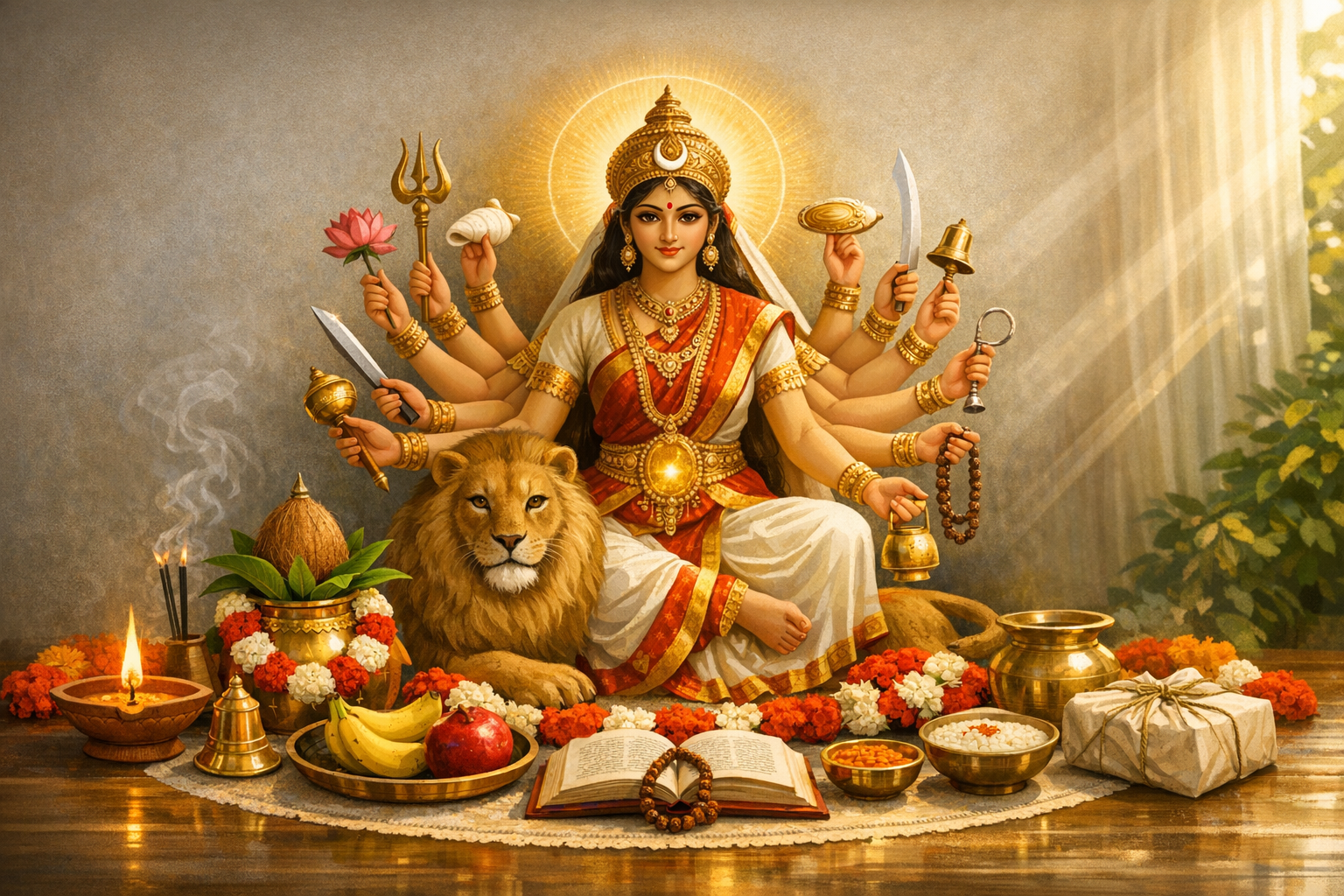
Goddess Chandraghanta derives her name from “Chandra” (moon) and “Ghanta” (bell). She is depicted with a crescent moon like a bell on her forehead, ten hands bearing divine weapons and sacred symbols, and a lion or tiger as her vahana. The bell’s resonant sound symbolizes the dissolution of fear and confusion, restoring clarity of mind and resolve. Many practitioners associate Day 3 with steadying the Manipura (solar plexus) center, the locus of personal will and transformative energy.
Date and timing note: daily Navratri worship is traditionally undertaken during the Madhyahna period, yet local panchangam guidance should be followed to align with the prevailing tithi in a specific place. As sunrise, moonrise, and tithi transitions vary by region, consulting a reliable regional Panchang is recommended, especially for precise sankalpa wording and puja muhurta.
Color traditions for Day 3 vary by region. Many practitioners adopt grey or white/golden attire to evoke serenity and luminous clarity. Families may simply choose a color associated with purity and courage if no regional consensus exists, prioritizing intention and discipline over rigid uniformity.
1) Prepare a sanctified shrine space. Clean the altar thoroughly and arrange an image or murti of Goddess Chandraghanta facing east if possible. Keep a diya (preferably ghee), a clean bell, incense or dhoop, water in a lota, fresh flowers (commonly red or white), and seasonal fruits. If a Navratri Kalasha has already been established on Day 1, retain it as the central focus; otherwise, place a simple water vessel with mango leaves and a coconut as a symbolic substitute.
2) Perform a formal sankalpa. State the date as per the local calendar, location, and resolve for vrata observance, welfare, and inner steadiness. Invoking Chandraghanta with dhyana is customary. A widely recited invocation is “Om Devi Chandraghantayai Namah.” Devotees often note an immediate sense of quiet focus when the sankalpa and dhyana are offered with undivided attention and rhythmic breathing.
3) Offer gandha, pushpa, and dhoop. Apply chandan or kumkum as per family tradition, offer fresh flowers or garlands, and light dhoop or incense. The gentle ringing of a bell at the start of puja symbolizes the withdrawal from distraction and the awakening of discriminative awareness. This ritualized sensory sequencefragrance, color, and soundcreates an environment conducive to sustained mantra japa.
4) Present milk-based bhog and satvik naivedya. Chandraghanta is propitiated with kheer, milk, curd, or milk-based sweets; fruits such as banana, pomegranate, or seasonal offerings are appropriate. Many households also offer panchamrit (milk, curd, ghee, honey, and sugar) in small quantity and distribute it as prasada after aarti.
5) Recite key mantras and hymns. A common japa is “Om Devi Chandraghantayai Namah,” traditionally 108 times with a rudraksha or tulsi mala. Devotees may also recite shlokas such as “Vande Vanchhita Labhaya Chandrardha Krita Shekharam, Sinhahrudha Chandraghantam Yashasvinim” or the praise “Pindaja Pravarudhha Chandakopastrakairyuta, Prasadam Tanute Mahyam Chandraghanta Yashasvini.” The rhythm of japa is as important as count; a steady pace supports mental absorption.
6) Read or listen to Durga Saptashati passages. Many traditions recommend adhyayas connected with Devi’s protective aspects on this day. A short, sustained daily recitation with accurate pronunciationfollowed by silent contemplationhelps internalize the narrative of courage that Chandraghanta embodies.
7) Observe Navratri fasting (vrata) with balance. Satvik preparations are recommendedsama ke chawal (barnyard millet), kuttu atta (buckwheat), singhare ka atta (water chestnut), sabudana, potatoes, and rock salt (sendha namak). Avoid onion, garlic, grains (where tradition prescribes), and stimulants. Hydration with water, lemon water, or buttermilk helps maintain clarity. Those with medical needs should adapt the fast responsibly or consult a physician; restraint and purity of intention remain the essence.
8) Practice mindful breathing and meditation. Many practitioners synchronize seated meditation with gentle diaphragmatic breathing (for example, 9 to 12 cycles of slow inhalation and exhalation). Focusing attention at the navel center (Manipura) while repeating “Om Devi Chandraghantayai Namah” or a seed syllable recommended by one’s lineage aids in cultivating stability and fearlessness. Any breathwork should be mild, safe, and pain-free.
9) Offer seva and dana. Acts of servicefeeding the hungry, supporting girls’ education, contributing to local annadan, or volunteeringamplify the merit of worship. This spirit of seva resonates across dharmic traditions: dana in Buddhism, ahimsa and dana in Jainism, and seva and langar in Sikhism. Day 3 therefore becomes a shared ethical practice of compassion beyond ritual boundaries.
10) Conclude with deepa and aarti to dispel inner turbulence. Evening aarti with a ghee lamp and the measured ringing of a bell symbolically clears residual fear and mental heaviness. Families often recite “Ya Devi Sarva Bhuteshu” collectively at this time. Sharing prasada reinforces gratitude and relational harmony at home.
Fasting details and meal ideas: Those observing a nirjala fast may continue on water, but a phalahar approachfresh fruits, nuts, and light vrat preparationsis widely practiced. Common meals include sabudana khichdi, kuttu puri with aloo rasedar (prepared with sendha namak), roasted peanuts, yogurt with roasted cumin, and kheer as bhog in moderation. Breaking the fast after evening aarti maintains rhythmic discipline through the day.
Why a bell (ghanta) matters on Day 3: In ritual science, sound (nada) supports mental entrainment. The bell’s tonal spectrumrich in harmonicsreduces scattered attention and can induce a meditative calm. This is thematically aligned with Chandraghanta’s role in dispelling fear and restoring order, as portrayed in Devi-katha.
Suggested simple home puja sequence: achamana and pranayama (brief), sankalpa, dhyana of Chandraghanta, avahana and asana offering, gandha-pushpa-dhoop-deepa naivedya, mantra japa, brief Saptashati reading, kshama prarthana, and aarti. Households with elders or young children can abbreviate steps while retaining sankalpa, mantra japa, and aarti as the core practice.
Responsible and eco-conscious worship: Use cotton wicks, natural incense, and biodegradable flowers. Prefer reusable metal or clay items over single-use plastics. If performing immersion for any reason during the festival cycle, adopt water-safe materials or symbolic home immersion to protect local ecosystems.
Inter-dharmic resonance and unity: Although Navratri is a Hindu festival, its ethical aimscourage rooted in compassion, disciplined mind, restraint in consumption, and serviceresonate with the contemplative and service-oriented practices in Buddhism, Jainism, and Sikhism. Framing Day 3 as a shared commitment to non-harming, generosity, and steady awareness nurtures mutual respect across dharmic communities.
Safety and inclusion: Keep lamps and incense away from flammable surfaces and supervise children near the altar. Those with dietary restrictions can adapt vrat menus without compromising the spirit of satvik living. Inclusion, care, and safety elevate the quality of worship.
Closing reflection for Day 3: Chandraghanta invites practitioners to cultivate fearless clarityresponding to life with poise rather than reaction. When ritual discipline (puja vidhi), mantra contemplation, mindful fasting, and seva converge, the result is a stable will anchored in compassion. This is the living essence of Navratri Day 3courage that protects, awareness that guides, and unity that heals.
Inspired by this post on Hindu Pad.