
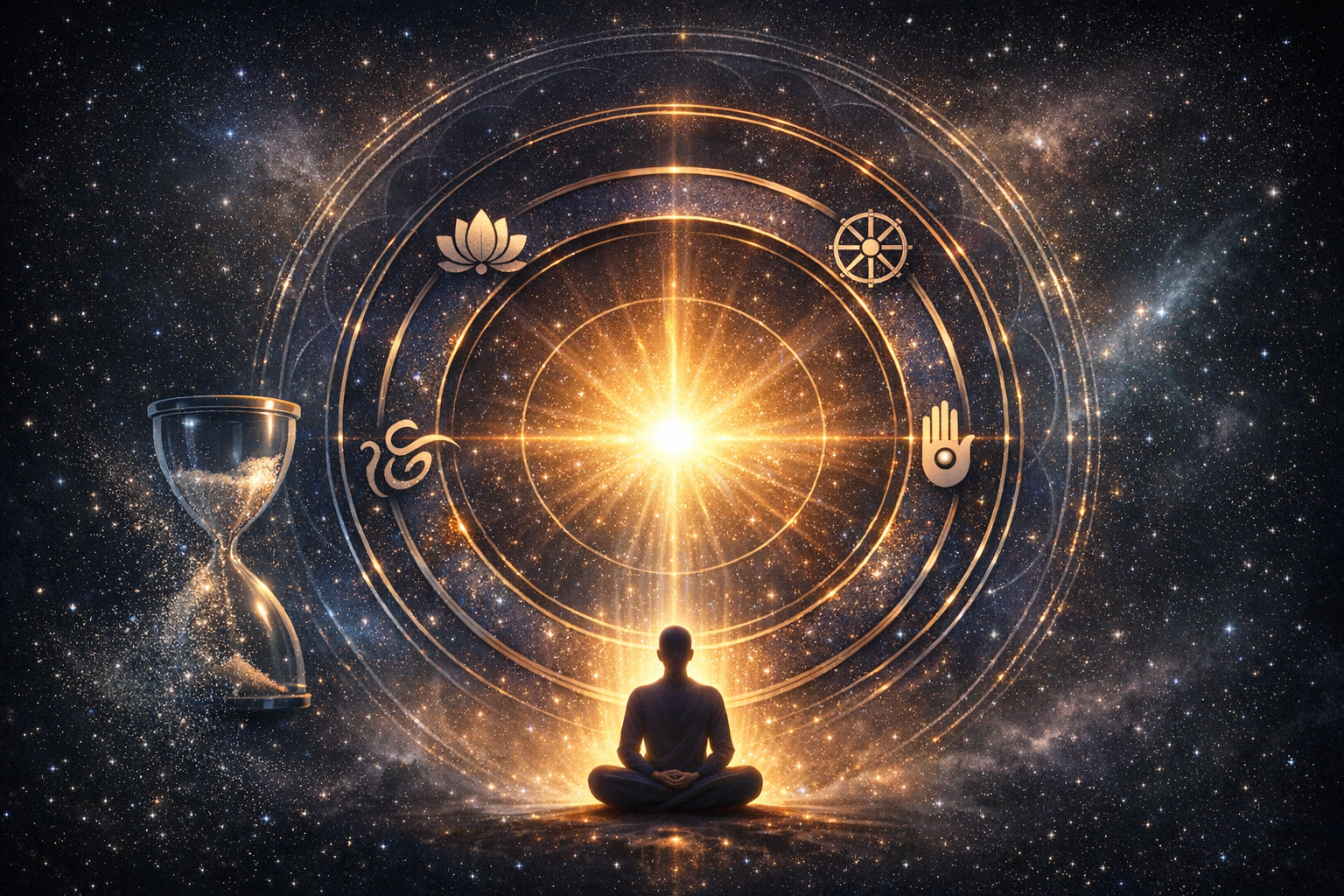
In the vast philosophical landscape of Hinduism, Kalatitaliterally ‘beyond time’names a condition of consciousness that is not gripped by past, present, or future. It distills a central insight of Hindu philosophy: the essence of self (Atman) and ultimate reality (Brahman) are not temporal processes but the ever-present ground in which time appears.
Etymology and conceptual reach are clear: from Sanskrit kala (time) and atita (transcended), Kalatita signals freedom from the compulsions of temporal becoming. Kindred Dharmic expressions include Mahakala and Kalabhairava in Shaiva thought, the Sikh Akaal Purakh (the Timeless One), Buddhist descriptors such as akaliko (timeless) for the Dhamma, and Jain reflections on kala dravya (time as a fundamental category). Across these traditions, the intuition is shared: what is finally real is not circumscribed by time.
Why this matters now is practical as well as philosophical. In an age structured by deadlines, feeds, and alerts, Kalatita reframes human identity and agency. It offers a rigorous metaphysical account of timelessness while yielding practical clarityless anxiety about outcomes, deeper presence in action, and an ethic of compassion that flows from recognizing a common ground beyond change.
Two registers of truth organize the discourse in Vedanta: vyavaharika (empirical, transactional) and paramarthika (absolute). Time, causation, and change operate reliably in the empirical order; calendars, panchang, and jyotisha support dharma, ritual, and social coordination. Kalatita belongs to the absolute register in which Brahman alone is; time does not bind awareness itself, the witness that illumines all change.
Hindu cosmology meticulously details cyclical timeyuga, maha-yuga, manvantara, and kalpawithout mistaking cycles for the absolute. A maha-yuga spans 4,320,000 years (Satya, Treta, Dvapara, Kali in the 4:3:2:1 ratio); seventy-one maha-yugas comprise a manvantara; fourteen manvantaras constitute a day of Brahma. These vast measures contextualize evolution and dissolution, while Kalatita names the still point that is present before, during, and after every cycle.
Scriptural anchors make the doctrine precise. The Katha Upanishad declares of the Self: na jāyate mriyate vā kadācin; it is unborn and undying, untouched by time’s arrow. The Mandukya Upanishad points to Turiya, the ‘fourth’ that is neither waking, dreaming, nor deep sleepa timeless awareness that underwrites all three states.
The Bhagavad Gita integrates cosmology and realization. It quantifies cosmic time in 8.17 and simultaneously teaches inward freedom in 2.16: nāsato vidyate bhāvo nābhāvo vidyate sataḥ; the real is never non-existent, the unreal never truly is. In 11.32, the Lord speaks as time, kālo ’smi, illuminating a subtle point: the absolute is both the ground of time and, in manifestation, the power that measures and transforms.
Yoga philosophy offers a complementary articulation. The Yoga Sutra (1.26) describes Īśvara as sa pūrveṣām api guruḥ kālenānavacchedāt, the teacher of even the ancients because not limited by time. Practice then becomes a disciplined reorientation toward a presence that experiences but is not exhausted by experience.
Purāṇic literature renders this insight symbolically. Śiva as Mahākāla and as Naṭarāja embodies time’s cyclical choreography while remaining the serene witness within the dance. The Bhāgavata Purāṇa analyzes kāla as one of the powers through which the Lord unfolds creation, yet repeatedly emphasizes that the Lord’s own nature is Kalatita.
Advaita Vedanta provides philosophical rigor. Time is a function of māyā, the projection that superimposes change upon the changeless substratum, a process Śaṅkara analyzes as adhyāsa. In paramarthika truth, Brahman is nirvikārafree of modification; time is an appearance inseparable from the perceiving mind and its incessant vṛttis.
Classical Sāṅkhya clarifies the mechanics of becoming without reifying time as an ultimate principle. Among its twenty-five tattvas, time is not a basic constituent; rather, parināma (transformational change) of prakṛti manifests sequences that the mind reads as time. Recognizing this interpretive layer invites detachment from compulsion while sustaining responsibility.
Bhakti traditions approach Kalatita through intimacy rather than abstraction. When devotion matures into ananya-bhakti, the heart abides in a presence that is prior to counting. The Bhagavad Gita’s teaching of surrender (śaraṇāgati) renders time-friendly: action continues, but its stinganxiety about resultsrelaxes in the recognition that the true doer is the Lord permeating all.
Soteriological significance is thus direct. Moksha is often described not as going elsewhere but as knowing, here and now, the Kalatita Self as one’s own nature. When the identity with the body-mind stream softens, birth-and-death are seen as events ‘in’ time, not of the Self that knows them.
A disciplined path operationalizes this recognition. Jñāna-yoga proceeds through śravaṇa (systematic study of Upanishads and Bhagavad Gita under a competent guide), manana (resolving conceptual doubts), and nididhyāsana (deep contemplative assimilation). Neti neti of the Bṛhadāraṇyaka Upanishad stabilizes discernment: not this body, not this thought, not this passing moodyet undeniably present as the witness of them.
The Mandukya method centers on Om. Sounded or contemplated as praṇava, Om gathers waking, dreaming, and deep sleep into a single, bright attention that eases into Turiya. Over time, practitioners report intervals in which measuring mind falls silent and awareness is simply presentan intimation of Kalatita that later informs life in motion.
Yoga’s eight limbs refine the instrument. Prāṇāyāma steadies fluctuations; pratyāhāra and dhāraṇā reduce temporal scatter; dhyāna lengthens unbroken attention; in samādhi, the knower, knowing, and known cease to appear as three. Traditional Advaita speaks of akhaṇḍākāra-vṛtti, a non-fragmented cognition in which the intellect reflects Brahman without temporal seams.
Karma-yoga translates timelessness into daily work. Action is undertaken as dharma with mindfulness, dedication, and relinquishment of fruit. The result is not passivity but poise; by attenuating doership (kartṛtva) and enjoyership (bhoktṛtva), the practitioner experiences a lucid, time-free center even while calendars and deadlines continue to be honored.
An ethical horizon follows. The Gita lists abhayamfearlessnessas the first divine quality (16.1). Fear lessens as identification shifts from the perishable to the imperishable; compassion deepens as others are seen not as competitors in time but as expressions of the same timeless ground. This is the practical face of Sanatana Dharma’s ideal of unity in diversity.
Importantly, Kalatita does not negate time-reckoning. Jyotiṣa, panchang, and muhurta remain valuable in vyavaharika life. The insight simply prevents reification: auspicious times are respected without superstition, and inauspicious phases are met with steadiness born of a deeper anchor.
A cross-Dharmic perspective affirms shared intuitions. In Buddhism, the Dhamma is praised as akalikoeffective ‘here and now’ and not confined by temporal delay. The Kalachakra tradition maps cosmic and psychophysical cycles while pointing to nirvāṇa as asaṅkhata, the unconditioned, beyond the flux of saṅkhata dhammas.
Jain philosophy treats time, kāla, as a dravyaa real category necessary to explain changeyet the culmination of the path, kevala-jñāna, reveals a knowing free of agitation. The liberated siddha abides at the apex of the universe, no longer subject to temporal bondage, a formulation convergent in spirit with Kalatita.
Sikh thought venerates Akal, the Timeless. The Mul Mantar proclaims Ik Onkar Satnam Karta Purakh Nirbhau Nirvair Akaal Moorat; the Formless Timeless One is the ground of action and fearlessness. The Sikh ideal of sahajnatural equipoiserhymes with abiding as awareness not measured by succession.
Taken together, these four streamsHinduism, Buddhism, Jainism, and Sikhismcompose a civilizational chorus: time is indispensable for moral growth and social order, yet not ultimate. Each offers disciplines for touching what does not age, laying the basis for interfaith respect and shared practice.
Common misconceptions can then be corrected. Kalatita is not fatalism; it does not excuse adharma or social negligence. It is not nihilism; it does not deny the empirical world but situates it. Nor is it an anti-scientific posture; it welcomes astronomy, history, and ecology while refusing to mistake their timelines for the measure of the Self.
Contemporary science, carefully interpreted, can enrich the conversation. Relativity reconceives time as dependent on frames of reference, and cognitive science distinguishes chronological time from psychological time. While these do not ‘prove’ Kalatita, they create conceptual space for a nuanced view in which time is not monolithic and awareness is not reducible to temporal processes.
Practical contemplations help operationalize the insight during daily life. Before beginning a task, pausing for one breath and silently recognizing, ‘The witnessing awareness is prior to this moment,’ reorients action. When a surge of regret or anticipation arises, quietly note, ‘Past and future appear in the present; the knower of both is not in time.’ Over weeks, this gentle discipline yields measurable calm.
Rituals can be similarly reframed. During sandhyā, the junctions of day, the practitioner may contemplate the junctionlessness of awareness itself. In darśan before Naṭarāja or Mahākāla, attention can rest not only on cosmic cycles but on the unstruck silence in which the drumbeat is heard.
Scholarly study sustains depth. Engaging primary sourcesthe Upanishads with Śaṅkara’s bhāṣya, the Bhagavad Gita with Śrīdhara or Madhusūdana, the Mandukya Kārikā of Gauḍapādaanchors experience in tested reasoning. Parallel readings in Pali Nikāyas on akaliko, Jain Agamas on kāla dravya, and Sikh Gurbani on Akal expand comparative insight and reinforce unity across Dharmic traditions.
For communities and institutions, Kalatita recommends a culture of long horizons without anxiety. Education can combine historical literacy with spiritual practices that cultivate present-centered attention. Public discourse can honor memory and justice while refusing cycles of resentment, taking guidance from the timeless values of Sanatana Dharmatruthfulness, non-injury, generosity, and inner freedom.
In summary, Kalatita is a rigorous, lived philosophy: metaphysically precise, scripturally grounded, and practically transformative. It honors time as a sacred instrument while recognizing awareness as the sacred beyond time. From this recognition flow fearlessness, compassion, and a resilient unity among the four great Dharmic paths.
Inspired by this post on Hindu Blog.
