“Meditation is a way of being, not a technique.” ~Jon Kabat-Zinn
There are seasons when formal meditation feels less like a doorway and more like a wall. Books may be read and benefits understood, yet every attempt to sit still can tighten the chest, quicken the mind, and sharpen the sense of exposure. For many, this is not a failure of discipline but a mismatch between method and nervous system state.
Consider a period marked by early parenthood, limited communal support, and the low, steady drain of burnout. The days run loud and crowded; inner space feels thin. On such an afternoon, a simple walk in a neighborhood park can become a turning point—without planning, instruction, or a clock.
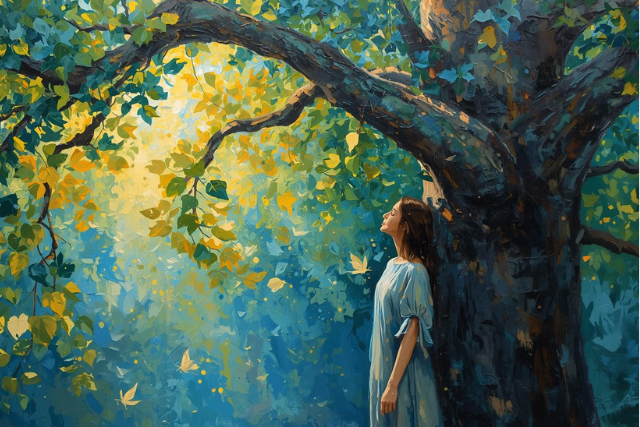
Pause occurs beside an ordinary tree. Attention rests on a single leaf: its sheen under angled light, the branching veins, the faint sway in air. No effort to concentrate. No attempt to “control the breath.” No internal correction. Only uncomplicated looking.
Something eases. Shoulders drop, breath lengthens, and the usual quiet vigilance loosens. There is arrival—body, place, moment—with no sense of performance. The shift is small yet memorable, and it lingers.
Why does this feel categorically different from eyes-closed stillness? The answer sits at the intersection of attention science and nervous system regulation. External, gently moving stimuli capture bottom-up attention through the dorsal attention network and salience network, giving the overactive default mode network—often associated with perseveration and self-referential rumination—fewer reasons to dominate. The result is not forced focus but spontaneous settling.
Polyvagal theory offers a complementary lens. When surroundings feel safe enough, neuroception permits ventral vagal activation: breath slows, facial muscles soften, auditory processing opens, and social engagement becomes possible. This is not mere relaxation; it is a physiological platform for presence. Nature, with its light, texture, and movement, can become a reliable co-regulator.
Environmental psychology reinforces these observations. Attention Restoration Theory describes how “soft fascination” in natural settings eases directed attention fatigue by offering effortless engagement, a sense of being away, extent (coherent richness), and compatibility (fit between environment and needs). Stress Recovery Theory adds that unthreatening natural scenes downshift sympathetic arousal—lowering heart rate and blood pressure—and support affective calm.
Even the geometry of the living world matters. Fractal patterns common in coastlines, leaves, and branches occupy mid-range complexity that the visual system processes efficiently, a property linked in laboratory studies to reduced stress markers. In practice, this means that a patch of moss or ripples on water can provide an attentional home that asks nothing yet gives enough.
What was once labeled “resistance to meditation” can therefore be reframed as a healthy boundary: a part that does not yet trust stillness without scaffolding. Nature supplies this scaffolding through movement, texture, and choice. Attention is invited rather than demanded; it feels accompanied, not examined.
Over days and weeks, such invitations accumulate. A stretch of ground after rain. The faint sound of water out of view. The tactile certainty of bark under the palm. A leisurely walk without destination. Stopping, without guilt, when something in the periphery asks to be seen. Attention wanders and returns on its own—like a tide, not a task.
The downstream changes are modest yet consequential. In conversation, the familiar urge to fix quickly is noticed; a brief pause appears; the moment breathes; tone softens. Background self-monitoring (“Am I present enough?”) quiets. Walking is simply walking; stopping is simply stopping. Pleasure—light through branches, damp earth, the recognition of ripeness while foraging—does not reflexively trigger analysis.
In effect, the practice is less about focus and more about trust. Trust that attention can self-organize when it is gently held by context. Trust that the body will settle when conditions signal safety. Trust that not every inner state requires supervision.
There are days, however, when nature feels flat, distant, or foggy. These are not failures but signals. The system may need more grounding—movement over stillness, stronger proprioceptive input, steadier contact with something solid. At other times, no landscape suffices; what is needed is human connection, reflective dialogue, or deeper therapeutic support. Discerning the difference is part of the discipline.

Presence carries a recognizable texture: a sense of contact and coherence. When that texture is missing, the invitation is not to push harder but to adjust the conditions—slowing further, adding movement, or reaching out instead of retreating. The aim is not constant calm but appropriate responsiveness.
This reframes stillness itself. Rather than an achievement produced by effort, presence often arrives as a response to being well met. A tree, a stone, a stretch of ground neither evaluates nor withdraws; attention has somewhere steady to land. Over time, the body learns it can remain without bracing.
Across the dharmic traditions of Hinduism, Buddhism, Jainism, and Sikhism, this principle resonates. Dhyāna in Yoga and Vedānta, sati in Buddhism, samayik in Jainism, and simran in Sikh tradition all honor attentive presence that is compassionate, non-coercive, and relational. Different doorways, shared essence: ethical awareness grounded in context, community, and care.
From a technical perspective, the approach can be described as bottom-up mindfulness in nature. It leverages exteroception (seeing, hearing, touching) to stabilize interoception (feeling internal states), then allows top-down attention to join without strain. The sequence is permissive: orient, linger, sense, and only then, if helpful, name or reflect.
A practical protocol can be brief. Begin outdoors if possible. Choose one small, ordinary element—leaf, stone, shadow, waterline—and let vision rest. Track three qualities: light, line, and movement. Notice the first spontaneous exhale that arrives unforced. Stay through two more.
Next, layer a tactile anchor. Touch bark, hold a small stone, or feel the edge of a coat sleeve. Name the sensation in simple terms—warm/cool, rough/smooth, still/moving—without analysis. If the mind wanders, allow the eyes to scan slowly and reorient to the most visually gentle feature available.
If energy is high or the body is restless, add locomotion. Walk at a pace that permits easy nasal breathing and comfortable peripheral vision. Let the rhythm of steps synchronize with breath; many find that six breaths per minute (approximately a 5-second inhale and 5-second exhale) naturally emerges, a cadence linked to favorable heart-rate variability in research on resonance breathing.
Close the practice by noticing one sign of settling: loosened jaw, warmer hands, widened hearing, or a softer gaze. No goal is required; recognizing what changed is sufficient consolidation for the nervous system.
Over time, this outwardly anchored presence can bridge inward. Once the system trusts stillness with support, brief periods of eyes-closed practice—open monitoring or breath awareness—often feel less exposing. The distinction matters: discipline becomes aligned with physiology rather than opposed to it.
Importantly, none of this replaces human care. Sangha, satsanga, or simple friendship can provide forms of co-regulation that a forest cannot. Nature therapy is a support, not a universal solution. The measure of fit is pragmatic: greater ease, clearer choices, kinder responses.
In summary, when formal meditation feels impossible, it can be wise—not wayward—to enter through another door. Gentle, outward attention in nature regulates the nervous system, reduces cognitive load, and lets attention self-organize. Presence then arrives not as something manufactured but as something recognized when it appears.
The instruction is disarmingly simple. Go outside. Let attention rest on one ordinary thing. Do not analyze or hold it tightly. Linger long enough to notice if something softens, even slightly. It may be all that is needed for the next right breath, the next kind choice, the next step taken without bracing.
Inspired by this post on Tiny Buddha.