Nori Narasimha Sastry’s corpus reveals a remarkable command over allied artsmusic, dance, sculpture, and paintingalongside literature. Across essays and novels, interdisciplinary awareness is not merely ornamental; it undergirds narrative credibility and cultural texture in ways that reward historically attentive reading.
One conspicuous hallmark of his fiction is the rigor with which both major and minor characters are situated in verifiable historical milieus. That breadth of documentation is especially striking given the constraints of information access in his time, and the fact that much of the research was undertaken from the small town of Repalle. The resulting synthesisprecise yet vividcontinues to astonish.
Kavisārvabhaomuḍu is a compact historical novel set in the fifteenth century. The action unfolds over roughly nine months, from Pushya to Ashwayuja, a compressed horizon within which numerous, tightly plotted events transpire. The shortened duration intensifies causality and credibility alike, while prior and subsequent contexts are deftly woven into the present narrative without straina clear mark of craftsmanship in plot architecture.
The reign of Devaraya II (Proudha Devaraya) constituted the apogee of the Vijayanagara Empire. A consummate warrior and shrewd statesman, Devaraya II presided over a cosmopolitan court whose scholarly prestige had been cultivated since the time of Vidyaranya Swami and Sayanacharya. Scholars from across the subcontinent gravitated toward this hub, including learned figures from Vanga or Gauda Desha; among them was Śōṇādrinātha.
In this milieu, a bronze gong reputedly gifted by Bukkaraya became a hereditary emblem of poetic and scholastic authority. A distinguished descendant, Arunagirinatha Dindima Bhattaserving as Vidyādhikāripublicly carried and sounded this gong, a confident, even provocative, assertion of his standing. The gesture stung rival poets and scholars, many of whom attempted to humble him in debate; yet his argumentative prowess typically prevailed, deepening quiet resentment.
To the northeast, along the banks of the Krishna River in the broader Andhra region of Vijayanagara, the principalities of Kondaveedu and Rachakondaruled by rival lineagesfaced one another from twin hill capitals. Their rulers, remembered as descendants of Malla Reddy and compatriots who had resisted earlier Sultanate incursions, presided over polities that had gradually fragmented due to internal fissures. Even amid rivalry, however, both courts sustained a spirited competition in patronizing poets, sculptors, and artists, seeking prestige through cultural rather than purely political means.
Srinatha Kavi flourished as the court poet at Kondaveedu under Maharaja Vema Reddi. Though the principality’s resources were limited, patronage for Srinatha remained generous and consistent. As Vijayanagara consolidated power over the region, Vema Reddirecognizing the limits of direct political contestresolved to pursue distinction through a literary triumph.
Encouraged by his patron and motivated by gratitude untainted by personal ambition, Srinatha accepted the charge to challenge Arunagirinatha, the Vidyādhikāri of Vijayanagara. Known for an expansive enjoyment of worldly pleasures yet firmly rooted in ethical discernment, Srinatha assembled a circle of poets and scholars and journeyed to the imperial capital. He observed the city closely, gauged its pulse, and prepared a strategy that required a legitimate pretext for debatesince polemic without a substantive dispute would risk reputation.
Accordingly, he composed a Sanskrit Khanda-Kavya titled Mānasōllāsa, celebrating Vijayanagara’s urban life and the sanctity of Pampa Virupaksha. While independent evidence of Srinatha composing this particular work is absent, the narrative deviceas employed by Noriremains historically plausible and congruent with the documented fabric of the period, enriching the novel’s verisimilitude without violating the record.
The poem was sent to Arunagirinatha through Nrsimha Bhatta, a grammarian in Srinatha’s entourage, accompanied by a respectful request for an informed assessment befitting a Vidyādhikāri. Crucially, Srinatha embedded a subtle deviceapaśabdābhāsa, the illusion of ungrammaticalitywherein verses that appear incorrect to a cursory or incautious reading prove structurally impeccable under exacting scrutiny. Such devices, well known in Sanskrit intellectual culture, reward attentiveness while quietly testing an interlocutor’s composure and depth.

Arunagirinatha, already wary of a challenger from Andhra, read the poem andmissing the devicepronounced it error-ridden. Srinatha, anticipating precisely this misstep, issued a letter of protest: it was improper to decry the work of an accomplished poet in the presence of a reputed grammarian (Nrsimha Bhatta). The letter demanded an apology and, symbolically, the surrender of the hereditary bronze drum. Arunagirinatha refused.
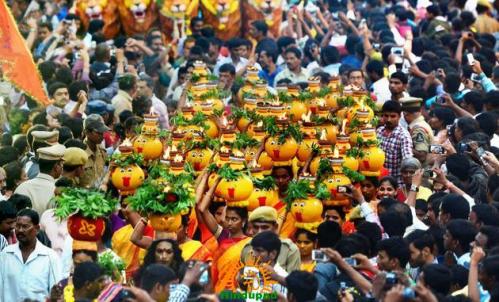
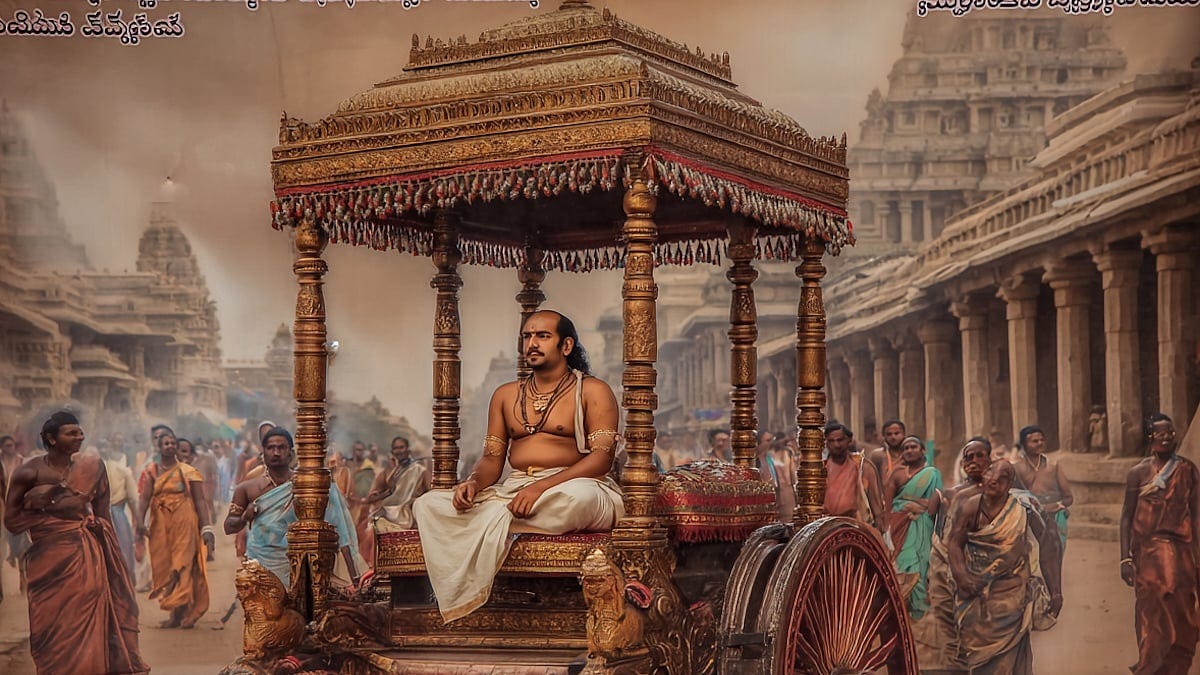
A second letter followed, stipulating an ultimatum: if the drum was not surrendered by the full moon of Vaishakha in acknowledgment of the error, Srinatha would commission drums of bronze, silver, and gold and proclaim himself Kavi Sarvabhauma in a public procession through Vijayanagara. Copies were disseminated to the king and to eminent courtiers. True to the declaration, Srinatha staged a triumphant procession across the capital. During this upheaval, Arunagirinatha’s elder son, Rajanathareturning from agraharas assigned to the lineage for grain collectionarrived to find the city abuzz.
Before his departure, Rajanatha had cautioned his father against haste and ego in handling a formidable opponent. Upon reading the poem, he recognized the device at once: “Alas, is this not the apaśabdābhāsa trick?” The misjudgment was now public. Assessing the damage, Arunagirinatha sought an alternative line of defense.
He pivoted from grammar to poetics (Alankara Sastra). In vyākaraṇa, the triad of authoritiesPanini, Vararuchi, and Patañjalisupplies rigorous and widely binding standards. By contrast, in poetics the measure of evaluation leans upon connoisseurial delight and aesthetic inference, often allowing multiple interpretive pathways. This asymmetry offered an escape route: where grammatical pramāṇa is hard-edged, aesthetic judgment admits nuance.
Beyond its dramatic appeal, the episode illuminates a distinctive Vijayanagara culture of learning: rigorous, pan-Indic, and confident enough to ritualize intellectual rivalry as public spectacle. Scholars from Vanga or Gauda Desha conversed with Andhra luminaries; the court’s ecumenical patronage enabled a civilizational dialogue that prized both vyākaraṇa and alankāra on their own terms. Read in a contemporary spirit of dharmic unity, the narrative showcases how debate, humility, and shared reverence for knowledge constitute common ground across Hinduism, Buddhism, Jainism, and Sikhismtraditions that valorize learning, ethical restraint, and plural modes of inquiry.
Several technical notes help anchor the narrative within medieval India. Pushya to Ashwayuja corresponds approximately to late winter through early autumn, clarifying the nine-month arc. Agraharas denote endowed Brahmin settlements supporting scholarly lineages through land revenue, explaining Rajanatha’s journey. The bronze drum (bherī) functions as a visible insignia of scholarly authority. Pampa Virupaksha refers to the sacred complex at Hampi, central to Vijayanagara’s ritual and cultural life. Together, these details frame the story within the political and cultural geography of Andhra Pradesh and the Vijayanagara Empire.
The episode, finally, reads as a cautionary meditation on intellectual hubris and a celebration of strategic intelligence. The apaśabdābhāsa device underscores the premium Sanskrit intellectual traditions place on composure, method, and depth of reading. Srinatha’s blend of filial gratitude, public accountability, and aesthetic courage exemplifies an ethic wherein scholarship advances cultural cohesion rather than sectarian rivalrya lesson with renewed relevance for readers invested in India’s shared cultural heritage.
To be continued
Inspired by this post on Dharma Dispatch.