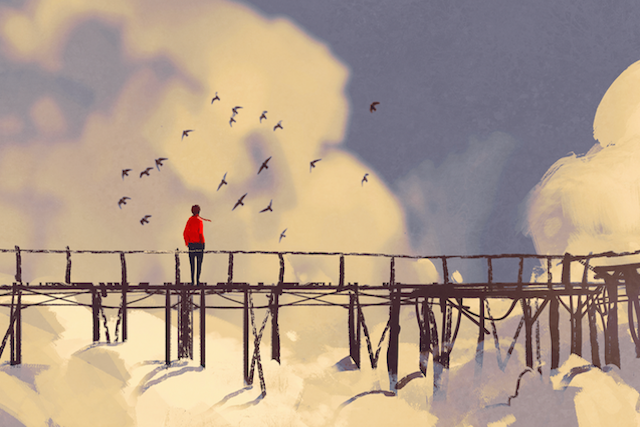
“What will mess you up most in life is the picture in your head of how it is supposed to be.” ~Unknown
Across cultures and traditions, many learn early to organize life as a linear sequence of milestones—education, meaningful work, partnership, home, family, and dignified aging surrounded by children and grandchildren. Such orderly scripts provide coherence and motivation, yet they also cultivate an illusion of control that can collapse abruptly when reality diverges from plan.
One case illustrates the stakes with painful clarity. After years of diligent work as a teacher and parent, a woman anticipated the familiar arc: a stable marriage, a home chosen with care, children joyfully welcomed and raised, shared travel in retirement, and regular family gatherings with future grandchildren. The recipe seemed straightforward—follow steps A, B, and C, and arrive at a promised destination.
On April 27, 2016, that assumed destination disappeared. She awoke to find her husband dying on the living room floor. In an instant, the expected life ceased to exist, replaced by a starkly different reality.
She was thirty-four, a widow, and the primary carer of three young children—a one-year-old she was still nursing, a three-year-old just forming sentences, and a six-year-old nearing kindergarten graduation. The domestic cadence that once felt like an assembly line of love and logistics—meals, school runs, staff meetings, errands, bath time, bedtime—fell silent. Ordinary had been upended on an ordinary day, as it so often is.
In the months that followed, grief manifested not only as the absence of a beloved partner but also as the collapse of an anticipated future. The mind reeled: this was not the life chosen, nor the one thought to be deserved. Resistance—an understandably human first response—took the form of anger, bargaining, and arguments with fate. Beneath those emotions sat the deeper shock of a quietly held premise: the world should make sense and reward adherence to the plan.
Gradually, a hard truth came into focus. Expectations—those carefully curated internal pictures—are thoughts, not guarantees. Cognitive science offers parallel insights: the planning fallacy overestimates control; the just-world belief presumes fairness that the world does not consistently provide; survivorship bias elevates the visible successes and masks the hidden pains. In short, expectations often overreach what conditions can promise.
Modern life amplifies this overreach through social comparison. She remembered her late husband’s steady refrain about curated online lives: “Everyone puts their best on Facebook. It doesn’t mean anything.” Later, contrasting public images with private realities made the point unmistakable; the glossy narratives of others often concealed fractures and endings. Comparison, far from clarifying truth, had distorted it.
With time, she recognized a middle path between despair and denial. Emotions, however intense, pass like weather. Thoughts can build entire fortresses of meaning—sandcastles, really—that the tide of a new day steadily reshapes. Accepting this transience did not trivialize pain; instead, it placed suffering in a broader, truer frame.
The immediate aftermath also exposed a succession of secondary losses: reduced capacity, shortened patience, relentless logistics, and the ambient loneliness that often accompanies single parenthood. Harsh self-judgment—“not enough” as a parent, worker, friend—pooled like poison. Yet there comes a threshold where free fall stops; at the bottom, the only option left is to stand up, rinse off, and take the next compassionate step.
From that quiet, practical moment, a constructive reframe emerged: rigid expectations, not reality itself, had become the chief adversary. The only certainty was the present; yesterday had ended and tomorrow remained unknown. This realization aligns with an enduring dharmic insight: impermanence is the ground condition of human life.
She instituted what might be called flexible expectations—standards and goals with intentional “give,” designed to accommodate disruption. Psychological research terms this capacity psychological flexibility, a core dimension of resilience that predicts better adaptation after loss. Process goals replaced outcome certainties; a long-term lens softened the sting of setbacks; a wider repertoire of “acceptable” paths reduced the suffering born of rigidity.
This cognitive shift dovetailed with a deeper spiritual synthesis drawn from dharmic wisdom shared across Hinduism, Buddhism, Jainism, and Sikhism. Hindu thought emphasizes vairagya (non-clinging) and shraddha (trust) as companions to purposeful action; Buddhist teachings on anicca (impermanence) and dukkha (unsatisfactoriness) invite clear seeing and compassionate presence; Jain philosophy underscores aparigraha (non-attachment) and anekantavada (many-sided truth), encouraging humility about any single perspective; Sikh tradition orients practice toward living in Hukam (the Divine Order), meeting hardship with Chardi Kala (resilient optimism), and expressing dignity through seva (selfless service). Together, these currents affirm a unifying principle: let go of rigid scripts, meet life honestly, serve others, and keep walking.
Contemporary bereavement research complements these traditions. Evidence indicates that resilience after loss is common (Bonanno), that meaning reconstruction supports healing (Neimeyer), and that post-traumatic growth can follow profound adversity (Tedeschi and Calhoun). Rather than “moving on” by forgetting, the continuing bonds model shows that integrating the relationship into an evolving life narrative is both possible and healthy.

Mindfulness-based approaches provide practical methods for this integration. Programs like Mindfulness-Based Stress Reduction (MBSR) cultivate non-judgmental awareness of sensations, thoughts, and feelings, reducing rumination and fostering equanimity. Compassion practices, including loving-kindness (metta), build warmth toward self and others when grief narrows perspective.
Regulating physiology also matters. Slow, diaphragmatic breathing (about 4–6 breaths per minute) engages the parasympathetic nervous system and supports vagal tone, helping the body exit fight-or-flight states more quickly. Gentle movement, sufficient sleep, sunlight exposure, and regular nutrition stabilize the nervous system—fundamentals that grief often disrupts yet recovery requires.
She also rethought information hygiene. Limiting upward social comparison online, curating inputs toward insight and community rather than spectacle, and privileging in-person connection over passive scrolling reduced needless suffering. Gratitude journaling—used cautiously and honestly rather than as forced positivity—helped rebalance attention by making the good more cognitively available alongside the difficult.
Roughly a year after her husband’s death, she conducted a deliberate audit: two columns labeled “good” and “bad.” Predictably, the first entry under “bad” was definitive—her husband had died, and she was single. Yet the “good” list grew longer than expected: new friendships; a community that showed up; travel to Japan, Italy, and Denmark; a joyful reunion with an old friend; unusually productive writing; children who were adjusting; stable shelter; fulfilling work that did not feel like work; health; and more. The year had contained darkness, but it was not only dark.
Community participation—expressed as mutual care and seva—proved foundational. Social support is among the most powerful buffers against traumatic stress, and dharmic traditions repeatedly direct attention outward through service. Helping others does not erase grief; it prevents isolation from narrowing a life to grief alone.
Rituals—religious and secular—also anchored meaning. Whether lighting a lamp, reciting a prayer, visiting a sacred space, observing a memorial day, or sharing stories over a meal, structured remembrance gave sorrow a place to rest without overtaking everything. Across dharmic paths, such practices hold space for love and loss together, inviting gratitude without demanding amnesia.
Practically, she adopted a Plan–Do–Pause–Adjust cycle. Goals remained, but each was paired with a contingency range rather than a single target. Scenario bands (best case, base case, worst case) protected against brittle planning. This approach—more engineering than wishful thinking—delivered dignity: life could be stewarded responsibly without pretending to command it.
She also used simple, research-backed tools such as WOOP (Wish, Outcome, Obstacle, Plan) and if–then implementation intentions to navigate daily friction points. These micro-strategies translated flexible expectations into reliable habits that worked on hard days as well as good ones.
Identity reconstruction unfolded slowly. She became “widowed and,” not “widowed only”—a parent, educator, traveler, community member, and learner whose capacities had changed but not disappeared. She described this phase as a quiet renaissance: fewer rigid rules, more authenticity, and a willingness to live by principled experimentation—do the best possible with what is available, with humility and care.
Mooji said, “Feelings are just visitors. Let them come and go.” This perspective aligns closely with cognitive defusion in psychology and with dharmic teachings on the transient nature of mental states. Honoring feelings without over-identifying with them allowed pain to be acknowledged and contained, not denied or enthroned.
When acute sorrow arrived, she made room: cleared the schedule where possible, lowered productivity expectations, and chose deliberate rest. When the wave receded, she resumed. The pain did not vanish, but it became integrated—part of the story, not the whole story.
In reflection, expectations had not betrayed her; misunderstanding their status had. Rigid pictures masqueraded as promises. Once recognized as provisional maps rather than fixed destinies, they became teachers—pointing toward humility, presence, and courage.
The unifying lesson is both psychological and dharmic: in a world of uncontrollable events, the stance of mind and heart is the most powerful lever within reach. Attitude and perspective do not eliminate hardship; they determine whether hardship narrows or deepens a life. Everything needed to persevere—clarity, compassion, community, and the capacity to begin again—already resides within, awaiting practice.
Inspired by this post on Tiny Buddha.