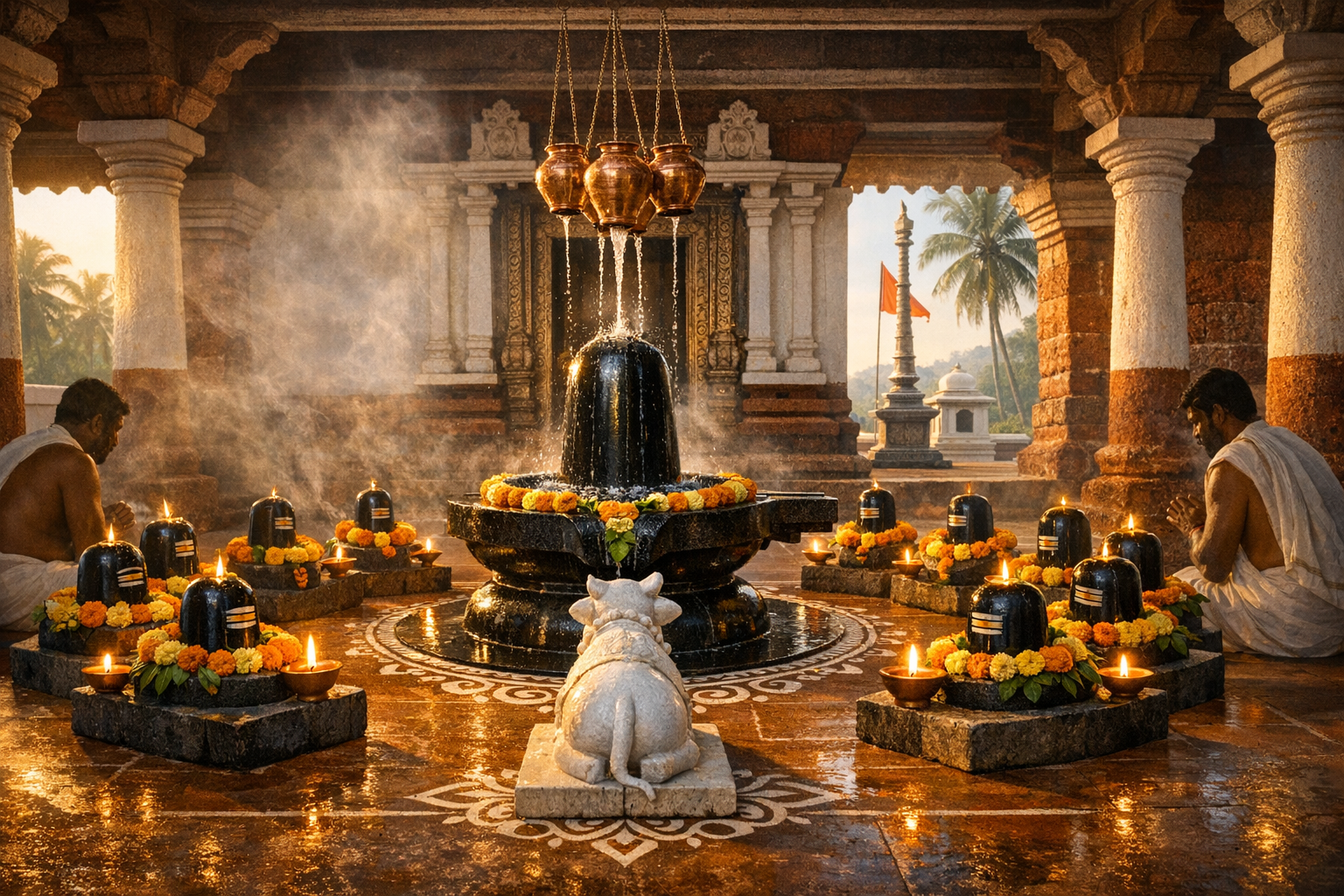
At Shri Goveshwar Devasthan (Mahashiv Temple) in Old Goa, a grand Pran Pratishtha ceremony has inaugurated a significant chapter in Goa’s living spiritual heritage. The consecration of twelve Jyotirlinga representations within a single sacred precinct not only expands the region’s ritual landscape but also positions the temple as an emerging hub for Hindu pilgrimage, contemplative practice, and responsible spiritual tourism in the Konkan.
Old Goa’s layered sacred geographyshaped by ancient coastal trade, temple networks, and later colonial historyrenders the revitalization of indigenous shrines especially meaningful. The ceremony affirms cultural continuity in which ritually consecrated space, architectural grammar, liturgical chant, and community service (seva) come together to sustain dharmic values in a plural society.
In the Agamic tradition, Pran Pratishtha is the solemn act of installing divinity (prāṇa) into a consecrated form (mūrti), thereby transforming a crafted object into a living locus of presence (arca). Rooted in textual canons such as the Shaiva Agamas and informed by Shilpa Shastra, the rite functions as a metaphysical bridge: it anchors the devotee’s intention, the priestly liturgy, and the sanctified icon in a single, vibrant field of worship. The result is not mere symbolism but a ritually verified embodiment of śakti in place and time.
While procedural nuances vary by sampradāya, the Pran Pratishtha sequence typically includes sankalpa (declaration of intent), site purification and vastu shuddhi, kalasha-sthāpana, adhivāsa (preparatory sanctification), nyāsa (mantric installation), netronmīlanam (ritual “opening” of the eyes), prāṇa-adhisthāna (invocation of life force), and mahā-maṅgala-ārati. For Shivalinga installations, ashtabandhanaan herbal-lime compound used to affix the linga to the yoni-pīṭhaensures both physical stability and ritual integrity, aligning material technique with sacral purpose.
The Jyotirlinga tradition, celebrated in the Shiva Purāṇa, commemorates twelve preeminent tirthas of Śiva across Bhāratavarsha: Somnath, Mallikarjuna, Mahākāleśvara, Omkāreśvara, Kedāranātha, Bhīmāśaṅkara, Kāśī Viśvanātha, Tryambakeśvara, Vaidyanātha (Baidyanāth), Nāgeśvara, Rāmeśvara, and Gṛiśneśvara. Housing twelve sanctified representations (pratirūpa) of these pan-Indian jyoti-kshetras within one complex offers devotees a rare, integrative pilgrimage experience, especially valuable for those unable to traverse the full subcontinental circuit.
Iconographically, the Śiva-liṅgaan aniconic form unified with the yoni-pīṭhaencodes a cosmological synthesis of stillness and generative energy. Temples of this typology typically include a garbhagṛha (sanctum), antarāla (vestibule), and maṇḍapa (assembly hall), with the Nandi maṇḍapa aligned on the east–west axis and a dhvaja-stambha and bali-pīṭha on the primary approach. Such arrangements follow vastu principles that orchestrate light, circulation, and acoustics to amplify mantra-recitation and meditative focus.
Ritual cadence in a consecrated Shiva temple commonly centers on nitya-pūjā, Rudrābhiṣeka, bilva-archana, and deepa-ārādhana, with the recitation of Śrī Rudram–Camakam (Taittirīya Saṁhitā) grounding the liturgy in Vedic resonance. The annual cycle culminates in Maha Shivaratri, when vrata, japa, and night-long darśana enfold the community in an ethos of self-restraint, compassion, and inner illumination. Ecologically sensitive abhiṣeka practicesmindful use of water, minimal plastic, and local, biodegradable offeringsare increasingly adopted to align devotion with stewardship.
From a heritage perspective, the twelve-Jyotirlinga configuration creates a compact pedagogical environment. Docent-led interpretive trails, multilingual signage, and archives of liturgical music and oral histories allow visitors to appreciate not only the ritual but also the craft traditions sustaining itstone work, ashtabandha preparation, metal casting (pañcaloha where applicable), wood carving, and gildingthus strengthening both livelihoods and intangible knowledge systems.
The ceremony’s social footprint extends to seva-driven initiativeshospitality for pilgrims, cleanliness drives, and inclusive cultural programsthat nurture cohesion. Such practices demonstrate how temple ecologies can be engines of social capital, where elders transmit ritual know-how, youth gain curatorial and organizing skills, and local artisans integrate heritage trade with contemporary safety and conservation standards.
Importantly, the consecration resonates with a broad dharmic ethos that values ahimsa, dana/seva, disciplined practice, and reverence for sacred learning. While ritual forms differ across Hinduism, Buddhism, Jainism, and Sikhism, the underlying commitmentsto inner transformation, ethical living, and respect for multiple pathsfind a hospitable setting in Goa’s plural environment. The temple’s programming can, therefore, serve as a bridge for inter-dharmic appreciation grounded in scholarship, dialogue, and shared cultural arts.
Goa’s reputation as a cultural crossroads and coastal destination enables a distinctive model of spiritual tourism. By integrating the Shri Goveshwar Devasthan into curated heritage itinerarieslinking shrines, museums, music traditions, and vernacular architecturevisitors encounter a holistic narrative of the Konkan. Capacity management, waste minimization, and community-guided visitor flows help balance footfall with sanctity, ensuring that devotional access and conservation reinforce one another.
Conservation considerations are central in a coastal climate. Stone selection (granite or amphibolite where possible), breathable lime plasters, periodic ashtabandha inspection, and controlled microclimates in the garbhagṛha mitigate humidity stress and salt-laden air. Parallel effortshigh-fidelity documentation of icons and inscriptions, audio-visual recording of chants, and digital inventoriesbuild resilience against material decay while preserving the temple’s evolving liturgical life.
For pilgrims and cultural travelers, best practices include observing silence near the sanctum, modest attire, mindful queuing, and using biodegradable offerings. Early morning and evening darśana typically afford a contemplative ambience, while festival periodsparticularly around Maha Shivaratrioffer a more immersive, community-centered experience. Engaging knowledgeable guides and temple stewards enhances understanding of Pran Pratishtha, Shivalinga Puja, and the pan-Indian significance of the twelve Jyotirlingas.
As a landmark in Goa’s spiritual landscape, the Pran Pratishtha at Shri Goveshwar Devasthan synthesizes text, ritual, craft, and community into a cohesive sacred ecosystem. By bringing the twelve Jyotirlinga representations into one accessible space, the temple strengthens devotional continuity, enriches cultural literacy, and models a sustainable pathway for spiritual tourism rooted in dharmic inclusivity and heritage excellence.
Inspired by this post on Hindu Jagruti Samiti.