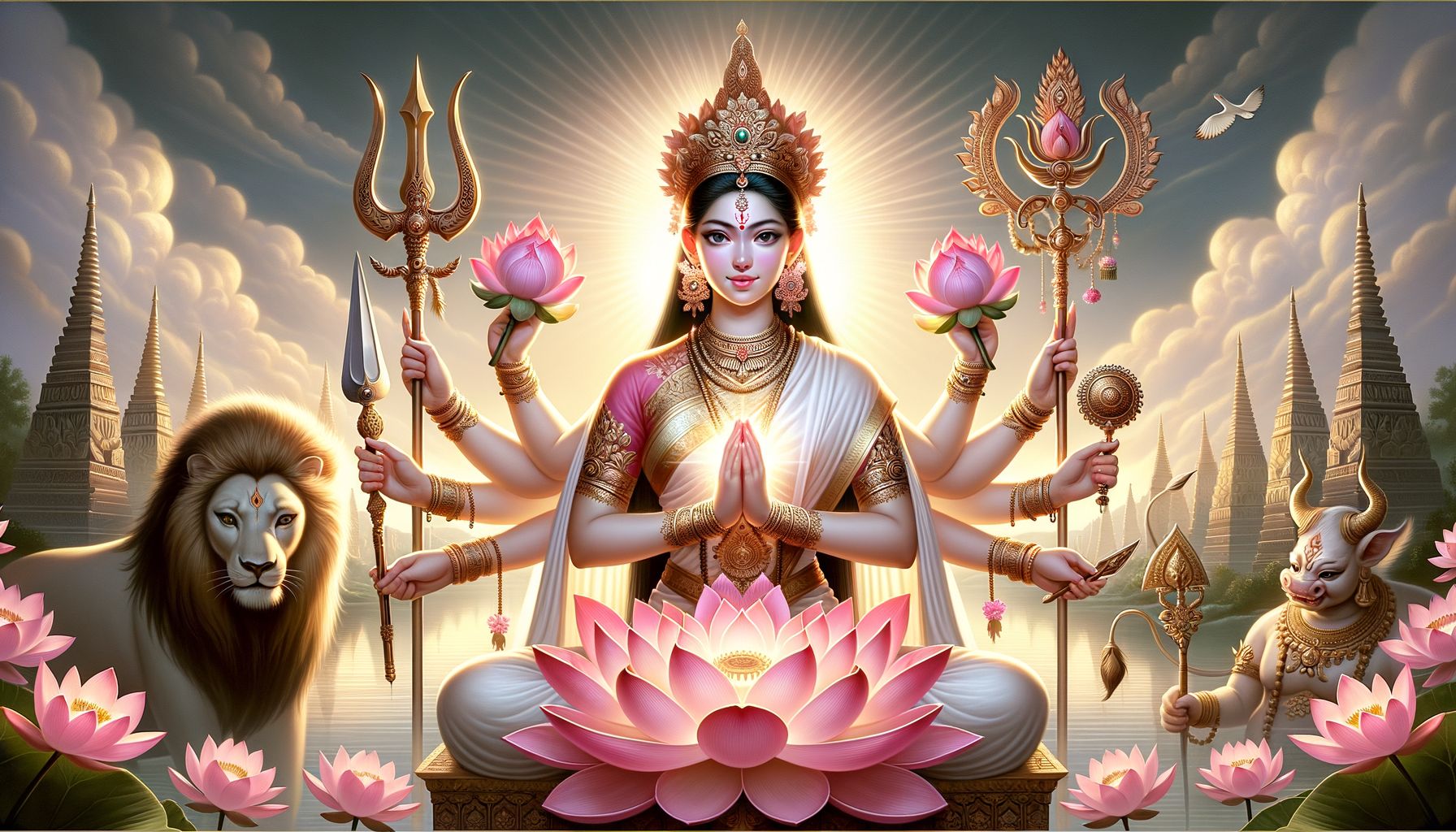
The Sacred Lotus in the Hands of Goddess Durga: Symbol of Consciousness and Divine Awakening. In the grand narrative of the Devi Mahatmya, Goddess Durga embodies strength, wisdom, and compassion. As the battle with Mahishasura unfolds, she wields many divine weapons bestowed by the devas; among these, the Padma (lotus) stands out as an emblem of awakened consciousness, serene sovereignty, and moral clarity.
Iconographically, the lotus rises untainted from mud, opening toward lightan image that mirrors the ascent of awareness beyond confusion. In Durga’s hand, the Padma complements Shakti’s force with insight, signifying that authentic victory is guided not merely by power but by consciousness aligned to dharma. Where weapons enact righteous action, the lotus frames intention, reminding that the aim of all struggle is inner and outer harmony.
Within the Devi Mahatmya’s dramatic scene of Mahishasura’s annihilation, the lotus functions as an ethical compass. It signals a state of alert serenity amid conflict: unshaken, compassionate, and lucid. The image teaches that courage without clarity can become excess, while clarity with courage restores order. Durga’s Padma thus encodes a balanced idealferocity in defense of dharma, tempered by the equanimity of enlightened awareness.
Across Dharmic traditions, the lotus depthens this insight and affirms unity. In Hinduism, the Padma is associated with purity, learning, and prosperity; it appears with Lakshmi and Saraswati and symbolizes the blossoming of sattva. In Buddhism, the lotus is a primary emblem of enlightenment, opening above the waters of samsara. In Jainism, it is linked with Tirthankaras such as Padmaprabha and with the serene posture of meditative stillness. In Sikh tradition, Gurbani frequently invokes the lotus as a metaphor for detachment and remembrance of the Divine, a mind unstained by the world while living within it. This shared symbolism underscores a common aspiration: awakening in the midst of life.
Read psychologically, Mahishasura personifies unbridled impulse, pride, and adharmaforces that cloud discernment. The Padma represents sattva and steadiness, the luminous center that neither avoids conflict nor is consumed by it. Many devotees observe that contemplating Durga’s lotus during times of turmoil supports a shift from reactivity to responsibility, from agitation to clarity, transforming struggle into a path of learning.
In practice, this symbol can anchor daily sadhana. During Navaratri and Durga Puja, reflecting on the Padma while engaging in japa or mindful breathing helps stabilize attention. The lotus image often aligns with the language of the chakrasanahata as a heart-lotus of balanced feeling, and the crown-lotus as a metaphor for expansive awarenessoffering practitioners a contemplative map for integrating compassion and insight.
Classical aesthetics and the Shilpa Shastras illuminate subtle iconographic cues: an open lotus may suggest revelation and readiness, while a closed bud indicates the potentiality of awakening. Color carries meaningwhite for purity and pink for compassionate presence. Whether the Padma appears in Durga’s left or right hand, the compositional balance invariably conveys that wisdom is integral to Shakti; the goddess’s might is inseparable from guiding intelligence.
Scriptural and liturgical traditions often praise the goddess with epithets that evoke the lotusits seat, its fragrance, and its radiancelinking the Padma to knowledge (jnana), clarity (viveka), and auspiciousness (mangala). The motif travels fluidly through Puranic, Tantric, and bhakti literature, reinforcing the insight that spiritual power matures through humility and understanding.
Contemporarily, the Padma offers a practical ethic: remain engaged yet unentangled, principled yet compassionate. Whether confronting personal dilemmas or societal challenges, holding the image of Durga with the lotus invites discernment, courage, and care. It also highlights a shared language among Hinduism, Buddhism, Jainism, and Sikhismone that encourages mutual respect and cooperative flourishing.
Ultimately, the lotus in Durga’s hand during the defeat of Mahishasura symbolizes the triumph of enlightened consciousness over chaos. It affirms that Shakti reaches its highest expression when guided by wisdom, that victory is complete only when it heals, and that the many petals of Dharmic traditions open toward a single light: the realization of truth with compassion.
Inspired by this post on Hindu Blog.