The conventional label of a singular ‘Muslim era’ in India oversimplifies a far more complex historical reality. From late antiquity through the early modern period, the subcontinent’s history reflects continuous resistance, accommodation, and renewal by dharmic politiesHindu, Jain, Buddhist, and later Sikhagainst a succession of external and transregional powers. Rather than an age defined by one community, the record shows a mosaic of Indian resilience, strategic alliances, cultural assimilation, and political reinvention.
Comparisons with world-conquerors underscore this point. Alexander’s advance, unstoppable across West Asia and North Africa, halted at India’s frontier when his forces turned back at the Beas. Indian sources do not celebrate him, a fact that signals the limited footprint of his campaign in the subcontinent and highlights the autonomy and strength of the polities guarding India’s gateways.
Equally telling is the fate of the Shakas, Kushans, and Huns. These groups, formidable elsewhere, were repeatedly checked in India, defeated, and ultimately assimilated into the civilizational fabric. The subcontinent’s capacity to absorb incoming peoplestransforming conflict into cultural synthesisremains a hallmark of Indian history.
Historical comparisons long noted by Bankimchandra Chattopadhyay illustrate why India’s experience is distinctive. While European and West Asian polities often succumbed rapidly to Roman, Arab, or Turkic expansion, Indian polities resisted comprehensive subjugation for centuries. Arab arms moved with astonishing speed across MENA, Iran, and Spain, yet in India they faced enduring checks that prevented long-term control over the Gangetic heartland.
Arab authority in Sindh and Multan did not translate into a stable, pan-Indian dominion. Rajput confederacies repeatedly contested advances from the northwest, and local recoveries followed early setbacks. This patternincursion, resistance, and reconstitutionrecurs across the medieval timeline and belies the notion of an uncontested ‘era’ belonging to any one imperial tradition.
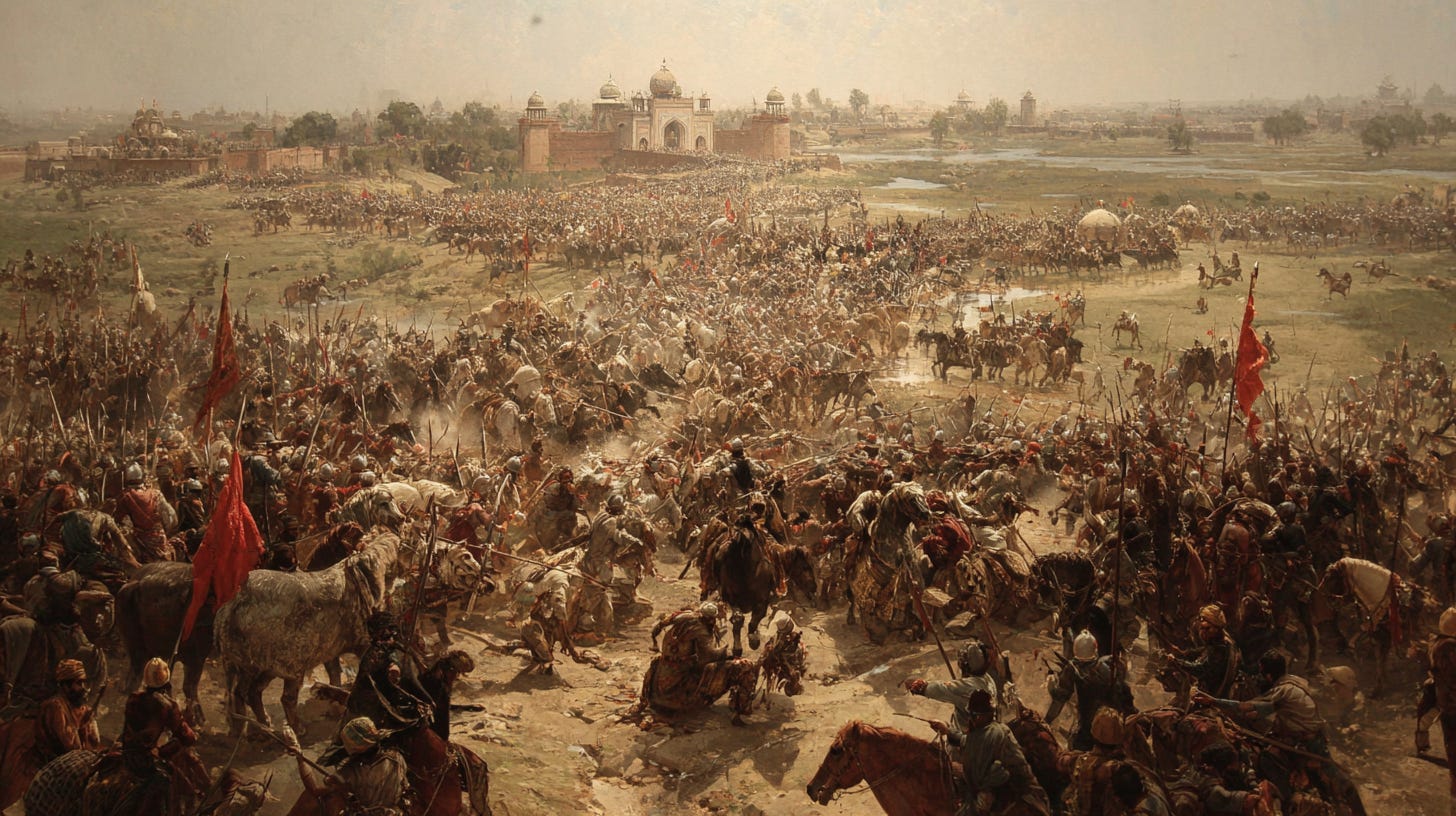
From 664 CE onward, successive wavesArab, Turkic (including Ghaznavids and Ghurids), and Afghanpressed into North India. Lasting control in parts of the north crystallized only after prolonged campaigns culminating in the late twelfth century with Indo-Afghan rule centered on Delhi. Notably, these establishments were neither Arab in origin nor uniform in policy; they depended on fluctuating alliances, regional negotiations, and Indian administrators and generals.
What many textbooks compress as a ‘Muslim era’ was, in substance, a long arc of competitive state formation involving dharmic powers and Indo-Islamic polities. Warfare, diplomacy, marriage alliances, and pragmatic governance shaped outcomes. Victory and setback alternated across regions and centuries, yet the civilizational core persisted and often reasserted itself with vigor.
Early medieval defense was particularly robust. The Chalukyas from the south, the Gurjara-Pratiharas across the west and north, and the Karkotas in Kashmir checked and contained Arab incursions. These counters stabilized frontiers, preserved key trade corridors, and enabled the continued growth of Indian institutions, learning, and temple-centered economies.
The Shahi rulers of Uttarapatha fought the Yamini (Ghaznavid) sultans over multiple generations, demonstrating a sustained will to resist. Their campaigns, despite heavy costs, exemplify the tenacity with which frontier states buffered the heartland from deeper incursions.
When Muhammad Ghori advanced eastward, he confronted formidable Indian dynasties: the Chauhans of Delhi, Gahadavalas of Kannauj, Chandellas of Jejakabhukti, and the Senas of Bengal. These contests were not one-sided; they reveal a competitive military ecosystem in which Indian polities repeatedly regrouped and countered after reverses.
Even during the intense campaigns of Alauddin Khalji and Malik Kafur against the Vaghelas of Gujarat, Parmaras of Malwa, Kakatiyas of Andhra, Yadavas of Maharashtra, Hoysalas of Karnataka, and Pandyas of Madura, resistance did not collapse into passivity. Odisha and Rajasthan, notably, eluded firm control for long stretches, and local institutions maintained considerable continuity.
The rise of the Vijayanagara Empire in 1336 marked a civilizational consolidation in the south. For roughly three centuries, Vijayanagara anchored the Deccan and repeatedly confined northern pressure to the far side of the Krishna-Tungabhadra line. As a bastion of dharmic culture and statecraft, it institutionalized administrative innovation, temple-centered urbanism, and robust military logistics.
By the early sixteenth century, the old Delhi Sultanate had fragmented. Babur’s decisive struggle in North India was not merely against an Indo-Afghan claimant but against a broad Rajput coalition led by Rana Sanga. A generation later, Raja Hemchandra (Hemu) mounted a powerful challenge to early Mughal consolidation, reflecting once more the cyclical resurgence of indigenous polities.
Akbar’s success owed much to a strategic shift from confrontation to conciliationsama-niti. Extensive alliances with Rajput houses and the service of numerous Hindu commanders and administrators underwrote imperial stability. Where cooperation prevailed, shared governance flourished; where it was refused, as in Mewar under Maharana Pratap and the Sisodias, independence was tenaciously maintained.
The seventeenth and eighteenth centuries saw a pronounced rebalancing. Marathas rose to paramountcy, the Jats established strongholds, and the Sikh misls and, later, the Khalsa polity reshaped North Indian power. By the time European companies deepened their political footprint, the Mughal emperor depended on Maratha power for survival, underscoring how indigenous forces had already transformed the subcontinental order.
Seen through a dharmic lens of continuity and renewal, there was no monolithic ‘Muslim era.’ Instead, India’s past reveals dynamic Indo-Islamic interactions amid resilient dharmic institutionsepisodes of conflict, diplomacy, assimilation, and shared governance. The long-run pattern is one of civilizational resilience, not civilizational eclipse.
This reframing invites unity across dharmic traditionsHindu, Buddhist, Jain, and Sikhby recognizing a shared historical stake in preserving cultural autonomy, ethical statecraft, and spiritual plurality. Emphasizing common cause over communal caricature strengthens present-day solidarity and honors the myriad communities that safeguarded India’s civilizational inheritance.
Understanding this history is not only a matter of accuracy; it is a source of confidence and cohesion. It reveals how India repeatedly converted external shocks into internal strength, how diplomacy complemented valor, and how plural institutions endured. That legacy continues to offer guidance for a diverse, democratic, and dharmic future.
Inspired by this post on Dharma Dispatch.