Questions about the real source of energy arise naturally from daily experience. Electricity illuminates a room only when an unseen force flows through a designed circuit. In a similar vein, dharmic philosophical perspectives observe that matter, by itself, does not originate or organize forms; it functions as potential that becomes expressive when animated by living energy.
Within Vedic philosophy, matter may be viewed as latent potency that attains shape and function through prana, the vital force. This understanding does not attempt to replace scientific explanations; rather, it offers a metaphysical lens. Hindu thought often speaks of Brahman and Shakti; Buddhism highlights dependent origination, indicating that phenomena arise through conditions rather than mere material aggregation; Jainism discusses jiva and ajiva to distinguish conscious and non-conscious substances; Sikh wisdom affirms Ik Onkar, the One Reality permeating existence. Across these traditions, a shared insight emerges: matter alone is insufficient to account for experienced vitality and creative order.
Analogies from everyday life clarify this view. Electrical energy requires a generating source and an intelligent arrangement to produce light. Likewise, the energies perceived in bodies, ecosystems, and minds reflect an underlying principle that coordinates, sustains, and directs. In dharmic language, this coordinating principle can be approached as universal consciousness, prana, or the One that suffuses all.
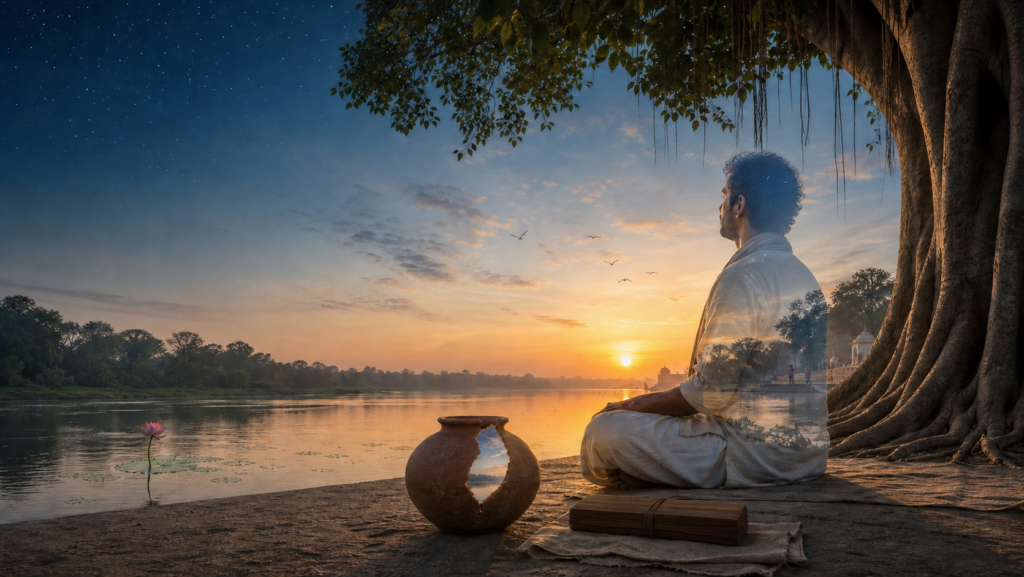
Relatable experiences often make this vivid. During meditation or attentive breathing, many notice how clarity increases, the body awakens, and creativity becomes effortless. When the breath deepens in pranayama and the mind settles, a distinct sense of inner alignment arises, as if a subtle current organizes attention and action. Such moments suggest that consciousness and prana are not abstractions but experiential realities that give matter its living expressiveness.
This insight also carries an ethical dimension central to Hinduism, Buddhism, Jainism, and Sikhism. Ahimsa, compassion, seva, and truthful living are repeatedly described as ways to refine the channel through which energy flows. When conduct is aligned with dharmaunderstood broadly as right order and responsibilitylife’s energy is neither squandered nor distorted; it is harmonized and strengthened.
From a philosophical standpoint, distinguishing between a material substrate and an enlivening principle resolves a frequent puzzle: matter exhibits structure, yet structure alone does not explain awareness, meaning, or value. The dharmic view holds that the “source” behind observable energies is not merely physical power but the presence of consciousness that informs and animates. Matter can then be appreciated as latent energy, becoming creative when guided by prana and awareness.
In practice, this perspective invites integrative disciplinesmeditation, pranayama, mindful action, and serviceto align daily life with the deeper source. The traditions may differ in metaphors and methods, but they converge on a unifying principle: cultivating awareness reveals the living energy that shapes matter into meaningful, compassionate, and purposeful expression.
Thus, the real source of energy, in the dharmic view, is the universal reality that manifests as consciousness and vital force. Matter is its field of expression; prana is its dynamic movement; and ethical, contemplative living is the pathway to experience and embody that truth.
Inspired by this post on Hindu Pad.