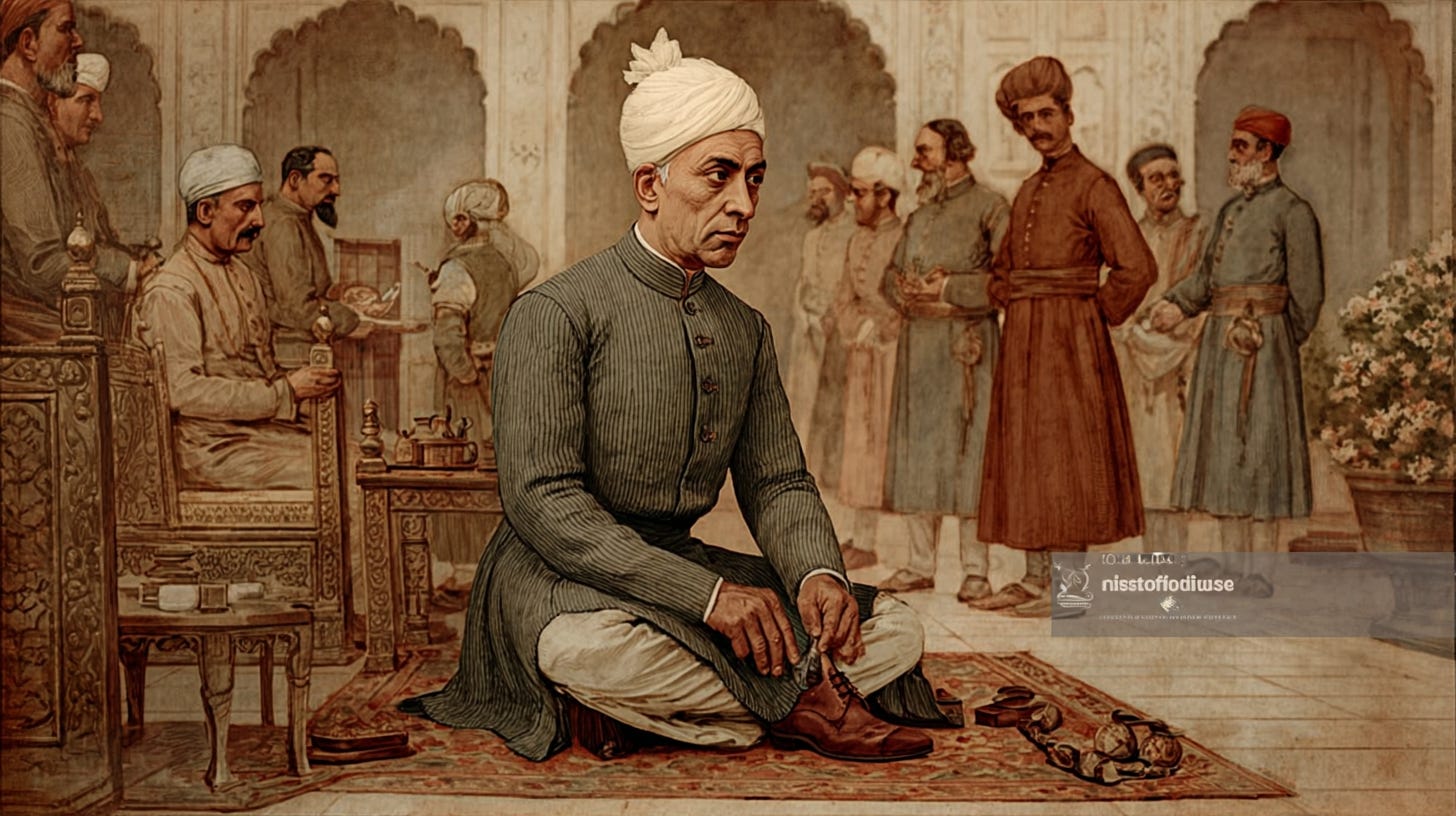
This analysis revisits Jawaharlal Nehru’s influential yet contested interpretation of medieval India, particularly his view that Islam introduced revitalizing energy into a society he judged to be stagnant. He memorably asserted that “Islam shook India to its very foundations,” a formulation that continues to shape debates in Indian historiography. Placing this claim within a broader academic frame clarifies what Nehru sought to explainand what his framework may have overlooked.
Nehru argued that the arrival of Islam infused a “new vital force” into social life and aesthetics, culminating in a vigorous synthesis often described as Hindu-Muslim or Indo-Islamic architecture. In this telling, India’s sthapatis absorbed new design principles, while a purportedly over-ornamented Hindu architectural idiom gave way to forms admired for simplicity, dignity, and structural clarityvisible in monuments such as the Taj Mahal, mosques, and forts. As an interpretive move, this links sthāpatya to civilizational dynamism, elevating aesthetic change as evidence of wider social renewal.
Critics counter that aesthetic brilliance, while real, cannot by itself substantiate claims about moral, social, or economic “progress.” Architectural transitions are complex, often driven by patronage, technology, materials, and political economy; inferring civilizational uplift solely from design elegance risks overreach. Many readersaccustomed to admiring Indo-Islamic monumentsrecognize the intuitive appeal of Nehru’s claim, yet also sense the need for a fuller evidentiary base beyond art history alone.
There is broad agreement that late-medieval India faced pronounced stress, including political fragmentation and institutional strain. The key question is whether this warrants the conclusion that Islam arrived bearing a unique “message of progress,” or whether that phrasing confuses cultural synthesis with linear advancement. Framing the issue this way encourages a careful review of evidence across domains rather than relying on any single indexarchitectural, political, or religious.
Nehru’s treatment of the Mughal decline exemplifies his Marxist historical materialism, foregrounding structural change over personalities or religious identity. He wrote: “Due to these economic changes, the Mughal Empire declined. However, no middle class (bourgeoisie) emerged at that time to take advantage of this decline and seize power… The excessive despotism of the rule had generally rendered the people powerless and spiritless, and the people had almost forgotten their ancient tradition of independence. Partly feudal, partly middle-class, and partly peasant such forces had made several attempts to seize power. And some of these attempts had almost succeeded.”
In this materialist framedeveloped further in Glimpses of World Historyeconomic shifts weakened centralized feudal structures, but a transformative bourgeoisie (as in Europe) did not arise to stabilize the system. Prolonged absolutism demoralized social actors, and mixed coalitionsfeudal magnates, middling elements, and peasantsmounted incomplete efforts to capture authority. The result, in Nehru’s telling, was a gulf between the decline of feudalism and the rise of a consolidating middle class, producing instability across the eighteenth century.
Scholars who differ with this diagnosis emphasize indigenous resilience and state-building capacities. The Marathas, Sikhs, Rajputs, and Jats mounted sustained challenges to Mughal power, built institutions, and articulated regional visions of sovereignty. Characterizing these formations as merely “reactionary” extensions of a decaying feudal order underplays their administrative innovations, military organization, fiscal reforms, and cultural productionfeatures that complicate any singular narrative of stagnation.
A dharmic lensmindful of the shared civilizational fabric of Hinduism, Buddhism, Jainism, and Sikhisminvites a more integrative reading of the period. It encourages attention to continuities in ethical life, learning networks, pilgrimage ecologies, monastic and temple economies, and vernacular literary cultures that persisted through political upheavals. Such a perspective advances unity by recognizing plural contributions while maintaining historical rigor and intercommunity respect.
Methodologically, reducing the crisis to a single causebe it class formation or courtly absolutismrisks a narrow view. A balanced account synthesizes economic records, inscriptions, revenue manuals, coinage, trade routes, environmental pressures, military logistics, vernacular chronicles, and art-historical analysis. It also avoids Eurocentric teleology, allowing Indian processes to be understood on their own terms rather than as parallels to European trajectories.
For many students first introduced to Nehru’s framework in school textbooks, the elegance of Indo-Islamic monumentsencountered in person at the Taj Mahal or in the shadow of Delhi’s forts and mosquescan feel like persuasive proof of civilizational renewal. Yet the experience also prompts a reflective question: can beauty stand in for evidence? The most fruitful answer blends admiration for aesthetic achievement with close reading of sources that test large claims about social change.
Reframing the debate in this way shifts attention away from polemics toward careful comparison of models: Nehru’s class-analytic template, economic and environmental histories of the eighteenth century, and micro-regional studies of Maratha, Sikh, and Rajput governance. This approach honors India’s plural inheritances and strengthens a dharmic ethic of harmonydharma as a shared commitment to truth-seeking, balance, and coexistencewhile engaging directly with contested questions.
The next installment will examine targeted case studiesMaratha revenue and mobility regimes, Sikh misls and confederation practices, Rajput courtly and military cultures, and transitions in sthāpatya from temple complexes to fort-mosque ensemblesto evaluate, with evidence, where Nehru’s Marxist lens illuminates and where it obscures the complexity of Indian history.
Inspired by this post on Dharma Dispatch.